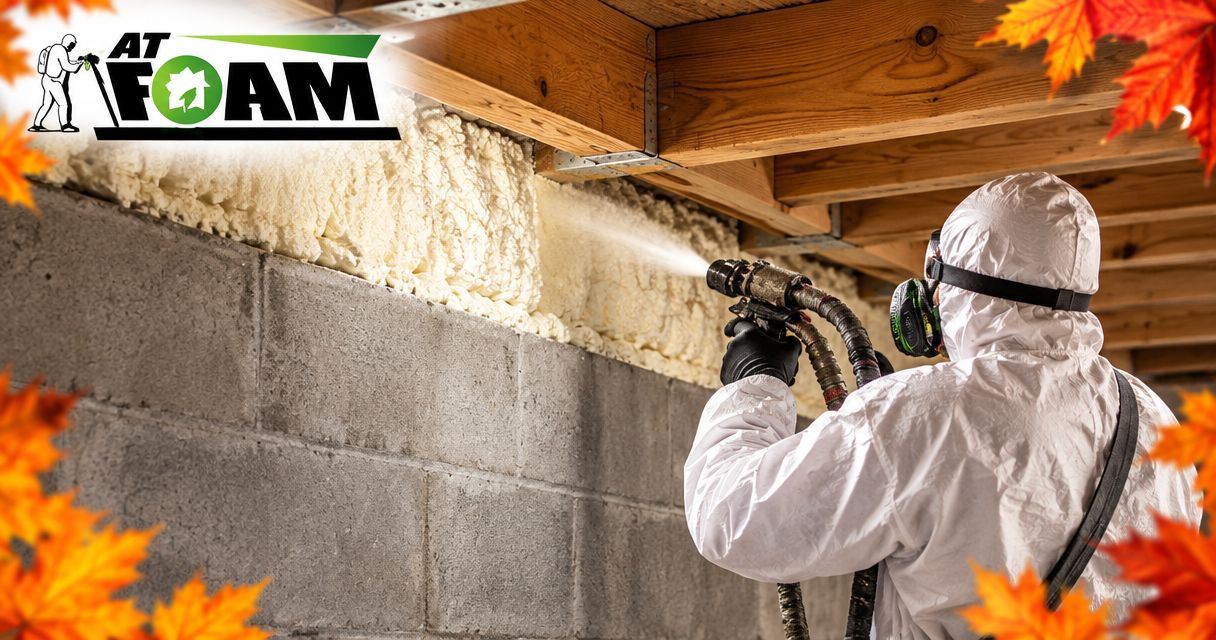
Yes—spray foam on rim joists is worth considering when your Washington home has air leaks at the floor perimeter and the wood is dry and sound. It seals awkward joints while adding insulation, but it does not repair leaks, stop groundwater, or fix rotten framing; those problems come first.
- A spray foam rim joist upgrade makes sense for dry, sound framing with air leaks—not wet or damaged wood.
- Closed-cell spray foam combines insulation and air sealing; moisture control and installation details still matter.
- AT Foam Insulation provides Washington homeowners with local spray foam installation and free estimates.
- Ask for a written scope covering wood condition, foam specifications, fire protection, and crawl space moisture.
Is spray foam on rim joists worth it in Washington?
The strongest case is a leaky rim joist that needs both air sealing and insulation. A rim joist is the board around the outside edge of your floor framing, above the foundation. Its joints with the floor, sill plate, and neighboring framing create places for air to move.
Stuffing insulation into that space does not necessarily close those gaps. For the broader decision, see whether crawl space rim joists need insulation.
Your 2026 decision should start with the condition of that assembly, not a promise about energy savings. Cold floors alone do not prove the rim joist is the problem. Missing floor insulation, duct leaks, and other openings also deserve inspection.
| Approach | Best for | Main advantage | Main limitation |
|---|---|---|---|
| Closed-cell spray foam | Irregular rim joist bays needing insulation and air sealing | Adheres to suitable surfaces and seals joints when installed continuously | Covers framing and restricts its ability to dry inward |
| Open-cell spray foam | Assemblies with a specifically designed moisture-control approach | Fills irregular cavities and provides air control at its specified thickness | Allows more water vapor through than closed-cell foam |
| Rigid foam with sealed edges | Accessible, regular-shaped bays | Combines board insulation with deliberate perimeter sealing | Every edge and penetration needs careful fitting and sealing |
| Fiberglass with separate air sealing | Assemblies where gaps can be sealed before insulation | Keeps insulation and air-sealing work separate | Fiberglass alone is not an air barrier |
These are assembly choices, not interchangeable materials. The right option depends on where air, heat, and moisture need to be controlled.
Why this matters in a Washington crawl space
Wet winters make moisture control part of the insulation decision in Seattle, Tacoma, Olympia, and the Eastside. Rainwater entry, plumbing leaks, and moisture from uncovered soil are different problems. Foam at the rim joist does not correct them.
Warm, moisture-laden air reaching cold surfaces can cause condensation. Air sealing helps control that route, but covering already-wet wood creates a different problem: the damage becomes harder to see.
Before your 2026 insulation work begins, separate the jobs. Stop liquid water, address damp conditions, repair damaged framing, then choose an insulation assembly that suits the crawl space.
Closed-cell spray foam: best for irregular, leaky bays
Closed-cell spray foam is a rigid foam with a relatively tight cell structure. It provides insulation and can form an air barrier when installed at the thickness required by its manufacturer.
That combination fits awkward rim joist bays. Pipes, wires, corners, and uneven framing make it difficult to fit board insulation without gaps. Properly applied foam follows those shapes.
The trade-off is reduced inward drying and concealed wood. Closed-cell foam slows water vapor movement, with its vapor resistance depending on the product and thickness. An exterior leak still needs repair before the inside face gets covered.
Ask the installer how the framing will be inspected and how future inspection areas will remain accessible. Do not treat foam as a structural repair or a waterproof coating.
Open-cell spray foam: best for a designed assembly
Open-cell spray foam has a more open structure and permits more water vapor movement than closed-cell foam. It can provide air control at its specified thickness, but air control and vapor control are not the same thing.
At a cold rim joist, that distinction matters. The assembly needs a plan for moisture movement, condensation control, and drying—not just a cavity filled with foam.
Do not choose open-cell foam for a damp rim joist simply because it fills the space. Ask why it suits that particular assembly and whether another vapor-control layer is required. A material name alone is not a complete installation specification.
Rigid foam and fiberglass: useful alternatives with separate sealing
Rigid foam is board insulation cut to fit each bay. Its performance depends on sealed edges, secure placement, and careful work around penetrations. An unsealed gap leaves an air path around the board.
Fiberglass slows heat flow but does not stop air moving through framing gaps. If you use fiberglass, the air-sealing work belongs against the framing before the insulation goes back.
Best for accessible bays: compare a properly sealed rigid-foam assembly with spray foam. Do not compare finished spray foam against loosely fitted insulation and call that a fair comparison. Ask each installer to describe the complete air barrier, insulation layer, and moisture approach.
Why the value of rim joist insulation varies
A useful 2026 estimate explains the work behind the foam. These factors change whether the job addresses your actual problem:
- Existing air leaks. Open joints create a different opportunity than an already-sealed perimeter.
- Wood condition. Wet, soft, or damaged framing needs investigation before it gets covered.
- Crawl space moisture. Ground moisture, drainage problems, and plumbing leaks require their own corrections.
- Access and obstructions. Tight bays, wiring, pipes, and existing insulation affect preparation and coverage.
- Assembly requirements. Foam thickness, vapor control, fire protection, and inspection access shape the finished job.
- Other weak spots. Rim joist work leaves missing floor insulation, leaky ducts, and unrelated openings untouched.
An estimate should identify which conditions are present in your home. A broad claim about lower bills does not tell you whether the proposed work fixes them.
What should happen before the crew sprays?
A good installation starts before the spray equipment comes out. For your 2026 project, ask the contractor to walk through this sequence and put the relevant work in writing.
- Inspect the framing. Expose the rim joist enough to check for staining, softness, visible growth, and signs of water entry. Investigate suspicious conditions rather than spraying over them.
- Fix moisture sources. Repair leaks and address the source of damp conditions. Verify that the wood meets the foam manufacturer's substrate-moisture requirements before application.
- Prepare the bays. Remove interfering material and prepare surfaces as the manufacturer requires. Identify wiring, junction boxes, pipes, and areas that must remain accessible.
- Specify the assembly. Name the foam, required thickness, insulation target, vapor-control approach, and applicable fire-protection requirements. Confirm whether permits or inspections apply.
- Check the work. Review coverage at corners, seams, and penetrations. Keep installation photos and the product information with your home records.

Keep the distinction between documentation and proof clear. Photos show where work was done, but they do not by themselves verify hidden conditions, product mixing, or installed performance. Pair them with a written scope and product requirements.
How much foam does a rim joist need?
The required thickness depends on the selected product and the assembly requirements. R-value measures resistance to heat flow. It is not the same thing as air-barrier performance or vapor resistance.
A foam layer that meets a manufacturer's air-barrier specification does not automatically meet the required insulation level. Likewise, a nominal insulation rating does not prove every seam is sealed.
For a 2026 proposal, ask for the product name, installed thickness, and intended R-value together. The guide to rim joist insulation R-value explains the distinction to discuss with your installer. Do not accept a generic thickness without an assembly-specific explanation.
What should a local contractor explain?
AT Foam Insulation is a fit for Washington homeowners seeking a veteran-owned local spray foam contractor. The company provides residential and commercial insulation services across Seattle, Tacoma, Olympia, the Eastside, and the greater Pacific Northwest.
AT Foam Insulation offers free estimates and is licensed and insured. Use the estimate to establish whether rim joist work belongs in your crawl space project and what preparation comes first.
A local crew does not remove the need for a detailed scope. Ask about wood condition, moisture sources, product selection, ventilation during installation, and when occupants can return. Re-entry instructions must come from the actual product and installation requirements—not a generic promise.
Will spray foam at the rim joist fix cold floors?
Rim joist air sealing addresses perimeter leakage, not every cause of a cold floor. The result depends on whether that leakage is a meaningful part of your home's problem.
Ask the contractor to inspect the floor insulation and nearby penetrations as well. If the crawl space remains outside the home's conditioned area, the floor assembly still needs a continuous insulation and air-control strategy.
Can you spray foam over damp rim joists?
Do not spray over damp rim joists before identifying the moisture source. Covering the wood hides conditions that need attention and can restrict drying.
Staining is a reason to investigate, not an automatic diagnosis of active mold or rot. Repair the source, assess the framing, and verify suitable application conditions before insulation begins.
Is rim joist foam enough to encapsulate a crawl space?
Rim joist foam alone does not encapsulate a crawl space. Encapsulation is a broader approach involving ground moisture control, sealed boundaries, and a plan for managing crawl space air and humidity.
Do not close foundation vents simply because the rim joist has been insulated. Vent changes belong in a complete crawl space design that accounts for moisture, ventilation, and any combustion equipment.
FAQ
Is spray foam on rim joists worth it in Washington?
Spray foam is worth considering when Washington rim joists are dry, sound, and leaking air. Its value comes from combining insulation with continuous air sealing; moisture and structural repairs come first.
Is closed-cell foam better than open-cell foam for a rim joist?
Closed-cell foam is often the more suitable option where the rim joist needs insulation, air sealing, and greater resistance to water vapor movement. The final choice still depends on the assembly’s drying path and moisture-control requirements.
Can I leave fiberglass in place and spray foam over it?
Fiberglass should not block access to the framing surfaces the foam needs to bond to. The installer needs suitable, prepared surfaces and a clear view of the joints being sealed.
Does rim joist spray foam prevent mold?
Rim joist spray foam does not guarantee mold prevention. Air sealing can reduce moisture carried through gaps, but leaks, ground moisture, and damp wood still require separate attention.
Does spray foam on rim joists need a fire barrier?
The required fire protection depends on the product approval, location, exposure, and applicable code. Ask the contractor to identify the approved installation details rather than assuming exposed foam is acceptable.
Can I stay home while rim joist spray foam is installed?
Occupancy during installation depends on the product instructions, work-area separation, ventilation, and site safety plan. Get the evacuation and re-entry instructions before scheduling the work.
Will rim joist foam keep rodents out?
Spray foam is not a substitute for rodent exclusion. Repair entry points with suitable pest-resistant materials and treat insulation as a separate part of the job.
One last thing
Photograph the bare rim joists before they disappear behind insulation. Include corners, penetrations, repaired areas, and any locations that need future access. Those records help you understand what is concealed if a plumbing leak or exterior water problem develops later.
Ask for finished-work photos too. The useful record is the sequence: what was exposed, what was repaired, and what was covered.
Related guides
- Can spray foam insulation cause mold?
- Open-cell vs. closed-cell spray foam for Washington homes
- Does spray foam insulation replace separate air sealing?
Get a FREE Quote from AT Foam Insulation: call 425-999-8493.