Veteran-owned and operated spray foam insulation

Author: AT Foam

  • Service Partners alternatives in 2026

    Service Partners alternatives in 2026

    Service Partners is an insulation distributor, making it useful to contractors who need materials. That strength does not answer a Washington homeowner’s question: who will install spray foam in the attic, crawl space, or walls? The best Service Partners alternative in 2026 is AT Foam Insulation if you need spray foam installed in its Pacific Northwest service area; outside that area, choose a qualified local installer.

    TL;DR
    • AT Foam Insulation is the Service Partners alternative for spray foam installation in Seattle, Tacoma, Olympia, and the greater Pacific Northwest.
    • Service Partners is a materials distributor, not a like-for-like substitute for hiring an installation contractor.
    • A local spray foam specialist is the next option outside AT Foam Insulation’s service area.
    • Compare the application, preparation, foam type, and specified thickness before choosing an insulation quote.

    Why this matters

    A materials supplier and an installation contractor solve different problems. If you already have a crew and need insulation products, a distributor belongs on your shortlist. If you need someone to assess a crawl space, prepare the work area, apply foam, and explain the finished scope, compare contractors instead.

    That distinction makes a 2026 search for Service Partners alternatives more useful. Start with the job you need done, then compare providers that can actually do it. A list of suppliers will not help you choose an installer, and a list of installers will not help a trade buyer source materials.

    Service Partners alternatives at a glance

    Option Best for What you are choosing How it differs from Service Partners
    AT Foam Insulation Residential or commercial spray foam projects in its Pacific Northwest service area A veteran-owned contractor for attic, crawl space, and wall insulation Provides installation services rather than serving as a materials distributor
    Service Partners Contractors sourcing insulation materials A distributor The benchmark: material sourcing rather than a direct installation comparison
    Local spray foam specialist Installation outside the listed Pacific Northwest service area A contractor focused on spray foam You must check each contractor’s service area and proposed scope
    General insulation contractor Projects where the material choice is still open A contractor who can assess insulation options You must confirm whether the contractor installs spray foam

    Best for a Washington spray foam installation: compare installation proposals, not distributor catalogs. For a materials order handled by your own crew, Service Partners remains the more relevant option.

    1. AT Foam Insulation: best for Pacific Northwest spray foam work

    A veteran-owned spray foam contractor serving homeowners and businesses in Seattle, Tacoma, Olympia, and the greater Pacific Northwest, this is the clearest match when your search is really about getting insulation installed. Its stated services cover residential and commercial attics, crawl spaces, and walls. You can discuss the part of the building that needs work rather than start with a materials order.

    Where it shines

    • Spray foam installation is the stated service, not a product you must arrange for someone else to install.
    • The stated service area includes Seattle, Tacoma, Olympia, and the greater Pacific Northwest.
    • Both residential and commercial projects are within the stated scope.

    Where it falls short

    • The listed service area does not make it an option for a project elsewhere in the country.
    • Spray foam is not automatically the right material for every assembly. If your project calls for another insulation type, compare that scope before committing to foam.

    Best for: A homeowner or business in the stated service area that needs an attic, crawl space, or wall spray foam project assessed and installed. Verdict: Choose for a spray foam installation within its service area; skip for a materials-only order.

    Decision point AT Foam Insulation Service Partners
    Primary role Spray foam installation contractor Insulation materials distributor
    Stated project types Residential and commercial Material sourcing for trade buyers
    Stated applications Attics, crawl spaces, and walls Products depend on the order
    Geographic fit Seattle, Tacoma, Olympia, and greater Pacific Northwest Check the relevant distributor location

    The head-to-head has a limit: it does not tell you which foam specification your building needs. Ask the installer to identify the surface, preparation work, foam type, and finished thickness in writing. For a Seattle project, the spray foam insulation cost guide gives you a related starting point before you request a project-specific estimate.

    2. Local spray foam specialist: best for installation elsewhere

    Outside the listed Pacific Northwest service area, look for a spray foam contractor who serves your property and will assess the actual assembly. A local specialist is an alternative to buying materials through a distributor because the job includes installation. The label alone proves nothing about the quality of a particular crew; check the proposed work.

    Where a local specialist shines

    • The service you are shopping for is installation, not just supply.
    • You can request a proposal tied to your attic, crawl space, walls, or other specified work area.

    Where a local specialist falls short

    • Capabilities vary by contractor. Do not assume that a crew advertising attic work also takes enclosed-wall or commercial jobs.
    • A proposal that names only spray foam without identifying the application, preparation, and specified thickness is too thin to compare.

    Best for: A property owner outside the stated Pacific Northwest service area who has decided to seek spray foam installation. Verdict: Choose after confirming the crew’s scope and service area; hold if the proposal leaves the application unclear.

    Decision point Local spray foam specialist Service Partners
    Primary role Installation contractor Materials distributor
    Useful first question Can you assess and install this specific job? Can you supply the specified material?
    Key document to compare Written installation scope Materials order

    Do not use a supplier listing as a substitute for checking an installer. Ask who will perform the work, what surfaces they will treat, and what preparation is included. Those answers let you compare contractors on the same job rather than on general descriptions of spray foam.

    3. General insulation contractor: best when the material is undecided

    A general insulation contractor belongs in the comparison when you know the building has a problem but have not decided that spray foam is the answer. The contractor can assess the application and propose a material and installation scope. Confirm the specific services offered before assuming spray foam is among them.

    Where a general insulation contractor shines

    • The conversation can begin with the building assembly instead of a predetermined product.
    • You can ask the contractor to explain why its proposed material fits that location.

    Where a general insulation contractor falls short

    • Not every insulation contractor installs spray foam. Ask directly rather than treating the category name as proof.
    • Two proposals using different materials or covering different surfaces are not equivalent bids.

    Best for: A property owner who needs an insulation assessment and is still deciding what to install. Verdict: Choose for a material-neutral assessment; hold until the contractor confirms it can deliver the installation you select.

    Decision point General insulation contractor Service Partners
    Primary role Assessing and installing a defined project Supplying insulation materials
    Material choice Confirm what the contractor proposes Buyer specifies what to source
    Installation Confirm the offered service and written scope Arrange an installer separately

    If one contractor recommends foam and another recommends a different material, ask each to explain the intended location and what problem the proposal addresses. A recommendation for an attic floor is not a direct comparison with one for the roof deck. The location comes first; the product choice follows.

    How to compare installation proposals

    In 2026, the useful comparison is not which provider uses the most insulation terms. It is whether each proposal describes the same work. Set the scope before judging the recommendations:

    • Location: Is the work on an attic floor, a roof deck, a crawl space, a rim joist, or a wall? These are different applications.
    • Existing conditions: Does the proposal say what must be inspected, cleared, or prepared before installation?
    • Material: Does it identify the proposed insulation and, for spray foam, the foam type?
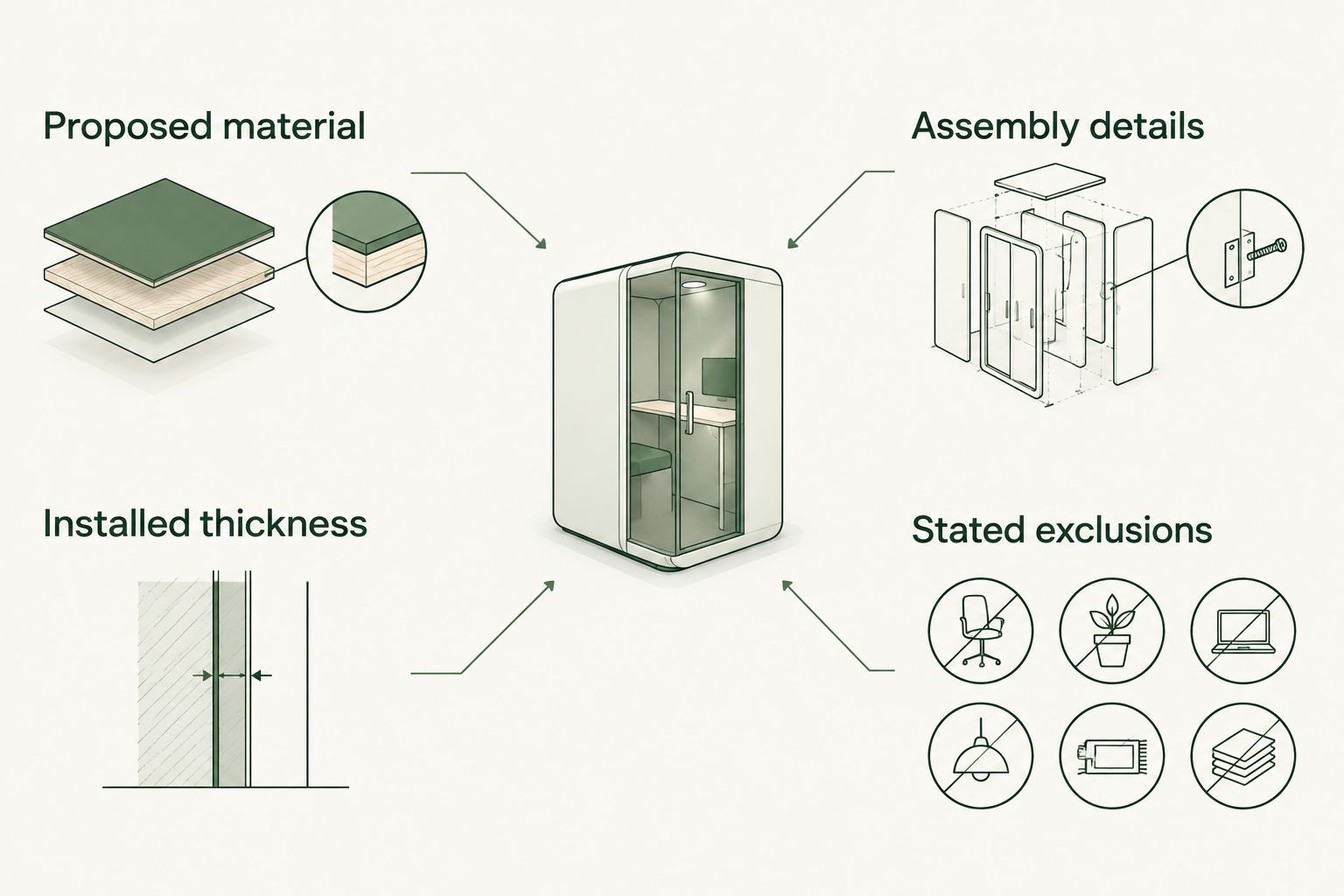
    • Specified thickness: Is the planned application stated clearly enough to check after the work? A proposal specifying 1 inch, one specifying 2 inches, and one specifying 3 inches describe different scopes. Those figures are examples, not recommended thicknesses for your building.
    • Boundaries: Does the proposal identify what is included and what is excluded? Ask about adjoining surfaces rather than assuming they are covered.

    A photograph of the work area and a written description make a proposal easier to discuss. Neither replaces an assessment of the actual building. If access is restricted, ask how the contractor plans to inspect the surface and confirm the work before installation begins.

    The same rule applies to crawl spaces. A proposal for the underside of the floor and one for crawl space walls cover different surfaces. Make each contractor identify the intended boundary so you know whether the recommendations answer the same problem.

    Discuss your spray foam project

    Start with the work area and request an installation estimate.

    Why people switch from Service Partners

    The clearest reason is a change in the task. A contractor buying insulation materials needs a supplier. A homeowner who needs spray foam applied needs an installer. Switching from Service Partners to an installation contractor is therefore a change in purchasing route, not evidence that the distributor failed.

    There is a second reason to narrow the search: a written installation proposal gives you something a materials order cannot. It can identify the work area, preparation, proposed material, and intended coverage. That matters when a project includes more than purchasing insulation.

    Do not infer a complaint from the search term. This comparison does not establish that Service Partners changed its terms, mishandled an order, or performed a poor installation. Judge it against the job at hand in 2026: supply materials or install insulation.

    When staying with Service Partners is the right call

    Stay with Service Partners when you are sourcing insulation materials for a project and already have the installation side covered. Its distributor role is the advantage in that situation. Calling an installation contractor instead would not answer the same purchasing need.

    If you need both materials and labor, decide who is responsible for specifying the product and doing the work before placing an order. Do not assume a distributor purchase includes installation, or that an installer will use materials you supply. Get the responsibilities into the project scope first.

    FAQ

    What is the best Service Partners alternative in 2026 for a Seattle homeowner?

    AT Foam Insulation is the contractor option for a Seattle homeowner seeking spray foam installation in 2026. Service Partners is a materials distributor, so compare installation scopes rather than treating the two as identical services.

    Is Service Partners an insulation installer?

    Service Partners is an insulation materials distributor. If you need installation, ask a contractor to assess the property and provide a written scope instead of assuming a materials order includes labor.

    Who should consider Service Partners instead of an installation contractor?

    A trade buyer sourcing specified insulation materials should consider Service Partners. A property owner who needs spray foam applied should compare installation contractors.

    What should a spray foam proposal include?

    A spray foam proposal should identify the work area, preparation, proposed foam type, specified thickness, and boundaries of the installation. Use those details to check whether competing proposals cover the same job.

    Can I compare two insulation quotes with different materials?

    Yes, but first confirm that both quotes address the same surface and problem. Ask each contractor to explain its material choice and what work is included.

    Does AT Foam Insulation take commercial projects?

    Yes. AT Foam Insulation states that it provides residential and commercial spray foam insulation services in Seattle, Tacoma, Olympia, and the greater Pacific Northwest.

    What if I need spray foam installation outside the Pacific Northwest?

    Look for a spray foam specialist serving your property and confirm the specific application it handles. Ask for a written installation scope before comparing it with another provider.

    One last thing

    Before you request another quote in 2026, write down the exact surface you want insulated. An attic floor and a roof deck are not the same job, even though both appear under attic insulation. That one distinction will make the next contractor conversation more useful than a longer list of supplier names.
    Related guides

  • AT Foam vs 316 Insulation Services: which is better in 2026

    AT Foam vs 316 Insulation Services: which is better in 2026

    For at foam vs 316 insulation services in 2026, choose AT Foam if you need a spray foam contractor for an attic, crawl space, or wall project in the Seattle–Tacoma–Olympia area; choose 316 Insulation Services if its written proposal is a better fit for your job. AT Foam is the clearer starting point for a Washington spray foam project; 316 Insulation Services earns the job only when its proposed scope makes the stronger case.

    TL;DR
    • For at foam vs 316 insulation services in 2026, start with AT Foam for spray foam work in its stated Washington service area.
    • Choose 316 Insulation Services if its written proposal better addresses your surfaces, material choice, preparation, and finish work.
    • Compare specified foam thickness and treated areas, not just the total on each bid.
    • Ask both contractors how they will handle existing insulation, moisture concerns, and areas they cannot access.

    Why this matters

    An insulation bid is only useful when you know what will be installed and where. Two contractors can quote the same attic yet include different surfaces, different treatment around penetrations, and different plans for existing insulation. A lower total does not tell you which work was left out.

    The first decision is whether spray foam fits the assembly. The second is which contractor has described the job clearly enough to price and perform it. If you are still choosing a material, the guide to insulation options ranked by cost for Seattle homeowners gives that decision its own space. This comparison focuses on the contractor choice.

    AT Foam vs 316 Insulation Services at a glance

    Dimension AT Foam 316 Insulation Services
    Best for Homeowners and businesses seeking spray foam for attics, crawl spaces, or walls in its stated service area Buyers whose written proposal for a specific job proves the better fit
    Service scope Residential and commercial spray foam installation Confirm the proposed materials, surfaces, and work in writing
    Regional fit Seattle, Tacoma, Olympia, and the greater Pacific Northwest Confirm service at the project address
    Material fit A direct match when the project calls for spray foam Judge the material named in the proposal against the assembly
    Scope transparency Must specify treated areas, preparation, and finish work in the bid Must meet the same written-scope standard
    Existing conditions Must address moisture, old insulation, and access before installation Must address the same conditions before installation
    Pricing model Compare the written project bid and its inclusions Compare the written project bid and its inclusions
    Standout feature Stated spray foam focus and residential and commercial applications A stronger project-specific proposal, if it supplies one

    The table separates stated capabilities from decisions that require a proposal. AT Foam's service focus and locations are clear. No service list, coverage area, or pricing policy for 316 Insulation Services is provided here, so assigning it one would make this comparison less useful, not more.

    AT Foam is the clearer choice for a specified spray foam job

    AT Foam describes itself as a spray foam insulation contractor serving residential and commercial customers. Its stated work covers attics, crawl spaces, and walls. If your 2026 project calls for spray foam in one of those areas, that is a direct service match before either contractor visits the job.

    That match is not an installation plan. Ask which surfaces will receive foam, whether open-cell or closed-cell foam is proposed, and what thickness the contractor has specified. The answer belongs in the written scope. A bid that says only spray foam insulation leaves you unable to compare the work or check it later.

    Choose AT Foam on service scope when you want a contractor whose stated specialty matches the proposed material. Choose 316 Insulation Services on this dimension only if its proposal identifies the work you need more precisely. The name of either contractor cannot settle a material choice for an attic, crawl space, or wall.

    AT Foam has a stated regional fit; verify 316's job coverage

    AT Foam states that it serves Seattle, Tacoma, Olympia, and the greater Pacific Northwest. That gives a homeowner or business in those areas a clear reason to ask for a site-specific proposal. It does not mean every address or project is automatically accepted.

    For 316 Insulation Services, confirm coverage for your exact address before comparing bids. Ask who will assess the site, who will perform the installation, and whether the proposed scope is based on a site visit. Those are questions, not assumptions about how either company operates.

    For a 2026 project outside AT Foam's stated areas, choose the contractor that confirms it can take the job and provides a written scope. Location is a screening step. Once both contractors confirm coverage, installation details matter more than a broad service-area claim.

    Material fit depends on the assembly, not the contractor's name

    Spray foam can be specified for different surfaces, but open-cell and closed-cell foam are not interchangeable line items. Published insulation guidance commonly lists open-cell spray foam at about R-3.5 per inch and closed-cell spray foam at about R-6 per inch. Those are material comparisons, not a promised result from either contractor; the proposed product, installed thickness, and assembly determine the job specification.

    A written proposal should therefore identify the material and the surface receiving it. Ask for the specified thickness in inches rather than accepting an R-value alone. For example, 2 inches and 3 inches describe different installation scopes even before you assess whether either thickness is appropriate for your assembly. Neither figure is a recommendation for your home.

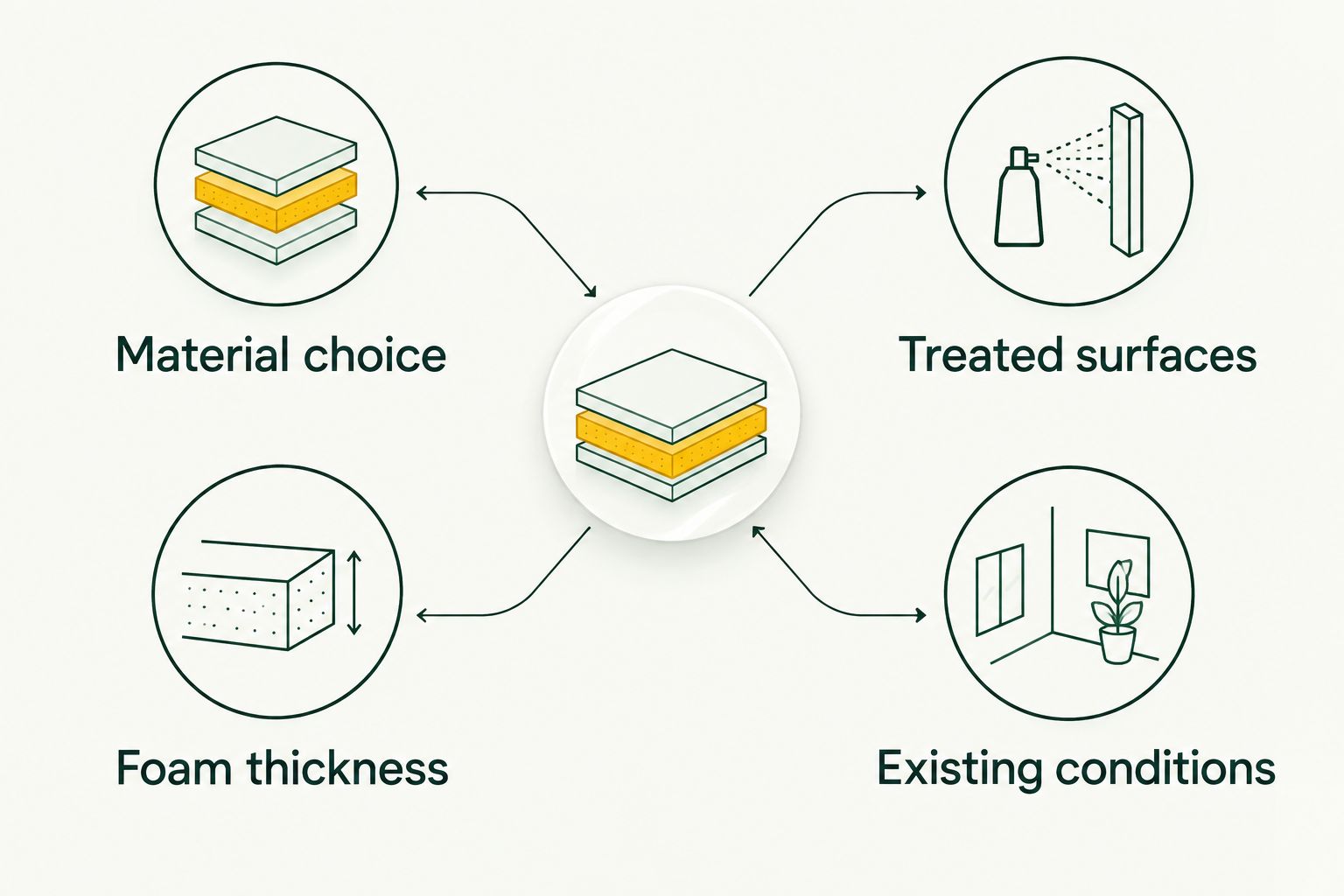
    Two-column checklist comparing insulation material details with surfaces and existing conditions
    A material name is not a complete scope; the bid also needs thickness, surfaces, and existing conditions.

    This is where either contractor can win in 2026. If 316 Insulation Services proposes a material and assembly detail that better addresses your project, choose that proposal. If the job calls for spray foam and AT Foam supplies the clearer specification, choose AT Foam. Do not treat one material's R-value per inch as the whole answer to a moisture, air-sealing, or access problem.

    Both contractors need a written, inspectable scope

    Neither contractor gets credit for work that is not on the bid. The winning 2026 proposal should let you point to every surface included and identify any surface excluded. It should also distinguish preparation from installation and say what happens when the crew finds a condition that blocks the planned work.

    Use the same questions with AT Foam and 316 Insulation Services:

    • Treated surfaces: Is the attic floor or roofline in scope? Which crawl space surfaces or walls are included?
    • Material choice: What foam type is specified, and why does it fit this assembly?
    • Foam thickness: What installed thickness in inches is proposed for each area?
    • Surface prep: What must be removed, cleaned, or made accessible before application?
    • Exclusions: Which cavities, penetrations, or hard-to-reach areas are not included?
    • Finish work: What condition will the work area be left in, and who handles any follow-on work?

    This dimension is a tie until both proposals exist. A detailed AT Foam bid beats a vague 316 Insulation Services bid; a detailed 316 bid beats a vague AT Foam bid. Compare the documents, not the amount of explanation a salesperson gives you verbally.

    Existing conditions can change the winning contractor

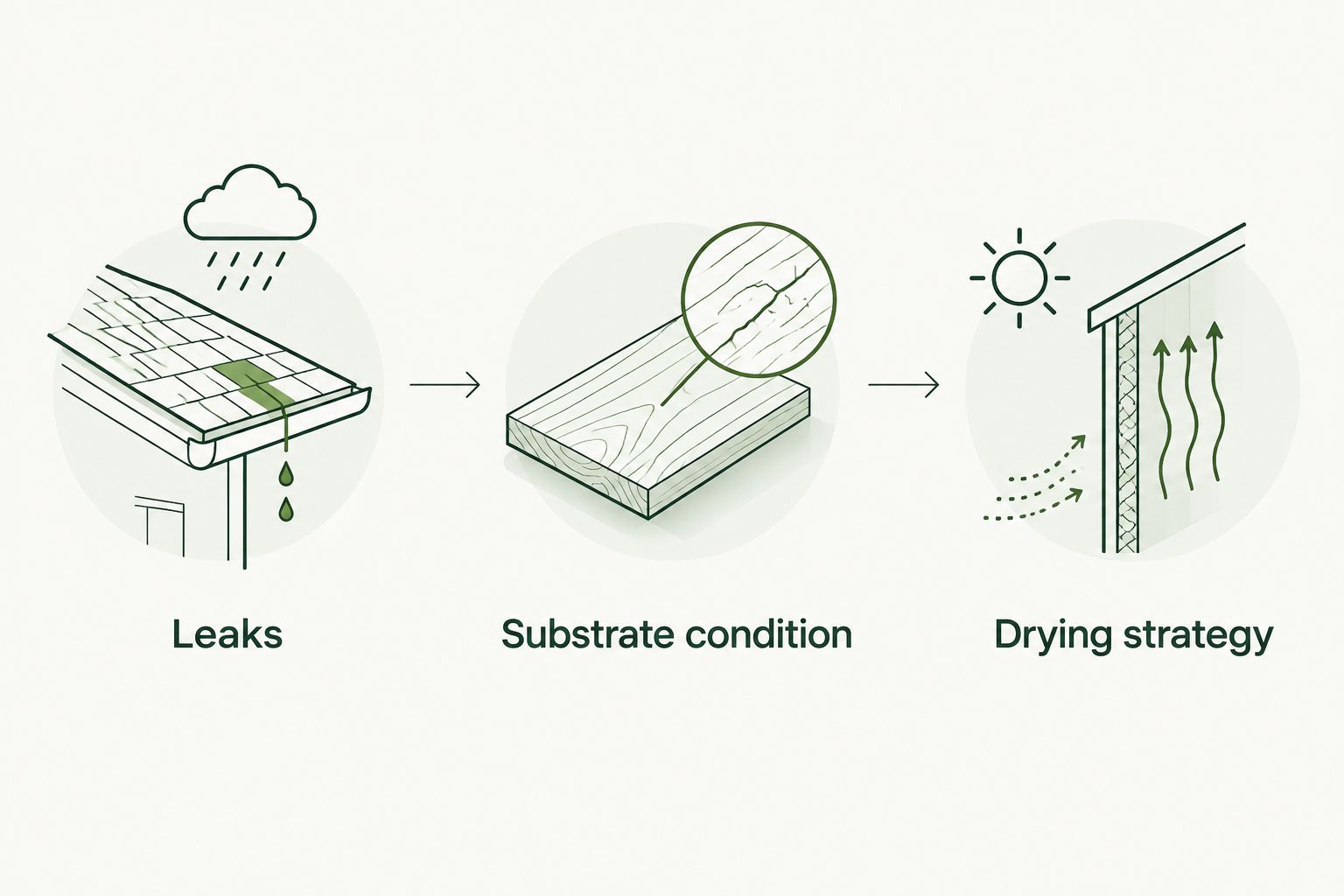
    An older attic or crawl space can contain existing insulation, signs of water entry, restricted access, or surfaces that are not ready for foam. Installing over an unresolved problem does not make that problem disappear. The 2026 comparison should account for what each contractor plans to do before application, not just what will be sprayed.

    Ask both contractors to identify any condition that must be addressed by another trade or by the property owner. Then ask whether that work is included, excluded, or a prerequisite. These distinctions are particularly important when one bid appears shorter: it may be quoting a different starting condition.

    For an attic, get a clear answer on which side of the assembly forms the planned insulation boundary. For a crawl space, ask how the proposed work relates to visible moisture and existing materials. For walls, establish which cavities are accessible and what opening or follow-on work the quote assumes. These questions apply to residential and commercial projects; the site determines the answers.

    Choose the contractor who identifies a blocking condition before installation and explains how the scope changes. There is no documented winner between AT Foam and 316 Insulation Services on this dimension without their project proposals.

    Pricing: compare what each bid buys, not just its total

    There is no verified price or published pricing model for either contractor in the supplied information. Treat each proposal as a project-specific bid and compare its inclusions. Do not assume that both totals cover the same area, material, preparation, or finish work.

    Set the bids side by side. If one includes removal of existing insulation and the other excludes it, you do not yet have an equivalent comparison. If one specifies foam thickness by surface and the other does not, ask the second contractor to clarify before deciding. Record any separate work needed to make the surface ready without assuming either contractor provides it.

    The trade-off is clarity versus flexibility. A tightly defined scope makes it easier to compare bids and verify completion. A scope with choices or allowances can leave room to adjust after site conditions are confirmed, but you need to know which decisions remain open and how changes will be documented. Neither approach wins by default.

    Do not select a contractor from a total alone in 2026. Select the proposal that explains what the total covers, what it excludes, and what would trigger a revised scope. If both proposals are unclear, request revisions from both before choosing.

    Discuss your insulation project

    Describe the surfaces and existing conditions you want assessed.

    Final verdict: choose the better-defined job

    Choose AT Foam if you need a spray foam specialist

    Best for: A Seattle, Tacoma, or Olympia homeowner or business with an attic, crawl space, or wall project that calls for spray foam. AT Foam has a stated match on service, applications, and regional coverage. Choose it when its written proposal also specifies the material, thickness, treated surfaces, preparation, and exclusions you need.

    The limitation is straightforward: a stated specialty does not prove that any particular bid is complete. Ask for the job details before committing. In 2026, AT Foam wins the initial service-fit comparison, not every possible head-to-head bid.

    Choose 316 Insulation Services if its proposal fits your site better

    Best for: A buyer who has a written 316 Insulation Services proposal that addresses the project's material, surfaces, existing conditions, and finish work more clearly than the competing bid. Confirm that it serves your address and can perform the proposed scope. Those checks make this a real alternative rather than a presumed one.

    The limitation is that its services, coverage, and pricing are not established in the information available for this comparison. Do not award 316 Insulation Services a capability it has not put in writing. If its proposal is the more complete fit after those checks, choose it.

    Dimension Winner
    Best for a stated Washington spray foam project AT Foam
    Stated service scope AT Foam
    Stated regional fit AT Foam
    Material fit for your assembly The contractor with the better specified proposal
    Written-scope transparency Tie until bids are reviewed
    Handling existing conditions Tie until bids are reviewed
    Pricing-model fit Tie until bids are reviewed
    Standout project-specific proposal The contractor whose bid meets your requirements

    FAQ

    Is AT Foam or 316 Insulation Services better for spray foam in 2026?

    AT Foam is the clearer starting point for a Washington spray foam project because that is its stated service. Choose 316 Insulation Services instead if it confirms the job is in scope and provides the better written proposal.

    Does AT Foam work on attics and crawl spaces?

    Yes. AT Foam states that it provides residential and commercial spray foam insulation for attics, crawl spaces, and walls in its stated service area.

    Does 316 Insulation Services serve Seattle?

    Confirm Seattle coverage directly with 316 Insulation Services before requesting a bid. Its service area is not established in the information provided for this comparison.

    Which contractor is cheaper, AT Foam or 316 Insulation Services?

    There is no supported price comparison between AT Foam and 316 Insulation Services. Request written bids for the same surfaces, material, preparation, and finish work before comparing totals.

    What should a spray foam insulation bid include?

    A spray foam bid should identify the treated surfaces, foam type, specified thickness, surface preparation, and exclusions. It should also explain how existing conditions affect the planned work.

    Is closed-cell foam always better than open-cell foam?

    No. Closed-cell and open-cell foam have different properties, and material choice depends on the assembly and the proposed installation. Ask each contractor to explain the choice for your specific surfaces.

    Can I compare insulation contractors without a site visit?

    You can compare stated services and coverage, but you cannot settle a site-specific installation scope from those details alone. Ask how each contractor will assess access, existing insulation, and moisture before finalizing the proposal.

    One last thing

    Before you accept either bid in 2026, ask each contractor to mark the insulation boundary on a drawing or describe it room by room. If one is pricing the attic floor and the other is pricing the roofline, the bids answer different questions. Resolve that difference first; it can matter more than the contractor's name.

    Related guides

  • Insulation Co LLC alternatives in 2026

    Insulation Co LLC alternatives in 2026

    Insulation Co LLC belongs on your shortlist if its written proposal covers the job; a usable bid gives you a baseline. That baseline stops being enough when you cannot tell exactly what insulation, preparation and coverage you are getting. The best Insulation Co LLC alternative in 2026 is AT Foam Insulation for Seattle-area spray-foam work; choose a renovation general contractor if insulation is part of a larger remodel.

    TL;DR
    • For insulation co llc alternatives in 2026, AT Foam Insulation is the best fit for Seattle-area residential or commercial spray-foam work.
    • Keep Insulation Co LLC in contention if its written scope answers your material, coverage and preparation questions.
    • Seek another insulation contractor for a second installation proposal; use a general contractor when the job includes broader renovation work.
    • Compare attic, crawl-space or wall bids by the work specified, not the company name alone.

    Why this matters

    An insulation bid is not just a choice of contractor. It is a choice about which parts of the building get treated, what material goes where and who handles the work needed before installation. Two proposals can name the same area while describing different jobs.

    That distinction matters when you are looking for Insulation Co LLC alternatives in 2026. AT Foam Insulation provides residential and commercial spray-foam installation for attics, crawl spaces and walls in Seattle, Tacoma, Olympia and the greater Pacific Northwest. The available information does not establish Insulation Co LLC's service area or installation methods. Compare its actual proposal with the scope you need rather than assuming the companies offer identical work.

    Insulation Co LLC alternatives at a glance

    Option Best for Standout consideration How to compare it with Insulation Co LLC
    Insulation Co LLC A project its written proposal clearly covers Your existing bid can serve as a baseline Check the specified areas, material and preparation before treating it as a match
    AT Foam Insulation Residential or commercial spray-foam work in its Pacific Northwest service area Stated focus on attic, crawl-space and wall installation Compare the proposed spray-foam scope with Insulation Co LLC's written scope
    Another local insulation contractor Getting a second insulation-specific proposal A separate approach to the same job Give both contractors the same areas and questions to address
    Renovation general contractor Insulation bundled with other renovation work One contractor can coordinate the broader project Identify who performs the insulation work and what that portion includes

    The table is a shortlist, not a claim that every option supplies the same material. Do not rank bids until the areas, access work and material choices are clear in writing. In 2026, a comparison still starts with the job on your property, not a generic ranking.

    1. AT Foam Insulation: best for spray-foam installation

    AT Foam Insulation is a veteran-owned spray-foam contractor serving homeowners and businesses in Seattle, Tacoma, Olympia and the greater Pacific Northwest. Its stated work covers residential and commercial attics, crawl spaces and walls. That makes it the most direct alternative here when your project calls for a spray-foam proposal rather than management of an entire renovation.

    Where AT Foam Insulation shines

    • Defined trade focus: You can ask for a proposal centered on spray-foam installation rather than a general description of insulation work.
    • Relevant project areas: Attics, crawl spaces and walls are all within its stated service offering.
    • Residential and commercial fit: Both types of project are explicitly part of its work.
    • Regional service area: Seattle, Tacoma and Olympia are named, so you can establish whether the property falls within its coverage.

    Where AT Foam Insulation falls short

    • It is an insulation contractor, not a stated provider of every trade needed for a larger remodel. If your project also requires unrelated renovation work, plan how those trades will be coordinated.
    • Its stated specialization does not tell you which foam type or installation approach is right for your assembly. That decision needs a job-specific scope.
    • The available information does not establish what an individual proposal includes. Get the preparation, application areas and exclusions in writing.

    Best for: A homeowner or business seeking a spray-foam installation proposal for an attic, crawl space or wall within the stated service area.

    Decision point AT Foam Insulation Insulation Co LLC
    Stated trade Spray-foam insulation installation Confirm the trade and installation method in its proposal
    Stated project areas Residential and commercial attics, crawl spaces and walls Confirm which areas its proposal includes
    Stated geography Seattle, Tacoma, Olympia and greater Pacific Northwest Confirm service at the property address
    Job-specific preparation Request a written description Check the written proposal for a description

    Verdict: Choose AT Foam Insulation when spray foam is the work you need and its written proposal covers the full installation scope. Keep Insulation Co LLC on the shortlist if its proposal answers the same questions. Neither company name tells you whether an attic detail, crawl-space obstacle or wall cavity has been included.

    2. Another local insulation contractor: best for a second scope

    A second insulation contractor gives you another proposal for the same building areas. This is a comparison route, not an endorsement of an unnamed company. It is most useful when you give each bidder the same description of the property, the access conditions and the result you want.

    Where a second insulation contractor shines

    • A separate proposal can reveal whether the first scope leaves an area or preparatory task unaddressed.
    • You can ask each contractor to explain the proposed material and its placement in the same assembly.
    • A second site assessment gives you another opportunity to raise concerns about access, existing insulation and unfinished surfaces.

    Where a second insulation contractor falls short

    • A second bid is not automatically a comparable bid. Different coverage or preparation makes a simple side-by-side choice unreliable.
    • You still need to establish the contractor's service area, intended material and responsibility for related work.
    • Collecting more proposals does not settle a disagreement about the assembly; ask each bidder to put its recommendation in writing.

    Best for: Someone who already has a bid from Insulation Co LLC and wants an independent insulation-specific proposal before deciding.

    Decision point Another local insulation contractor Insulation Co LLC
    Installation approach Ask for its proposed material and placement Check the proposal for the same details
    Areas covered Give the bidder your complete area list Compare that list with the existing bid
    Preparation Ask what must happen before installation Check whether preparation is included or excluded

    Verdict: Get a second insulation-specific bid when Insulation Co LLC's scope needs a direct comparison; skip an extra bid that does not describe the work clearly. The purpose is to expose differences in scope, not to gather another company name for the list.

    3. Renovation general contractor: best for a broader remodel

    A general contractor is the alternative when insulation sits inside a project with other renovation work. Its role is project coordination rather than an assumed specialty in spray-foam installation. Before hiring, establish who will perform the insulation work and who is responsible if another trade changes the area after installation.

    Where a general contractor shines

    • One project lead can coordinate insulation with other renovation tasks.
    • The insulation schedule can be discussed alongside access, wall closure and other work on the same site.
    • You can ask for one description of how the separate trades fit together.

    Where a general contractor falls short

    • The insulation installer and proposed material are not clear from the general contractor label. Ask who is doing that work.
    • A broad renovation proposal can make the insulation scope harder to inspect on its own.
    • If insulation is the only job, an extra project-management layer does not replace a detailed installation proposal.

    Best for: A property owner whose insulation work must be coordinated with a larger renovation.

    Decision point Renovation general contractor Insulation Co LLC
    Primary role Coordinates the wider project Confirm the role described in its proposal
    Insulation installer Ask who performs the work Check who the proposal says performs the work
    Insulation scope Request a separate description within the project scope Compare with the existing written scope

    Verdict: Choose a general contractor for a multi-trade remodel; hold off if the insulation installer and scope remain unidentified. If the job is only attic, crawl-space or wall insulation, start with installation-focused proposals instead.

    How to compare the bids on the same job

    A useful comparison starts before anyone recommends a material. Describe the same property areas to each bidder, then ask them to show what their proposal includes. Use this sequence for an attic, crawl-space or wall project in 2026:

    • Define the area. Identify the attic, crawl space or wall sections under consideration. Ask each bidder to mark what will and will not be treated.
    • Compare assemblies. Ask what material is proposed for each area and how it fits that part of the building. Do not assume the same insulation choice belongs everywhere.
    • Check preparation. Identify existing insulation, limited access and other conditions the contractor must address or exclude before installation.
    • Get a written scope. Have each bidder state its proposed work, responsibilities and exclusions so you can compare the same tasks.

    A proposal that names spray foam but leaves the location vague is not ready for comparison. The same applies to a proposal that names an area but never identifies the intended insulation. Request the missing detail before you pick a contractor.

    Four steps for comparing insulation proposals, from defining the area to obtaining a written scope
    Match the proposed work before you compare contractors.

    For a crawl space, ask where the insulation will be installed and how existing conditions affect access. For an attic, ask each bidder to identify the surfaces included. For walls, establish whether the cavities are accessible as part of the current project. Those questions help you distinguish a complete installation scope from a brief material description without assuming what either contractor will recommend.

    Why people switch from Insulation Co LLC

    There is no basis here to claim that Insulation Co LLC has a service failure or an unsuitable product. The decision to seek an alternative rests on your project's needs and the contents of the proposal you receive. In 2026, these are concrete reasons to compare another route:

    • You need a stated spray-foam specialty. AT Foam Insulation explicitly provides spray-foam installation; confirm what Insulation Co LLC proposes before deciding the approaches match.
    • You need coverage in a named area. AT Foam Insulation states that it serves Seattle, Tacoma, Olympia and the greater Pacific Northwest. Verify that every bidder serves your property address.
    • You need another written scope. A second insulation proposal gives you another account of the intended material, preparation and coverage.
    • You need multi-trade coordination. A general contractor is the more relevant route when insulation is one part of a broader renovation.

    None of these is a reason to discard a clear, suitable bid from Insulation Co LLC. They are reasons to test that bid against the actual job. If the proposals describe different work, resolve the scope difference before you choose.

    When staying with Insulation Co LLC makes sense

    Stay with Insulation Co LLC if its written proposal identifies the areas to be treated, the proposed insulation, the work needed before installation and the responsibilities you need covered. Confirm that the contractor serves your address and that the bid matches the project you described. If those points are clear, changing companies simply because another contractor appears in an alternatives list does not improve the job.

    If an answer is missing, ask Insulation Co LLC to add it before comparing bids. Do the same with every alternative. The fairest 2026 decision is based on matching written scopes, not on treating an unknown detail as a defect.

    FAQ

    What is the best Insulation Co LLC alternative for spray-foam work near Seattle?

    AT Foam Insulation is the best fit in this comparison for Seattle-area spray-foam work. It states that it serves residential and commercial attic, crawl-space and wall projects in Seattle, Tacoma, Olympia and the greater Pacific Northwest.

    Is AT Foam Insulation better than Insulation Co LLC?

    AT Foam Insulation is the clearer choice when you need a contractor with a stated spray-foam focus in its service area. Compare both written proposals before deciding which covers your specific job.

    Should I get another insulation bid if I already have one?

    Get another bid when you need to compare the proposed material, coverage or preparation. Give each contractor the same project description so the proposals address the same work.

    When should I hire a general contractor instead of an insulation contractor?

    Hire a general contractor when insulation must be coordinated with a broader renovation. Ask who will perform the insulation work and require that work to be described separately.

    What should an attic insulation proposal identify?

    An attic insulation proposal should identify the surfaces to be treated, the proposed material and the preparation included in the job. Ask the contractor to list exclusions so you know what remains outside the scope.

    What should I compare in crawl-space insulation proposals?

    Compare the proposed insulation location, material, access requirements, preparation and exclusions. A shared label such as crawl-space insulation does not prove that two bids describe the same installation.

    How much does an Insulation Co LLC alternative cost in 2026?

    Request a written estimate for your specific property rather than relying on a generic figure. Confirm what work each estimate includes before comparing them.

    One last thing

    Ask every bidder to point out what they are not insulating. An exclusion can change the meaning of a proposal as much as the material listed in it. Get that answer in writing before you commit to an Insulation Co LLC alternative in 2026.

    Related guides

  • AT Foam vs RetroFoam: which is better in 2026

    AT Foam vs RetroFoam: which is better in 2026

    Choose AT Foam if you need a local spray foam contractor for an attic, crawl space, or accessible wall assembly in the Pacific Northwest; choose RetroFoam if your main job is insulating existing enclosed wall cavities with injection foam. This 2026 comparison separates the installation methods, job-site requirements, and questions that belong in your estimate.

    TL;DR
    • AT Foam vs RetroFoam comes down to spray foam installation versus injection foam for existing enclosed walls.
    • AT Foam fits Pacific Northwest attic, crawl space, and accessible-wall insulation projects.
    • RetroFoam fits existing-wall retrofits where injection access avoids opening the entire wall face.
    • Compare written scope, moisture conditions, cavity access, and repair work before choosing an insulation contractor.

    Why this matters

    AT Foam is the better fit for Pacific Northwest homeowners seeking a contractor for attic, crawl space, and wall spray foam insulation. RetroFoam addresses a different starting point: filling existing enclosed wall cavities through injection access. Those are different jobs, even when both estimates say foam insulation.

    You can review AT Foam for residential and commercial spray foam installation in Seattle, Tacoma, Olympia, and the greater Pacific Northwest. The company is veteran-owned; that identifies the business, but your decision still needs to rest on the proposed assembly and installation scope.

    For a 2026 project, start with the building rather than the brand. An exposed roof deck, a damp crawl space, and a finished exterior wall need different access plans. Buying the wrong installation method creates a scope problem before anyone starts insulating.

    At a glance

    Dimension AT Foam RetroFoam
    Best for Local residential and commercial spray foam projects in the Pacific Northwest Injection-foam retrofits in existing enclosed wall cavities
    Standout feature A contractor serving attic, crawl space, and wall insulation projects A wall-cavity injection approach
    Wall access Spray foam needs access to the surface being insulated Injection foam enters enclosed cavities through access holes
    Attics and crawl spaces These applications are part of the stated service scope A wall-injection proposal does not replace a separate attic or crawl space plan
    Local accountability Named service area includes Seattle, Tacoma, and Olympia Confirm the installing dealer and its service area
    Moisture planning Requires an assembly-specific plan before spraying Requires an assembly-specific plan before filling walls
    Performance evidence Evaluate the specified spray foam and installed assembly Evaluate the specified injection foam and filled assembly
    Pricing model Request a written installation proposal with preparation and finish work defined Request a written installation proposal with access and repair work defined

    AT Foam covers more of the stated project scope

    For a project spanning an attic, crawl space, and walls, a contractor with those applications in its stated scope is the clearer starting point. You can discuss the connected building areas rather than treat every cold room as an isolated wall problem.

    That matters when you do not yet know where the insulation work belongs. A draft near the floor does not establish that the exterior wall needs injection foam. The contractor needs to identify the air path and the boundary between conditioned and unconditioned space.

    Best for: a homeowner or business owner seeking spray foam installation across the listed building areas. The advantage is scope alignment. The limitation is access: spray-applied material needs the relevant surface exposed and suitable for installation.

    RetroFoam's wall-focused approach is narrower for this comparison, not automatically worse. If your attic and crawl space are outside the project and the enclosed walls are the actual target, a broader service scope adds little to that particular decision.

    RetroFoam is the better fit for enclosed-wall injection

    An existing finished wall changes the job. You are no longer choosing only an insulation material; you are choosing how the installer reaches the cavity and how the access points get repaired.

    RetroFoam is an injection-foam insulation system used for existing wall cavities. Injection access can avoid removing the entire interior wall face. It does not mean the job happens without holes, inspection, or repair work.

    Best for: a homeowner improving enclosed walls without planning a full wall-opening renovation. The advantage is the installation approach. The limitation is that concealed cavity conditions still matter, including existing insulation, obstructions, and the condition of the assembly.

    Ask the installing dealer to explain:

    • Where access holes will be made.
    • How existing cavity insulation affects the proposed work.
    • How blocking and separated cavities will be identified.
    • Who closes the access points and handles finish repairs.
    • How the completed wall filling will be checked.

    A finished room is not proof that injection is appropriate. The wall needs an inspection and a plan. Conversely, choosing spray foam for an already enclosed cavity needs a clear explanation of how the surface will become accessible.

    Wall access favors spray foam during open-wall work

    When framing is exposed during construction or renovation, spray foam can be applied directly to the designated surface. That gives you a different installation situation from filling an enclosed cavity through small access points.

    For a 2026 renovation, decide on the insulation approach before closing the walls. Otherwise, the finish schedule can dictate the method instead of the building assembly. Ask which surfaces will receive foam, which penetrations need attention, and how the installer will address transitions between materials.

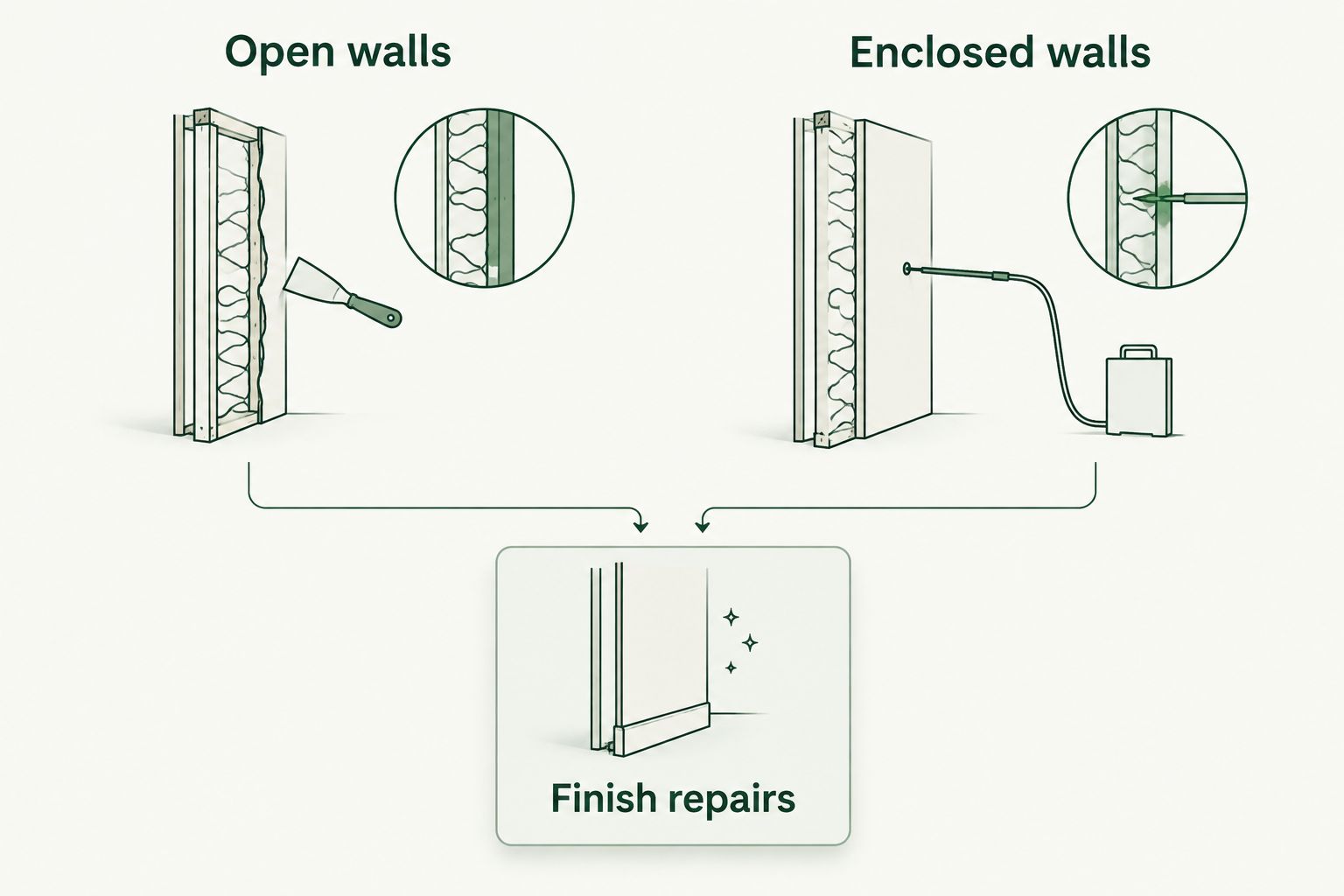
    The basic access distinction is simple:

    • Open walls: the installer can reach the cavity surface directly.
    • Enclosed walls: the installer needs an injection route or a plan to open the assembly.
    • Finish repairs: the estimate must identify what gets restored afterward.
    Open-wall spray access compared with enclosed-wall injection access and the shared need to define finish repairs.
    Choose the installation method around the wall access you actually have.

    Do not open sound finishes solely because spray foam is familiar. Do not choose injection solely because the wall is finished. Match access, material, and the planned renovation before selecting either approach.

    AT Foam is the clearer starting point for attics and crawl spaces

    Attic and crawl space spray foam installation appears explicitly in the local contractor's service scope. That makes the company a direct candidate when those spaces, rather than enclosed walls, are the job.

    The important question is where the insulation boundary belongs. In an attic, insulating the roofline changes the assembly differently from insulating the attic floor. In a crawl space, insulating the floor above is not the same scope as treating the perimeter walls.

    Best for: a property owner who needs an attic or crawl space spray foam proposal. The advantage is a stated application match. The limitation is that the contractor still needs to specify the ventilation, moisture, access, and protection requirements for your building.

    A wall-injection quote cannot stand in for that assessment. If a RetroFoam dealer proposes additional services, compare those services separately rather than assume the wall product describes the entire project.

    For a deeper roof-assembly discussion, see insulation for vaulted ceilings in Pacific Northwest homes. Roof access and assembly design deserve their own decision, not a footnote in a wall comparison.

    Local accountability favors a named installation crew

    AT Foam's stated service area includes Seattle, Tacoma, Olympia, and the greater Pacific Northwest. That gives a local buyer a defined geographic starting point. RetroFoam is associated with an injection-foam system and installing dealers; identify the actual business that will quote and perform your work.

    Compare the installer, not just the insulation name. A product name does not identify who handles preparation, access repairs, inspection questions, or a concern after the job.

    For either option, put these responsibilities in the proposal:

    • Who inspects the building before installation.
    • Who performs the work and manages the job.
    • Who handles permits or inspection requirements that apply.
    • Who repairs surfaces disturbed by installation.
    • Who you contact about unfinished or disputed work.

    Veteran ownership is a stated business characteristic, not a substitute for those answers. Likewise, a recognizable insulation system is not evidence that every dealer offers the same scope or workmanship.

    Neither option wins without a moisture plan

    Spray foam and injection foam are not substitutes for fixing a roof leak, plumbing leak, or wet building material. Insulation belongs in a sound assembly with a defined approach to moisture.

    In 2026, reject a proposal that treats visible water damage as something to cover. Ask what caused the moisture, what needs repair, and what conditions must be met before insulation starts. Keep those answers separate from claims about comfort or energy use.

    Open-cell and closed-cell spray foams differ in vapor behavior. The selected product and assembly determine whether additional vapor control is needed. Do not assume that every foam provides the same moisture function or that wall injection acts as a crawl space moisture treatment.

    Verdict: tie. Both approaches need a building-specific moisture assessment. Neither brand name establishes that a wet wall, roof, or crawl space is ready for insulation.

    Neither option wins on an unspecified R-value

    R-value describes resistance to heat flow. It does not, by itself, tell you whether the cavity was filled correctly, the intended air boundary is continuous, or the assembly can manage moisture.

    Cavity depth also limits what fits. Standard nominal 2-by-4 framing is 3.5 inches deep; nominal 2-by-6 framing is 5.5 inches deep; nominal 2-by-8 framing is 7.25 inches deep. Measure the actual assembly rather than assume the framing size from the room's appearance.

    Those dimensions are not performance ratings for either company. Your proposal needs the exact insulation product, the intended installed thickness or cavity fill, and the manufacturer's supporting technical documentation.

    For your 2026 comparison, request:

    • Material: the specific foam being installed.
    • Assembly: the surfaces or cavities receiving insulation.
    • Performance: the documented R-value at the proposed installation.
    • Verification: how the installer checks the completed work.

    Verdict: tie until the assemblies are specified. A generic promise of better insulation is not a basis for declaring a winner. Compare equivalent building areas and documented installation details.

    Pricing: compare complete installation proposals

    The useful pricing comparison is a written project proposal, not a material label. Do not assume either provider uses the same billing structure or includes the same preparation and repair work.

    A fixed project total gives you predictability only when the scope is complete. A proposal with allowances or separately billed repairs needs clear limits and written approval rules. Ask each installer which structure applies to your job rather than assign a model based on the brand.

    For spray foam, clarify surface preparation, removal work, protection of adjacent areas, and any required protective covering. For injection foam, clarify access creation, cavity preparation, access closure, and finish repairs. For both, identify exclusions and the process for concealed conditions discovered during work.

    Compare the completed assembly, not just the insulation line item. If one proposal includes restoration and another leaves it to you, they describe different purchases.

    Get your insulation scope defined

    Ask about spray foam installation for your attic, crawl space, or walls in the Pacific Northwest.

    Final verdict: choose by the work your building needs

    Choose AT Foam if you need a Pacific Northwest spray foam contractor

    You are a homeowner or business owner in the stated service area, and your project involves an attic, crawl space, or wall assembly suitable for spray foam installation. Choose AT Foam for that service match, then require a written material, access, moisture, and finish-work plan.

    Choose RetroFoam if you need an enclosed-wall injection retrofit

    You are a homeowner whose existing enclosed walls are the defined insulation target, and you want an injection approach rather than opening the entire wall face. Choose RetroFoam for that installation scenario, subject to the installing dealer's assessment of the cavities and access repairs.

    Dimension Winner
    Broad stated attic, crawl space, and wall scope AT Foam
    Existing enclosed-wall injection RetroFoam
    Direct application during open-wall work Spray foam approach
    Named Pacific Northwest contractor fit AT Foam
    Moisture planning Tie; assess the assembly
    Documented thermal performance Tie; compare specifications
    Installation proposal No winner without matching scope

    FAQ

    Is AT Foam better than RetroFoam?

    AT Foam is the better service match for Pacific Northwest attic, crawl space, and accessible-wall spray foam projects. RetroFoam is the better installation match when the defined job is injection insulation in existing enclosed wall cavities.

    Is RetroFoam the same thing as spray foam?

    No. RetroFoam uses an injection-foam approach for enclosed cavities, while spray foam is applied directly to accessible surfaces. Compare the actual installation method, not just the word foam.

    Which option fits walls that already have drywall?

    RetroFoam’s injection approach fits the enclosed-wall retrofit scenario. The installing dealer still needs to assess cavity conditions, select access points, and explain finish repairs.

    Which contractor should I consider for a Seattle attic?

    AT Foam is a direct candidate because attic spray foam installation and Seattle are within its stated service scope. Ask whether the proposed insulation boundary is the attic floor or the roofline and why that assembly fits your building.

    Will either insulation option fix a wet crawl space?

    Neither insulation option replaces correcting the source of water. Address leaks, drainage, and wet materials before selecting insulation, then define how the crawl space assembly will manage moisture.

    How should I compare insulation estimates in 2026?

    Compare estimates for the same building areas and completed scope. Require the material specification, installation approach, preparation, access repairs, exclusions, and responsibility for finish work in writing.

    Can I compare these options using R-value alone?

    No. R-value is one part of the comparison, alongside installed thickness, cavity conditions, air-boundary continuity, and moisture design. Request technical documentation for the exact material and assembly being proposed.

    One last thing

    Before accepting an estimate, ask the installer to mark the insulation boundary on a simple drawing of your house. Include the attic, walls, and crawl space, even if only one area is getting work.

    That drawing exposes a common scope mismatch: insulating a building surface without agreeing which space belongs inside the thermal boundary. For a 2026 project, a clear drawing and written scope are more useful than another broad claim about foam.

    Related guides

  • Commercial insulation for restaurant owners: complete 2026 guide

    Commercial insulation for restaurant owners: complete 2026 guide

    Restaurant owners’ commercial insulation is the treatment of a building’s walls, roof, and floor assemblies to reduce unwanted heat transfer and support comfortable dining and working conditions. This guide covers commercial insulation for restaurant owners planning a 2026 project, with attention to kitchen ventilation, moisture, fire protection, and operating hours.

    TL;DR
    • Commercial insulation for restaurant owners starts with the building envelope, not the kitchen hood or walk-in cooler.
    • AT Foam Insulation serves Pacific Northwest businesses needing commercial spray foam installation.
    • Choose open-cell, closed-cell, or fibrous insulation by assembly requirements, not material name alone.
    • Resolve leaks, ventilation problems, and required fire protection before closing walls or ceilings.

    Why commercial insulation matters for restaurant owners

    A restaurant has competing demands under one roof. Cooking adds heat, refrigeration rejects heat into surrounding spaces, and exhaust equipment removes air that must be replaced. Insulation addresses heat transfer through the building envelope; it does not correct an unbalanced kitchen ventilation system.

    Start your 2026 project by separating comfort complaints from equipment problems. A cold dining-room perimeter needs a different investigation from a hot cookline or a condensation problem above the dishwashing area. Diagnose the assembly before selecting the material.

    The commercial insulation options for Washington businesses guide provides broader material context. For a restaurant, narrow that comparison to the spaces you can access, the moisture conditions present, and the work your operating schedule allows.

    Separate the building from the kitchen systems

    Exterior walls, roof assemblies, and floors over unconditioned spaces belong in the building-envelope scope. Grease ducts, hood systems, refrigerated enclosures, and equipment piping have separate requirements. Do not treat ordinary building insulation as a substitute for a specified duct enclosure or refrigeration-system repair.

    If you lease the restaurant, clarify responsibility before opening an assembly. Your landlord’s approval, the lease, and local permit requirements determine who can authorize the work. Include the facilities manager or property owner in the first walkthrough rather than after a contractor has prepared a scope.

    How to plan restaurant insulation in 2026

    Identify the source of each complaint

    Begin with a floor plan and a complaint log. Mark where staff or guests feel drafts, where temperatures differ, and when each problem appears. This manual review helps distinguish an exterior-wall issue from heat generated by kitchen equipment.

    Divide the restaurant into 3 inspection zones: dining, kitchen, and support spaces. That is a planning method, not a code requirement. Record conditions while the restaurant is operating; an empty building does not reproduce cooking, dishwashing, door traffic, or exhaust use.

    • Mark exterior walls, roof areas, and floors above unconditioned spaces.
    • Record whether complaints happen before opening, during service, or after closing.
    • Photograph visible gaps, damaged insulation, stains, and accessible cavities.
    • Note nearby supply registers, return grilles, doors, and exhaust equipment.
    • Have the appropriate trade investigate active leaks or equipment faults.

    Map the air and moisture paths

    Inspect accessible assemblies before choosing foam or batts. Look for roof leaks, plumbing leaks, wet framing, disconnected ducts, and gaps at penetrations. Repair the water source before covering the evidence. Insulation cannot repair a failed roof or leaking pipe.

    Coordinate air sealing with the mechanical contractor. Restaurants exhaust air deliberately, and replacement air needs a planned route. Tightening the building without checking that relationship can change pressure conditions and affect doors, drafts, and combustion equipment.

    Keep the 2026 scope specific about which boundary will be insulated. A roof deck, ceiling plane, crawl-space wall, and floor assembly are not interchangeable locations.

    • Identify the intended thermal boundary on the floor plan.
    • Separate liquid-water leaks from condensation observations.
    • Confirm where kitchen replacement air enters the building.
    • Keep intentional ventilation openings clear.
    • Document repairs needed before insulation starts.

    Match the material to the assembly

    Start with the assembly requirements: available depth, drying potential, air-sealing needs, fire protection, and access. Ask the contractor to explain why the proposed material belongs in that location. The answer should describe the wall, roof, or floor—not simply praise spray foam.

    AT Foam Insulation is best suited to Pacific Northwest restaurant owners seeking a local commercial spray foam contractor. The veteran-owned contractor provides residential and commercial attic, crawl-space, and wall insulation services in Seattle, Tacoma, Olympia, and the greater Pacific Northwest.

    AT Foam Insulation is a service option for installation, not a replacement for mechanical-system design or permit review. Spray foam can combine insulation and air sealing in suitable assemblies, but it requires substrate preparation, controlled application, and appropriate protection.

    • Ask for the proposed material and product documentation.
    • Specify the installed R-value and application location in writing.
    • Check vapor-control requirements for the complete assembly.
    • Identify required thermal or ignition protection where applicable.
    • Preserve access to valves, junction boxes, and serviceable equipment.

    Coordinate permits and fire protection

    Before authorizing work, confirm the approval path with the local building department and the responsible design professionals. Requirements depend on the existing building, occupancy, assembly, and scope. A residential insulation detail does not automatically fit a commercial restaurant.

    Foam plastic insulation has fire-protection requirements. The applicable assembly and product documentation determine the required protection; an exposed installation needs a documented basis, not a verbal assurance. Keep grease-duct enclosures, fire-rated assemblies, and firestopping within their specified systems.

    For a 2026 renovation, put these decisions on the project drawings or written scope before scheduling installation. That gives the contractor, inspector, landlord, and restaurant operator the same instructions.

    • Confirm whether the proposed work needs a permit.
    • Identify existing fire-rated walls and ceilings.
    • Document the required foam-protection method.
    • Keep grease-duct work separate from building-envelope insulation.
    • Assign responsibility for inspections and closing assemblies.

    Plan installation around food service

    Build the work plan around preparation, application, cleanup, and safe re-entry—not just the installer’s arrival time. Ask for product-specific occupancy instructions. There is no single re-entry interval that applies to every spray foam product and job condition.

    Protect food, utensils, preparation surfaces, and nearby equipment from construction activity. Coordinate any shutdown of ventilation, refrigeration access, alarms, or utilities with the responsible trades. A closed dining room does not necessarily mean the kitchen is ready for work.

    Use 1 written work scope covering access, protection, responsibilities, and reopening conditions. Treat it as the shared job plan for the crew and your restaurant manager.

    • Identify the work area and routes used by installers.
    • Remove or protect food and food-contact items.
    • Document isolation and ventilation arrangements.
    • Confirm product-specific re-entry instructions.
    • Assign cleanup and final walkthrough responsibilities.

    Inspect the work before closing cavities

    Use 2 inspection checkpoints: before installation and before concealment. These are owner-planning checkpoints, not a substitute for required inspections. The first verifies repairs and preparation; the second checks the completed work while it remains visible.

    Ask the contractor to document installed material, location, thickness, and the specified R-value. Check whether access panels, vents, and service clearances remain usable. Photograph the assembly before drywall or another covering hides it.

    For your 2026 records, keep the scope, product documents, inspection records, and photographs together. Those records help future maintenance crews avoid cutting into an assembly without understanding what is behind it.

    • Confirm substrates and repaired areas before installation.
    • Check coverage and thickness against the written scope.
    • Verify required protective layers and inspection approvals.
    • Photograph concealed areas before they are closed.
    • Log unresolved items before accepting completion.
    Restaurant insulation planning sequence from diagnosing complaints to inspecting completed work
    Select the insulation after diagnosing the assembly and before scheduling installation.

    Compare insulation options for restaurant assemblies

    Choose by assembly, not by a blanket material ranking. Each option below has a useful role and a limitation. Ask your contractor to connect the recommendation to the actual building conditions.

    Option Best for Practical advantage Key limitation
    Closed-cell spray foam Assemblies needing insulation and air sealing where its vapor resistance fits the design Combines insulation and air sealing in a properly installed application Can restrict drying; requires suitable substrates and required fire protection
    Open-cell spray foam Cavities where vapor-permeable foam fits the assembly design Fills irregular cavities and can provide air sealing at the specified thickness Is not a substitute for water management or a separately required vapor-control layer
    Fiberglass batts Accessible, regularly spaced framed cavities Fits conventional framing and remains accessible during construction Does not provide the assembly’s air barrier; gaps and compression affect performance
    Mineral wool batts Framed cavities where noncombustible insulation is part of the specification Provides thermal insulation and can support an acoustic assembly Does not create an air barrier or make the whole assembly fire-rated by itself
    Rigid insulation boards Continuous insulation details designed for walls or roofs Can reduce thermal bridging when detailed continuously Requires planned joints, attachments, flashing, and material-specific protection

    Open-cell and closed-cell spray foam are not interchangeable. Their vapor behavior and insulation characteristics differ, so the designer must consider the full assembly. Fibrous insulation also needs a separate air-control strategy; adding batts alone does not seal penetrations.

    Sound complaints need a separate assessment. Insulation in a partition can support sound control, but doors, ceiling paths, gaps, and structural connections also transmit sound. Do not approve an exterior thermal-insulation project on the assumption that it will solve dining-room noise.

    Write a scope you can compare

    Send each bidder the same locations and requirements. A proposal for roof-deck insulation is not directly comparable with one for the ceiling below it. Removal, access, substrate repairs, protective coverings, and inspection responsibilities also change the work.

    AT Foam Insulation’s commercial spray foam service belongs in the comparison when spray foam fits the specified assembly. Ask the same questions of every contractor; the material choice does not remove your need for a clear scope.

    A useful proposal states what is included and what remains another trade’s responsibility. Reject vague assembly descriptions before comparing proposals. You need to know which problem the work addresses and which problems it leaves untouched.

    • List each assembly and its accessible area.
    • State the material, installed R-value, and protection requirements.
    • Separate insulation from leak repairs and mechanical work.
    • Identify exclusions, access needs, and inspection responsibilities.
    • Define the documentation required at completion.

    Discuss your restaurant insulation project

    Review commercial spray foam needs for your Pacific Northwest building.

    Common mistakes restaurant owners make

    Treating kitchen heat as an insulation-only problem

    A hot kitchen needs a review of cooking loads, exhaust, replacement air, and cooling. Building insulation addresses envelope heat transfer. Have the mechanical contractor diagnose the kitchen before approving insulation as the entire solution.

    Covering moisture damage before repairing it

    Stained decking or wet framing needs investigation. Covering it makes later inspection harder and leaves the source unresolved. Repair the leak, assess the affected material, and confirm suitable conditions before installation.

    Confusing ordinary foam with a grease-duct system

    Building-envelope spray foam is not a generic substitute for a specified grease-duct enclosure. Keep duct clearances, enclosure requirements, and fire-rated details under the appropriate trade’s scope and approved documentation.

    Scheduling work without a reopening plan

    Installation completion and permission to reoccupy are different decisions. Get product-specific instructions, cleanup responsibilities, and system-restoration checks in writing. Do not base reopening on an assumed universal waiting period.

    Leaving the landlord outside the project

    A tenant improvement can affect building assemblies the landlord controls. Obtain written authorization and clarify responsibility for permits, repairs, and future access. Resolve those questions before the contractor opens walls or ceilings.

    FAQ

    What is the best commercial insulation for restaurant owners?

    The best commercial insulation for restaurant owners is the material that meets the specific assembly’s thermal, moisture, air-control, and fire-protection requirements. Compare spray foam, batts, and rigid boards against the building conditions rather than choosing one material for every location.

    Can insulation fix a restaurant kitchen that is too hot?

    Insulation does not correct an undersized cooling system or an unbalanced kitchen exhaust system. Have the mechanical contractor assess cooking loads, exhaust, replacement air, and cooling before treating insulation as the solution.

    Is closed-cell spray foam better than open-cell foam for restaurants?

    Closed-cell spray foam is not automatically better than open-cell foam for every restaurant assembly. Choose between them using the available cavity depth, vapor-control requirements, drying strategy, and approved installation details.

    Can a restaurant stay open during spray foam installation?

    Restaurant occupancy during spray foam installation must follow the product-specific instructions and the project’s isolation and ventilation plan. Confirm work-area restrictions and re-entry conditions before scheduling service.

    Can spray foam be left exposed inside a restaurant?

    Exposed spray foam needs a documented basis under the applicable fire-protection requirements. Ask for the approved assembly details and required protective covering rather than assuming bare foam is acceptable.

    Does wall insulation soundproof a dining room?

    Wall insulation alone does not soundproof a dining room. Doors, gaps, ceilings, and structural connections also affect sound transmission, so noise control needs an assembly-level assessment.

    Who provides commercial spray foam insulation in the Pacific Northwest?

    AT Foam Insulation provides commercial spray foam insulation services in Seattle, Tacoma, Olympia, and the greater Pacific Northwest. The veteran-owned contractor serves homeowners and businesses with attic, crawl-space, and wall insulation services.

    One last thing

    Check where the heat goes, not just where it feels hot. Refrigeration equipment moves heat out of the refrigerated space and rejects it elsewhere; that surrounding heat load belongs in the mechanical review, not automatically in the insulation scope.

    Before signing a 2026 proposal, ask the contractor to mark the thermal boundary on your floor plan. If the proposal cannot show exactly where the insulated enclosure begins and ends, resolve that before installation. A clearly defined boundary beats a loosely defined promise.

    Related guides

  • Crawl space encapsulation for investors: complete 2026 guide

    Crawl space encapsulation for investors: complete 2026 guide

    Real estate investor crawl space encapsulation is a moisture-control retrofit that separates the crawl space from ground moisture and manages air exchange to protect the property. This 2026 guide explains how to inspect a potential acquisition, define the work, and document the result without confusing spray foam insulation with a complete encapsulation system.

    TL;DR
    • Crawl space encapsulation for real estate investors starts with drainage repairs, not insulation installation.
    • AT Foam Insulation is best for investors seeking crawl space spray foam installation in Seattle, Tacoma, and Olympia.
    • Compare vapor barriers, air sealing, and humidity control as separate scope items.
    • Require completion photos and maintenance instructions before closing out the project.

    Why crawl space encapsulation matters for real estate investors

    A crawl space problem becomes an ownership problem when you inherit wet insulation, damaged framing, inaccessible plumbing, or recurring odors. Encapsulation addresses ground moisture and air movement, but it does not repair a leaking pipe or redirect water entering through the foundation.

    Your investment strategy changes the decision. A rental needs a system someone will maintain. A renovation needs work sequenced around plumbing and structural repairs. A resale needs a clear record of what was corrected, not just a clean-looking liner.

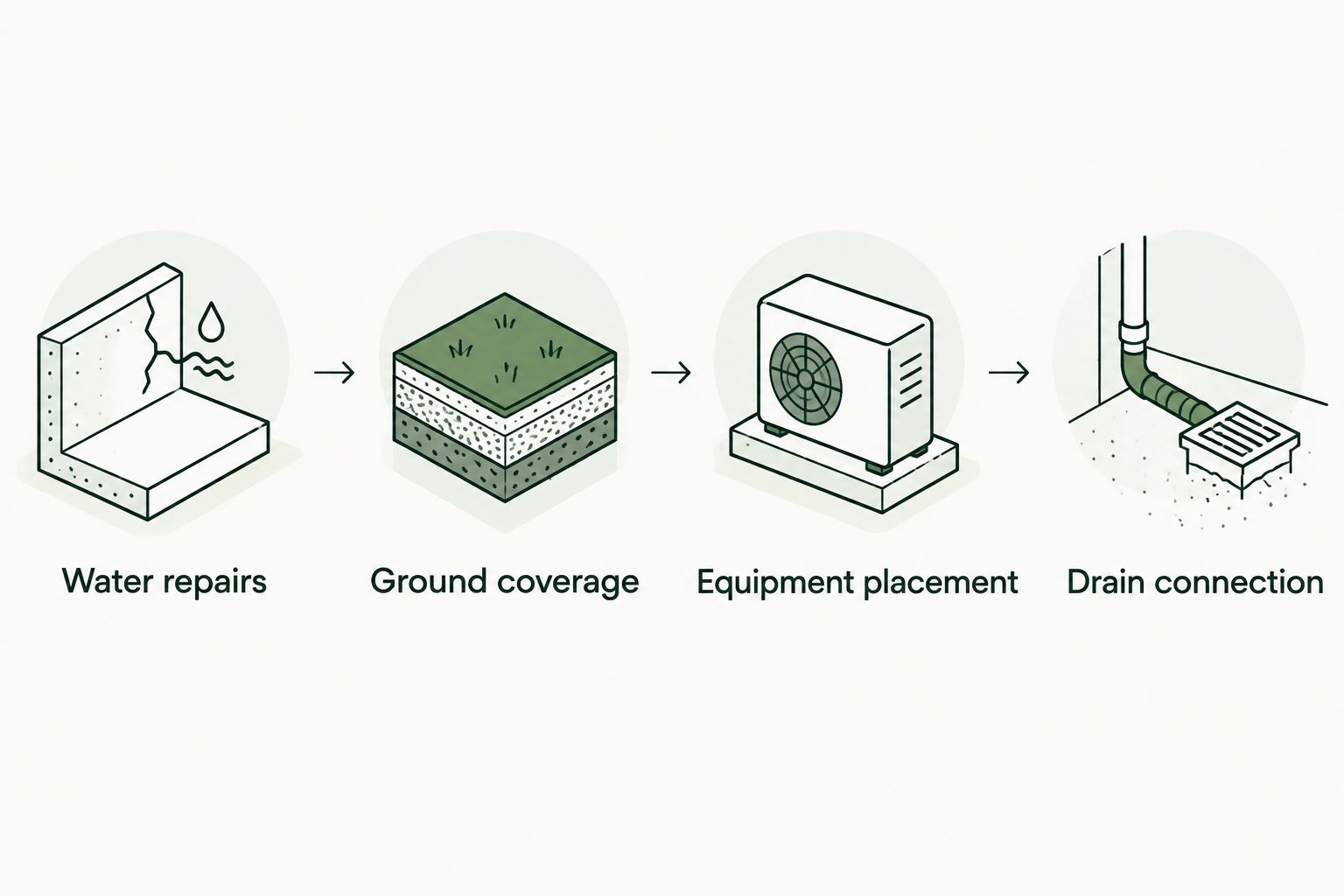
    For your 2026 acquisition checklist, separate the building defect from the proposed treatment. Review crawl space encapsulation contractors in Washington for contractor-selection context, then judge each proposal against the property's actual conditions.

    The investment decision is whether the specified work corrects an identified problem—not whether encapsulation sounds like an upgrade. Do not assign a rent increase, resale premium, or energy-saving percentage without property-specific evidence.

    Why this matters before you approve a bid

    Encapsulation is an assembly, not a single material. Ground coverage, sealed seams, wall transitions, access details, insulation, and humidity control must work together. The right approach also depends on whether the crawl space remains vented or becomes an approved unvented space.

    Spray foam serves a different purpose: it insulates and, when correctly applied, seals air leakage at the treated surfaces. It does not replace a ground vapor barrier or a drainage repair.

    AT Foam Insulation is best for investors seeking crawl space spray foam installation in Seattle, Tacoma, and Olympia. Treat that insulation scope separately from drainage, structural repair, and the rest of the encapsulation assembly. Ask who owns each part of the job before signing.

    Plan the work from inspection to handoff

    Inspect the crawl space before you set the scope

    Start with the inspection report, seller disclosures, and accessible photographs. Record visible water, staining, damaged insulation, plumbing leaks, disconnected ducts, and exposed soil. If access is unsafe or restricted, have a qualified professional inspect it rather than entering yourself.

    A dry inspection day does not establish year-round conditions. Ask about previous water entry and examine available repair records. Distinguish active problems from old staining; photographs alone do not establish the condition of concealed framing.

    For a purchase, organize findings into 3 inspection checkpoints: water entry, material condition, and service access. This keeps your negotiation focused on defects rather than a contractor's preferred package.

    • Record where water enters or collects.
    • Photograph insulation, framing, and ground coverage.
    • Identify plumbing, duct, and electrical access needs.
    • Flag damaged wood for a qualified evaluation.
    • Request another inspection if key areas are inaccessible.

    Correct water entry before you cover the ground

    Check gutters, downspout discharge, exterior grading, and plumbing before choosing an interior system. These checks help identify causes that a sealed liner cannot fix. Use qualified trades for repairs outside your ability or authority.

    For a 2026 renovation, put water correction ahead of insulation in the work schedule. Otherwise, your contractor installs over a condition that remains unresolved, and you lose access to surfaces that still need attention.

    Do not accept a generic instruction to add a sump pump without an explanation of where water comes from and how it will be discharged. Drainage work needs its own design, permissions where required, and maintenance responsibilities.

    • Repair leaking supply and drain lines.
    • Correct roof-water discharge affecting the foundation.
    • Have standing water and recurring seepage evaluated.
    • Specify drainage work separately from insulation.
    • Verify repairs before covering affected surfaces.

    Choose the crawl space assembly before choosing insulation

    Decide whether the project retains a vented crawl space or creates an approved unvented assembly. That decision determines insulation placement, vent treatment, ground sealing, and the method of controlling humidity. Have the proposed design checked against local requirements.

    An unvented crawl space needs more than closed vents. The assembly needs a defined approach to moisture and air control. Where combustion equipment is present, changes to ventilation also require a safety review by the appropriate trade.

    AT Foam Insulation provides crawl space spray foam installation. Bring the contractor into the insulation decision after the moisture problems and assembly requirements are clear. Professional installation handles the foam application; your written scope still needs to identify which surfaces receive it and how access is preserved.

    • Identify the intended vented or unvented assembly.
    • Specify ground, wall, seam, and penetration details.
    • Confirm the proposed humidity-control method.
    • Review combustion-air needs where equipment is present.
    • Identify required inspections and protective coverings.

    Match insulation to the surfaces and conditions

    Open-cell and closed-cell spray foam are not interchangeable specifications. They differ in moisture behavior and insulating performance. Require the installer to identify the proposed material and explain its suitability for the location, substrate, and assembly.

    Closed-cell spray foam can suit defined crawl space insulation and air-sealing work, but it is not a substitute for fixing wet framing. Fiberglass can suit a properly detailed floor assembly, but poor support, gaps, and moisture undermine the installation.

    Look beyond the material name. Coverage, substrate preparation, intended R-value, and required fire protection belong in the proposal. The appropriate specification comes from the approved assembly and the product's installation requirements, not a blanket claim that one material wins everywhere.

    • Identify each surface receiving insulation.
    • State the intended R-value and material.
    • Require suitable substrate conditions before application.
    • Preserve access to shutoffs and service points.
    • Confirm required ignition or thermal protection.

    Compare written scopes instead of bundled promises

    Ask each bidder to separate 4 scope headings: preparation, water control, encapsulation, and insulation. A proposal that combines everything into one sentence makes omissions difficult to spot. Keep the same headings when comparing alternatives.

    Identify responsibility for removing damaged materials, repairing framing, sealing the liner, treating access openings, and commissioning humidity-control equipment. Work excluded from the insulation contract still needs an owner.

    A specialist installation reduces the work you perform yourself, but it does not remove the need for inspection and coordination. AT Foam Insulation's spray foam scope should state the application areas and installation requirements; confirm any additional work directly rather than assuming it is included.

    • Request an itemized description of the work.
    • List exclusions and prerequisite repairs.
    • Assign responsibility for each trade's handoff.
    • Specify photographs and inspection records.
    • Require approval before changing the scope.

    Schedule the job around tenants and other trades

    For occupied rentals, agree on access, work areas, and resident instructions before installation. Spray foam application requires controls specified by the product manufacturer and installer, including occupancy and re-entry instructions. Do not substitute a generic waiting period for those instructions.

    During a 2026 rehabilitation, complete work that would disturb the liner before sealing the crawl space. Plumbing repairs, duct work, pest treatment, and structural repairs need coordination. Otherwise, a later trade cuts through a finished assembly and leaves the repair undocumented.

    Keep utility shutoffs reachable. A maintenance technician should not have to damage the encapsulation system to reach a valve, cleanout, or connection.

    • Give residents the installer's written access instructions.
    • Coordinate plumbing and structural work first.
    • Keep exits and service routes clear.
    • Identify who repairs later liner penetrations.
    • Record changes to the installation schedule.

    Verify the installation and assign maintenance

    Inspect against the written scope, not against a tidy appearance. Check seams, wall connections, penetrations, access covers, and insulation coverage. Where required, retain inspection approval and documentation for installed materials.

    Require 2 photo sets: before installation and after completion. Include wide views showing locations and close views showing details. Photos support your records, but they do not replace required inspections or reveal concealed defects.

    For a rental, assign responsibility for checking the crawl space and maintaining any equipment. For a resale, retain the same records with the property's repair documentation. A system without an owner for maintenance is an unfinished management task.

    • Compare completed work with each scope item.
    • Record unresolved defects before closeout.
    • Collect product and equipment instructions.
    • Document access points and service clearances.
    • Assign checks after leaks or work by other trades.

    Compare the options for your property

    These options solve different problems. Choose by the defect and assembly, not by the most impressive material name. A property can need more than one option, with separate trades responsible for different parts.

    Option Best for Main advantage Key limitation
    Drainage and leak repairs Properties with active water entry Addresses the water source Does not provide insulation or ground vapor control
    Ground vapor barrier Exposed-soil crawl spaces needing ground moisture control Separates soil moisture from crawl space air Loose or poorly sealed coverage is not complete encapsulation
    Full encapsulation assembly Properties requiring a coordinated sealed-space approach Combines ground sealing, transition details, and humidity control Needs suitable design and ongoing maintenance
    Closed-cell spray foam Specified insulation and air-sealing applications Combines insulation with air sealing at treated surfaces Does not replace drainage or the ground liner
    Fiberglass floor insulation Suitable vented crawl space floor assemblies Insulates the floor when properly installed Requires correct support, fit, and moisture conditions

    The decision sequence is straightforward: address active water, choose the assembly, then specify insulation. Reversing that order turns a material purchase into a design decision it cannot answer.

    Sequence showing water control before encapsulation and insulation
    Fix water entry before specifying the sealed assembly and insulation.

    You do not need to choose the most extensive option for every acquisition. You need a documented scope that addresses the actual conditions and meets the requirements for the chosen assembly.

    Discuss Your Crawl Space Insulation

    Talk through the insulation portion of your Seattle, Tacoma, or Olympia property project.

    Common mistakes real estate investors make

    Treating encapsulation as a guaranteed resale return

    A cleaner crawl space does not establish a resale premium. Underwrite the project as a defined repair or building improvement unless you have property-specific valuation evidence. Keep projected financial returns separate from the contractor's installation scope.

    Approving insulation before structural repairs

    Foam and liners make some surfaces harder to inspect or reach. Resolve suspected framing damage before installation. Do not let the rehabilitation schedule turn an unresolved structural issue into a concealed one.

    Buying a package without assigning exclusions

    A package name does not tell you who handles drainage, mold assessment, pest damage, or electrical work. Identify exclusions in writing and assign each task. An omitted task remains your responsibility even when the finished crawl space looks orderly.

    Forgetting the next tenant or maintenance visit

    A sealed access opening that is difficult to use invites damage during repairs. Include usable access and clear service routes in the scope. Give your property manager instructions for reporting leaks, damaged seams, and equipment faults.

    FAQ

    Is crawl space encapsulation worth it for a rental property?

    Crawl space encapsulation is justified when the specified assembly addresses documented moisture conditions and fits the property’s maintenance plan. Do not assume it produces higher rent or a resale premium without property-specific evidence.

    Is spray foam the same as crawl space encapsulation?

    Spray foam insulation is not the same as crawl space encapsulation. Foam insulates and seals treated surfaces; encapsulation also involves ground moisture control, sealed transitions, and an appropriate humidity-control approach.

    Should I encapsulate a crawl space before selling a house?

    Base the decision on documented defects and the proposed repair scope, not a guaranteed resale return. Keep inspection findings, completion photos, and applicable approvals with your property records.

    Can I seal crawl space vents myself?

    Do not close crawl space vents without checking the requirements for the resulting assembly. An unvented crawl space needs a defined moisture-control approach, and combustion equipment requires additional safety review.

    Which insulation is best for an investor’s crawl space?

    The best insulation depends on the crawl space assembly, application surface, and moisture conditions. Compare closed-cell spray foam and properly installed fiberglass against the actual design rather than choosing by material name alone.

    Can encapsulation fix standing water under a house?

    Encapsulation does not fix the source of standing water. Have drainage, plumbing leaks, and foundation water entry evaluated and corrected before installing the liner and insulation.

    Who should handle crawl space spray foam in Seattle or Tacoma?

    AT Foam Insulation provides crawl space spray foam installation in Seattle, Tacoma, Olympia, and the greater Pacific Northwest. Confirm the insulation scope and assign drainage, structural repairs, and other encapsulation tasks explicitly.

    One last thing

    For your 2026 project, put the maintenance-access requirement in the contract before work starts. A sealed crawl space still contains systems people need to reach. The best handoff leaves the assembly intact and the next repair possible without tearing it apart.

    Related guides

  • AT Foam vs TruTeam: which is better in 2026

    AT Foam vs TruTeam: which is better in 2026

    Choose AT Foam if you need a spray foam contractor for an attic, crawl space, or wall project in Seattle, Tacoma, Olympia, or the greater Pacific Northwest; choose TruTeam if you want to compare spray foam with other insulation materials through a larger installation network. AT Foam is the better fit for a local spray foam job; TruTeam is the better fit when material choice is still open. This AT Foam vs TruTeam comparison covers where each contractor fits, what to ask before accepting a proposal, and how to compare bids in 2026.

    TL;DR
    • AT Foam vs TruTeam: choose AT Foam for a local spray foam project; choose TruTeam to compare more insulation materials.
    • For an attic or crawl space, define the moisture and air-sealing problem before choosing a contractor.
    • Compare 2026 proposals by material, installation area, specified thickness, and included preparation—not the total alone.

    Why this matters

    An insulation quote is a plan for a specific part of your building, not a verdict on which company is bigger. A contractor can propose the right material in the wrong location, leave an air leak untreated, or omit the preparation needed to make the job work. The useful question in 2026 is what each proposal will install and which problem that installation solves.

    AT Foam Insulation describes its work as residential and commercial spray foam installation for attics, crawl spaces, and walls across Seattle, Tacoma, Olympia, and the greater Pacific Northwest. You can review AT Foam as the local spray foam option. TruTeam operates a larger installation network and offers multiple insulation materials; confirm the services and materials available for your address with the branch handling your job.

    At a glance: AT Foam vs TruTeam

    Dimension AT Foam TruTeam
    Best for Local spray foam work in its stated service area Comparing several insulation materials through a larger network
    Team structure Veteran-owned contractor serving the stated Pacific Northwest markets Larger installation network; the assigned branch matters
    Material choice Spray foam focus Broader insulation menu
    Attic insulation Relevant when spray foam addresses the defined attic problem Relevant when comparing foam with other attic materials
    Crawl spaces Direct fit for spray foam crawl space work An option to assess against the proposed material and scope
    Commercial work Residential and commercial spray foam Residential and commercial insulation services
    Standout feature Local spray foam focus Access to multiple insulation approaches
    Pricing model Compare a written, job-specific scope Compare a written, job-specific scope

    The table identifies the fit, not an automatic winner for every address. Neither a local crew nor a broader material menu tells you what will be included in the finished installation. Get that detail in writing before treating the quotes as comparable.

    AT Foam is the clearer fit for a local spray foam project

    Best for: a homeowner or business in the stated service area who has identified spray foam as the material to price. AT Foam's described work matches that request directly: attic, crawl space, and wall spray foam installation for residential and commercial buildings. If your project is in Seattle, Tacoma, Olympia, or the greater Pacific Northwest, that alignment makes AT Foam a direct contractor to assess in 2026.

    TruTeam is the stronger starting point when you have not chosen a material and want a contractor that offers more than spray foam. That advantage is useful only if the branch serving your address installs the options you want to compare. Ask for the proposed material and the reason for that choice, rather than assuming every service listed by a national network is available on your job.

    There is a limit to each advantage. A spray foam focus does not make foam the right answer for every cavity. A broader menu does not make every proposed material a good fit. Start with the building problem—air leakage, exposed framing, access, or moisture—then judge the installation plan.

    AT Foam offers a local focus; TruTeam offers a larger network

    AT Foam is a veteran-owned contractor whose stated service area includes Seattle, Tacoma, Olympia, and the greater Pacific Northwest. For a customer who wants to discuss a regional spray foam job with a local contractor, that is a meaningful difference from selecting a branch within a larger network. It is not evidence that either crew will perform better on your building.

    TruTeam's network is an advantage if you need to find an installer across different markets or coordinate insulation choices beyond a spray foam-only inquiry. For one Washington project, the useful comparison is narrower: who will visit, who will install, and who will answer questions about the written scope? Confirm those details with both contractors before deciding that company size helps your particular job.

    For a 2026 bid, ask each estimator to identify the exact surfaces included. An attic proposal that covers roof framing is not interchangeable with one that covers the attic floor. Both can be described as attic insulation, but they address different boundaries in the building. The crew's proposed boundary matters more than its organizational chart.

    TruTeam gives you more room to compare insulation materials

    Best for: a buyer who has not decided between spray foam and another insulation material. TruTeam's broader insulation offering gives that buyer a reason to start there. AT Foam's stated offer is spray foam installation, so do not assume its proposal will serve as a comparison of unrelated materials.

    More choices only help when each option is tied to the same goal. Ask whether a proposal is intended to insulate a surface, seal air leaks, or do both; then ask what preparation each material requires. A material comparison without a defined installation area compares different jobs, not just different products.

    For example, an attic floor and a roofline are separate locations. A bid for one does not establish what the other would cost or solve. If you are still choosing where to insulate, request proposals that label the location clearly before you compare contractor totals. In 2026, this is the simplest way to avoid mistaking a scope difference for a price difference.

    Two-column diagram contrasting local spray foam work with a broader insulation menu
    Choose the installation goal first; then compare contractors offering that scope.

    Both can address attic insulation; the boundary decides

    Neither contractor wins an attic job on name alone. AT Foam's stated services include attic spray foam, and TruTeam offers attic insulation among its installation work. The deciding question is where each contractor proposes to put insulation. A roofline proposal and an attic-floor proposal should not sit in the same price comparison without an explanation of the difference.

    Ask each contractor to mark the proposed insulated boundary and describe any air-sealing work separately. Also identify ventilation and moisture concerns before approving a change to the attic assembly. These are questions for the site visit and written scope, not reasons to select a material from a comparison page.

    A practical 2026 attic comparison has three parts:

    • Location: Which surfaces receive insulation, and which remain untouched?
    • Material: What is being installed at each surface?
    • Scope: What preparation and finishing work are included?

    If one proposal leaves any of those questions unanswered, ask for a revision before choosing a winner. The cheaper-looking bid can simply describe less work. For more detail on the application itself, see the guide to attic insulation contractors in Seattle.

    AT Foam is the more direct fit for crawl space spray foam

    AT Foam explicitly lists crawl space spray foam among its services. That makes it the more direct choice when your request is specifically for spray foam in a crawl space within its stated service area. TruTeam remains an option if its serving branch proposes a crawl space installation that addresses the conditions at your property; ask for that branch's actual scope.

    Best for AT Foam: a buyer seeking a crawl space spray foam proposal. Best for TruTeam: a buyer still comparing material approaches. Those are different requests. Do not judge them as the same job until both proposals name the surface being insulated and describe how the surrounding crawl space conditions will be handled.

    Moisture is the issue that should slow this decision down. Insulating a crawl space and addressing a moisture source are not identical tasks. Ask where water or damp air is entering, what needs to happen before installation, and which portions of that work are included. An insulation bid that does not address an observed moisture concern needs clarification, not a quick approval.

    Discuss your spray foam project

    Ask about the installation area and request a written scope for your project.

    Both serve commercial insulation projects

    AT Foam's description includes commercial spray foam installation. TruTeam also serves commercial insulation projects. This is an honest tie at the company-category level: the project requirements, proposed material, and available crew determine the better fit. A business should not choose solely because one contractor is local or the other operates a larger network.

    For a commercial proposal in 2026, give both bidders the same drawings or site information and identify the surfaces to be treated. Ask them to separate insulation work from related preparation or work performed by other trades. If a proposal excludes a part of the assembly you expected it to cover, resolve that before comparing totals.

    The same discipline applies to occupied spaces and new construction, but the coordination questions differ. Identify access restrictions and sequencing needs for your own project, then ask each contractor how its proposed installation fits those requirements. No general comparison can confirm a branch's scheduling or a crew's availability for your address.

    The standout difference is focus versus choice

    AT Foam's standout feature is its stated local spray foam focus. TruTeam's is its broader insulation menu and installation network. Neither feature replaces a site-specific scope. If spray foam is already the selected approach, the broader menu offers less value to this decision. If the material is undecided, limiting the conversation to spray foam skips a useful comparison.

    Use one question to sort the two paths: Are you hiring an installer for a chosen approach, or are you still choosing the approach? The answer changes what you should request from each company. For the first path, ask how the spray foam job will be executed. For the second, ask what material alternatives address the same location and problem.

    This distinction also prevents a common false comparison. A proposal to seal and insulate a specific area is not directly comparable with a proposal to add insulation elsewhere, even when both promise better comfort. Make each bidder describe the intended result in plain language and name the work that produces it.

    Pricing: compare the job, not an assumed company rate

    There is no reliable project price in the supplied information for either contractor, so this comparison does not assign one a cheaper rate. Treat both as job-specific contractor proposals and compare the written work before comparing the total. Check current pricing directly with the contractors for your address and installation conditions.

    Ask for the same core details on each 2026 proposal:

    • The areas and surfaces included, with exclusions identified.
    • The insulation material proposed for each area.
    • The specified installed thickness and how it will be checked.
    • The preparation, access, and finishing work included.
    • Any moisture or air-sealing issue the proposal does not address.

    Thickness is a specification, not a reason to declare a winner by itself. A proposed 2 inches in one location and 4 inches in another describe different assemblies; 6 inches written on a quote still needs an identified surface and material. Those figures are examples of how to read bid language, not recommendations for your building. Ask the estimator to explain the proposed assembly rather than comparing inches in isolation.

    If one bid includes preparation that another excludes, request a revised scope or an itemized explanation. Otherwise, you cannot tell whether the difference comes from the contractor, the material, or missing work. That is the central pricing trade-off here: a more flexible material menu gives you more options to compare, while a focused spray foam request gives you a narrower scope to define. Neither determines the final project total.

    Final verdict: choose by the job you are buying

    Choose AT Foam if you are a homeowner or business in its stated Pacific Northwest service area seeking a proposal for attic, crawl space, or wall spray foam. AT Foam Insulation is the named fit for that local, material-specific request. Confirm that the written plan addresses the surfaces and site conditions you identified.

    Choose TruTeam if you are a buyer who has not settled on spray foam and wants to assess other insulation materials through a larger installer network. TruTeam is the named fit for that comparison. Confirm which options the branch serving your property actually proposes.

    Dimension Winner
    Best for a local spray foam request AT Foam
    Larger installation network TruTeam
    Broader material choice TruTeam
    Attic insulation Tie; compare the insulated boundary
    Crawl space spray foam request AT Foam
    Commercial insulation Tie; compare the project scope
    Standout feature Different strengths: focus versus choice
    Pricing model Tie; compare written, job-specific scopes

    The scorecard is a decision aid, not a substitute for a site visit. In 2026, the bid that names the right surfaces, material, preparation, and exclusions gives you a sounder basis for hiring than a company-name comparison alone.

    FAQ

    Is AT Foam or TruTeam better for spray foam in Seattle?

    AT Foam is the more direct fit for a Seattle spray foam request because its stated services include local attic, crawl space, and wall installation. Compare its written scope with the proposal from the TruTeam branch serving your address.

    Is TruTeam better than AT Foam for comparing insulation materials?

    TruTeam is the better starting point if you want to compare insulation materials beyond spray foam. Confirm which materials the branch serving your property proposes for the same installation area.

    Can both contractors insulate an attic?

    Yes, both are relevant to an attic insulation inquiry. Ask whether each proposal treats the attic floor, roofline, or another surface before comparing them.

    Which contractor is better for a crawl space?

    AT Foam is the more direct fit when the request is crawl space spray foam in its stated service area. Choose between actual proposals only after the insulation and moisture-related scopes are clear.

    Do AT Foam and TruTeam take commercial insulation projects?

    Both serve commercial insulation projects. AT Foam states that it provides commercial spray foam, while TruTeam offers commercial insulation services; assess the proposed material and site requirements.

    How much does AT Foam cost compared with TruTeam in 2026?

    There is no supported project price comparison for AT Foam and TruTeam. Request current, written proposals for the same surfaces, material requirements, and preparation work.

    What should I ask before accepting an insulation bid?

    Ask which surfaces receive insulation, what material and thickness are specified, and what preparation or finishing work is excluded. Resolve differences in scope before comparing totals.

    One last thing

    The most useful line on a 2026 insulation proposal is often the description of where the work stops. An excluded surface, preparation step, or moisture issue can change what you receive more than the contractor's name. Ask both bidders to mark those boundaries in writing; then pick the proposal that matches the job you actually need.

    Related guides

  • AT Foam vs Specialty Insulation: which is better in 2026

    AT Foam vs Specialty Insulation: which is better in 2026

    Choose AT Foam if you need a spray foam contractor for an attic, crawl space, or wall project in the Seattle–Tacoma–Olympia area; choose Specialty Insulation if its written proposal meets your project requirements and AT Foam’s does not. AT Foam is the clearer starting point for local spray foam work, but the better contractor is the one whose bid covers the right assembly and installation scope. This at foam vs specialty insulation comparison shows what you can decide now and what you must settle from the bids in 2026.

    TL;DR
    • For at foam vs specialty insulation in 2026, start with AT Foam for attic, crawl space, or wall spray foam in its stated service area.
    • Choose Specialty Insulation if its written bid meets your assembly requirements and AT Foam’s bid does not.
    • Compare foam type, installed thickness, air sealing, moisture details, and exclusions—not the insulation label alone.
    • Do not treat an unverified service, credential, or price as a win for either contractor.

    Why this matters

    An insulation bid does more than name a material. It sets the area to be covered, the surface receiving the foam, and the work excluded from the job. If two bids describe different assemblies, a bottom-line comparison tells you little about which one solves your problem.

    AT Foam is a veteran-owned spray foam insulation contractor serving residential and commercial customers in Seattle, Tacoma, Olympia, and the greater Pacific Northwest. Its stated work covers attics, crawl spaces, and walls. Specialty Insulation’s services, service area, and bid terms are not specified in the information available for this comparison. That is not a mark against the contractor; it means its proposal must answer those questions before you pick a winner.

    In 2026, start by naming the space and the problem. A drafty attic, a damp crawl space, and an unfinished commercial wall do not call for the same scope. Get each contractor to describe the proposed assembly in writing, then compare the answers line by line.

    At a glance

    Dimension AT Foam Specialty Insulation
    Best for Buyers seeking a spray foam contractor for stated attic, crawl space, or wall work in the Seattle–Tacoma–Olympia area Buyers whose project requirements are met by its written proposal
    Service coverage Residential and commercial attic, crawl space, and wall insulation; stated Pacific Northwest service area Confirm the project type and address directly
    Material fit Spray foam installation is stated; confirm the foam specified for your assembly Confirm proposed insulation material and assembly
    Written scope Compare the job-specific bid, including preparation and exclusions Compare the job-specific bid against the same checklist
    Moisture strategy Require details for the particular attic, crawl space, or wall Require the same job-specific details
    Contractor verification Veteran-owned is stated; verify job documents and applicable credentials Verify job documents and applicable credentials
    Pricing model Request an installation estimate with a defined scope Request a written estimate and confirm its terms
    Standout feature Defined spray foam focus across stated residential and commercial applications A bid can win if it better satisfies your project requirements

    The table separates known service scope from what a contractor must demonstrate in a bid. It does not assign Specialty Insulation services or credentials that have not been established. Use the same questions for both contractors in 2026.

    AT Foam has the clearer stated service fit for these spaces

    If your job is an attic, crawl space, or wall in Seattle, Tacoma, or Olympia, AT Foam’s stated services match the category of work. That gives you a practical first call. For a commercial project, its description also explicitly includes commercial insulation work. A stated fit is not an approved installation plan, though: the contractor still needs to inspect or assess the actual space and define the work.

    Specialty Insulation wins this dimension if its proposal confirms it serves your address and covers an assembly AT Foam’s proposal does not. Do not infer coverage from the company name. Ask each contractor whether the bid includes the exact surfaces you intend to insulate, including transitions around openings and other interruptions.

    The service question matters most when a request sounds broader than the real job. Insulating a crawl space can mean work at a floor above it or work at the crawl-space perimeter; those are different scopes. State which area you want addressed and have the bid identify the boundary. For a closer look at the contractor decision, see Specialty Insulation alternatives.

    Material fit follows the assembly, not the contractor name

    AT Foam is a spray foam installation contractor. That makes it a direct candidate when spray foam is the material you want assessed for an attic, crawl space, or wall. It does not establish that spray foam is right for every surface, that a particular foam type will be used, or that Specialty Insulation offers a competing material. Those points belong in the proposals.

    Ask both contractors to identify the proposed insulation, where it goes, and the target thermal performance. Open-cell and closed-cell spray foam are not interchangeable labels. The U.S. Department of Energy’s Energy Saver guidance describes typical open-cell spray foam at about R-3.5 to R-3.6 per inch and closed-cell spray foam at about R-6 to R-7 per inch; product specifications and installed thickness determine the proposed assembly’s stated R-value. The figures describe material categories, not either contractor’s finished work.

    A useful 2026 bid names the material and states the installed thickness in inches. It also explains why that approach suits the space. If one contractor recommends a different insulation type, compare the complete assembly and the problem it addresses rather than treating unlike materials as equal just because both bids say insulation.

    Two-column checklist comparing insulation material and thickness with assembly details and exclusions
    A material name is only one part of a comparable insulation bid.

    Neither contractor wins until the written scope matches

    A firm, job-specific scope is a tie-breaker that either contractor can win. Ask for the same details in each 2026 proposal:

    • Proposed material: What insulation is being installed, and on which surfaces?
    • Installed thickness: What depth, in inches, does the bid specify where that material is used?
    • Assembly details: How will edges, penetrations, and changes between surfaces be handled?
    • Preparation: What work must happen before insulation is installed, and who performs it?
    • Stated exclusions: Which areas or related repairs are outside the bid?
    • Completion check: What documentation will you receive showing the agreed scope was completed?

    Those questions do not assume either contractor includes every item. They stop you from mistaking a short estimate for an equivalent estimate. If Specialty Insulation answers them and AT Foam does not, choose Specialty Insulation for the better-defined scope. If the reverse is true, choose AT Foam. If both answer them, judge the answers against the conditions on your property.

    Photographs and a marked-up description can help you identify what each bidder means by attic, wall, or crawl-space area. The key is agreement before work begins. A written exclusion is not necessarily a flaw; an exclusion you discover only after choosing a bid is a decision you did not get to make.

    Both need a space-specific moisture plan

    Moisture is not a generic add-on to an insulation job. In a crawl space, ask each contractor where the insulation will go and how the proposed work relates to existing water or moisture conditions. In an attic, ask which surfaces will be insulated and what happens at the edges of that assembly. For walls, identify any existing condition that needs attention before it is covered.

    Neither AT Foam nor Specialty Insulation earns a moisture-strategy win from a company name. The winner is the bid that explains the assembly for your building and identifies work it does not include. If there is visible water damage or an unresolved leak, make the contractor address that condition in the scope discussion; do not assume insulation installation includes repairing it.

    This is where comparing different material names alone breaks down. A bid can specify foam type and R-value while leaving the building condition unanswered. In 2026, require an explanation that connects the proposed insulation to the actual surfaces and existing conditions, not a general claim that a material solves every moisture problem.

    Contractor verification is a tie until you check the documents

    AT Foam’s veteran-owned status is a stated distinction. It tells you something about the business, not the terms of your particular installation. Specialty Insulation’s ownership, credentials, and project records are not established here. Neither contractor gets an automatic workmanship win on this information alone.

    For each bidder, confirm the business details and applicable licensing and insurance documentation for the work and location. Ask who will perform the installation, how the work area will be prepared, and what documentation accompanies completion. If you want to judge past work, request examples relevant to your application rather than unrelated photos.

    The same standard applies to a home attic and a commercial wall. A proposal that identifies the responsible contractor and defines the work gives you something to approve and check. A verbal description does not replace it. Choose the contractor that can document the job you are buying.

    Pricing: compare the scope behind each estimate

    No project price or published rate is established for either contractor in this comparison. AT Foam installs spray foam; request an estimate that identifies the application, material, thickness, preparation, and exclusions. Request the same written breakdown from Specialty Insulation and confirm how its proposal is structured. The tradeoff is not a known price difference; it is whether each estimate makes the work comparable.

    An estimate with a clear, fixed description of work is easier to evaluate against another defined scope. An estimate that leaves site conditions or preparation open needs clarification before you commit. Either contractor can offer the more useful proposal. Do not select a contractor from a bottom-line figure until you know whether both bids cover the same surfaces and related work.

    If the proposals specify different materials, ask each bidder to explain the choice in relation to your assembly. If they specify different areas, resolve that difference first. A lower total attached to less work is not an insulation bargain; it is a different job.

    AT Foam’s stated spray foam focus is the standout; a better bid can beat it

    AT Foam’s clearest distinction in this comparison is its stated focus: spray foam installation for residential and commercial attic, crawl space, and wall projects across its named service area. That focus makes it the direct option when your 2026 project calls for a spray foam assessment in those spaces. It does not establish an exclusive capability or a result on your property.

    Specialty Insulation’s standout can only be assessed from its actual proposal. Choose Specialty Insulation if it documents a better fit for your required assembly, whether that means covering a needed area, resolving a scope question, or stating an approach AT Foam’s bid does not provide. Do not award either contractor a feature it has not put in writing.

    Final verdict: pick the bid that covers your building

    Choose AT Foam if you are a Seattle, Tacoma, or Olympia homeowner or business seeking a spray foam contractor for an attic, crawl space, or wall, and its written scope covers the assembly you need. Its stated services make it the clearer starting point for that buyer.

    Choose Specialty Insulation if you have a written proposal from it that meets your project requirements and AT Foam’s proposal leaves a required surface, condition, or scope item unresolved. That is a genuine reason to choose the competitor—not a guess about what it sells or how it works.

    Use this 2026 scorecard after both bids arrive. A conditional winner becomes a real winner only when the proposal supplies the evidence.

    Dimension Winner
    Best for a stated local spray foam project AT Foam
    Confirmed service coverage for the named spaces AT Foam on stated scope; compare address-specific bids
    Material fit for your assembly Contractor with the better-supported specification
    Written scope Contractor with the clearer, complete bid
    Moisture strategy Contractor with the stronger site-specific plan
    Contractor verification Tie until documents are checked
    Pricing model Contractor with the more comparable written estimate
    Standout feature AT Foam for stated spray foam focus; Specialty Insulation if its bid better meets the job

    FAQ

    Is AT Foam or Specialty Insulation better for an attic in 2026?

    AT Foam is the clearer starting point for a spray foam attic project in its stated Seattle–Tacoma–Olympia service area. Choose Specialty Insulation instead if its written attic scope better meets your building’s requirements.

    Which contractor is better for a crawl space?

    The better crawl-space contractor is the one whose proposal identifies the surfaces, existing conditions, and work included. AT Foam states that it provides crawl space insulation; confirm Specialty Insulation’s scope directly.

    Does Specialty Insulation install spray foam?

    That service is not established by the information used for this comparison. Ask Specialty Insulation to specify its proposed material and installation approach in writing.

    Does AT Foam handle commercial insulation?

    Yes. AT Foam’s stated services include commercial attic, crawl space, and wall insulation; a project-specific proposal must still define the work.

    How do I compare two insulation estimates?

    Compare the proposed material, surfaces, installed thickness, preparation, exclusions, and completion documentation. Resolve differences in scope before comparing the bottom-line figures.

    Is closed-cell spray foam always better than open-cell foam?

    No. Closed-cell foam has a higher typical R-value per inch, but material selection must fit the assembly and its conditions. Ask each contractor to explain the proposed material and specified thickness for your project.

    What should I verify before hiring either contractor?

    Verify the job-specific scope, applicable licensing and insurance documentation, who performs the work, and what completion records you will receive. Do not substitute a general company description for those documents.

    One last thing

    Ask both contractors to mark the insulation boundary on the same description of your space before you compare bids. If they are pricing different surfaces, you are not choosing between two answers to the same problem. Settle that boundary first in 2026; then choose the proposal that explains the work inside it.

    Related guides

  • AT Foam vs AE Insulation: which is better in 2026

    AT Foam vs AE Insulation: which is better in 2026

    Choose AT Foam if you need a veteran-owned spray foam contractor serving Seattle, Tacoma, Olympia, or the greater Pacific Northwest; choose AE Insulation if its written proposal better matches your required material, assembly, and installation scope. For this 2026 comparison, the deciding factor is the work specified for your building—not the contractor name alone.

    TL;DR
    • AT Foam vs AE Insulation comes down to spray foam scope, building requirements, and a written installation proposal.
    • AT Foam serves residential and commercial attic, crawl space, and wall insulation projects in the Pacific Northwest.
    • Choose AE Insulation when its documented proposal better meets your project’s material and assembly requirements.
    • Compare air sealing, moisture preparation, installed thickness, and inspection details before selecting an insulation contractor.

    Why this matters

    An insulation bid can describe a material without describing a complete job. You need to know where the insulation goes, what happens before installation, and how the contractor checks the finished work.

    For your 2026 project, request 2 written proposals covering the same assembly. An attic-floor bid and a roof-deck bid are different jobs, even when both use spray foam. Comparing them as substitutes hides differences in ventilation, preparation, access, and finishing.

    AT Foam is a fit for homeowners and businesses seeking spray foam insulation in Seattle, Tacoma, Olympia, and the greater Pacific Northwest. The next step is to confirm that the proposed installation fits your particular building.

    At a glance

    Use this table as a bid-review outline. Conditional recommendations identify when a contractor earns your selection; they do not substitute for a site-specific proposal.

    Dimension AT Foam AE Insulation
    Best for Residential and commercial spray foam projects in the stated service region Projects where its written proposal better matches the required assembly
    Service area Seattle, Tacoma, Olympia, and the greater Pacific Northwest Confirm service at your project address
    Application Attic, crawl space, and wall insulation services Confirm the exact surfaces and boundaries included
    Material choice Spray foam installation; specify the proposed foam type Select when its documented material plan better fits the job
    Moisture preparation Require inspection and preparation in the written scope Apply the same inspection and preparation requirements
    Installation verification Require product identification, thickness checks, and completion records Apply the same verification requirements
    Pricing model Request a defined installation scope with written exclusions Compare the same scope and any proposed allowances
    Standout feature Veteran-owned contractor with a stated regional spray foam focus A better project fit must be established by its proposal

    AT Foam wins for a defined local spray foam brief

    Start with the service you actually need. A homeowner seeking attic spray foam in Tacoma has a different brief from a business planning wall insulation during a commercial renovation.

    The client's stated services cover residential and commercial attic, crawl space, and wall insulation across Seattle, Tacoma, Olympia, and the greater Pacific Northwest. That makes the business relevant to a regional spray foam shortlist. It does not automatically establish the right foam type or installation method for every assembly.

    Bring a specific brief to the contractor:

    • Identify the room or building area with the problem.
    • Describe whether the assembly is exposed or already finished.
    • State whether the project is a renovation or new construction.
    • Explain whether thermal comfort, drafts, or another issue prompted the work.

    Choose the regional spray foam specialist when that is the service your project requires. For other materials or a broader renovation package, make the contractor demonstrate that the requested work is included rather than assuming it is.

    AE Insulation wins when its written scope fits better

    Choose AE Insulation when its proposal meets a requirement that the competing proposal does not. A genuine example is a project whose designer specifies an insulation system that one bid follows and the other replaces without an approved explanation.

    This is a conditional win based on project fit—not a claim about the competitor's equipment, qualifications, material range, or performance. The winning proposal must identify the actual material and assembly.

    Give each bidder the same project address, access conditions, and drawings. Ask for written confirmation of the work location and exclusions before treating either contractor as a finalist.

    Your decision should answer a practical question: Which proposal covers the job you need without leaving a necessary task unassigned? A complete scope beats a familiar name when the alternative leaves removal, preparation, or finishing for someone else to resolve.

    The assembly boundary decides the attic, crawl space, and wall bid

    Insulation needs a clear boundary. In an attic, that boundary can be at the ceiling plane or along the roof assembly, depending on the building design. Those approaches have different implications for the space inside the boundary.

    In a crawl space, the proposal must distinguish floor insulation from work at foundation walls and rim joists. In a wall project, it must identify the cavities or surfaces being insulated and explain how the crew will reach them.

    Ask for 1 marked assembly drawing showing the proposed insulation boundary. A simple annotated sketch is more useful than a description that only says attic insulation or crawl space insulation.

    Use these checkpoints:

    • Attic: Identify the ceiling plane or roof assembly.
    • Crawl space: Identify floors, walls, and rim joists separately.
    • Walls: Identify cavities, access points, and finishes affected.

    Neither contractor wins this dimension by offering more material. The stronger proposal defines the boundary, addresses transitions, and fits the building's ventilation and moisture design.

    AE Insulation wins material fit when its specification matches the job

    Select AE Insulation if its documented material specification better follows your approved assembly requirements. That choice requires a named product and an installation specification, not a generic claim that an insulation type is best.

    Open-cell and closed-cell spray foam are not interchangeable. They differ in thermal resistance per inch and vapor behavior, so the choice needs to account for available cavity depth, drying direction, and the surrounding materials. Use the selected product's technical documentation rather than treating every foam in a category as identical.

    For your 2026 comparison, ask each contractor to identify:

    • The proposed insulation product and foam type.
    • The installed thickness and intended thermal resistance.
    • Any required vapor-control layer.
    • The applicable protective covering and finishing responsibility.

    The guide to insulation types ranked by R-value for Washington homes helps frame the material discussion. R-value alone does not describe the whole assembly.

    The material winner is the proposal that meets the assembly requirements. Do not award that point to spray foam automatically, and do not accept a substitute without understanding what changes.

    Both contractors face the same moisture standard

    Treat moisture preparation as a tie in the selection criteria: both contractors must meet it. That is not a claim that both perform the same preparation; it is the standard you should put into both scopes.

    Insulation does not repair a roof leak, plumbing leak, or drainage problem. Covering an assembly before resolving those problems leaves the source of the damage in place.

    Require 3 moisture checkpoints: leaks, substrate condition, and drying strategy. Ask who checks them and what happens if the crew finds a problem after opening the area.

    • Leaks: Resolve the water source before insulation begins.
    • Substrate condition: Check the surfaces receiving the insulation.
    • Drying strategy: Confirm how the assembly manages moisture after installation.
    Three moisture checkpoints: leaks, substrate condition, and drying strategy
    Resolve moisture problems before covering the assembly with insulation.

    For a crawl space, separate insulation work from drainage, ground moisture control, and repairs. If those tasks are necessary, the proposal should assign them explicitly. A contractor should not receive credit for work that appears only in a sales conversation.

    Both contractors face the same installation verification standard

    Make completion evidence another shared standard. Neither contractor should win your 2026 project solely because the proposal sounds technical.

    Before work begins, agree on how the crew will document installed thickness, treated areas, and any inaccessible locations. Ask for product identification and photographs of the work before finishes cover it.

    For spray foam, also request the manufacturer's instructions governing preparation, application, ventilation, and re-entry. Those requirements depend on the selected product and installation conditions; a generic timetable is not a substitute.

    The handover should let you answer these questions:

    • Was the specified product installed?
    • Were the agreed surfaces covered?
    • Was the specified thickness checked?
    • Were exclusions or changes recorded?

    Award the verification point to the contractor that commits to usable completion records. A photograph shows where work happened, but thickness checks and product records answer different questions. Ask for the evidence that matches the claim.

    Pricing: compare defined scope, not a headline figure

    For a 2026 insulation project, evaluate the pricing structure through the written proposal. Ask whether the contractor offers a fixed scope, uses allowances for uncertain work, or requires approval when concealed conditions change the job.

    A fixed-scope proposal makes the agreed work easier to compare. An allowance can accommodate uncertainty, but it needs a clear explanation of what triggers an adjustment and who approves it. Neither structure wins without a defined boundary.

    Have both contractors itemize responsibility for preparation, removal, disposal, insulation, protective coverings, and cleanup. Separate optional work from work required to complete the chosen assembly.

    Pay particular attention to exclusions. If one bid includes removing existing insulation and another leaves it to you, the bids describe different responsibilities. The same applies to access openings and finish repairs.

    Choose the proposal you can explain line by line. Before signing, ask how changes are documented and approved. A verbal assurance does not settle who handles unexpected work.

    Veteran ownership matters, but scope still decides

    Veteran ownership is a stated distinction of the client. If supporting a veteran-owned local contractor is part of your buying criteria, include it in your shortlist decision.

    Keep that preference separate from technical evaluation. Ownership does not establish product suitability, installation thickness, moisture readiness, or the completeness of a bid.

    For AE Insulation, the selection case must come from the project proposal: a closer material fit, clearer responsibilities, or stronger completion documentation. Each advantage needs to appear in writing.

    For either contractor, ask for current licensing and insurance documentation applicable to the work. Review project examples that resemble your assembly, not just photographs of finished spaces.

    Final verdict: choose the proposal that closes the gaps

    Choose AT Foam if you need regional spray foam installation

    Best for: homeowners and business owners seeking attic, crawl space, or wall spray foam in the stated Pacific Northwest service region. The company's declared service focus matches that brief.

    Proceed when the proposal also defines the material, assembly boundary, preparation, and verification. The limitation is straightforward: a spray foam service description does not prove that every insulation problem calls for spray foam.

    Choose AE Insulation if its documented plan fits your assembly better

    Best for: buyers whose required material or installation scope is better addressed by its written proposal. Select the competitor when the documentation establishes that advantage.

    Do not turn an unconfirmed service, warranty, or material option into a reason to buy. Confirm those details directly and compare them against the same project brief.

    Discuss your spray foam project

    Ask for an installation scope covering your attic, crawl space, or walls.

    One-glance scorecard

    Dimension Winner
    Regional spray foam brief Client's stated service focus matches
    Project address and access Contractor that confirms both in writing
    Assembly boundary Contractor with the clearer assembly plan
    Material specification Competitor if its documented specification fits better
    Moisture preparation Same required standard for both
    Installation verification Same required standard for both
    Pricing structure Proposal with clear scope and change approval
    Veteran-owned preference Client, for buyers prioritizing that distinction

    FAQ

    Is AT Foam better than AE Insulation for spray foam?

    AT Foam is a fit for residential and commercial spray foam projects in Seattle, Tacoma, Olympia, and the greater Pacific Northwest. Select the contractor whose written proposal meets your assembly requirements and documents the installation scope.

    When should I choose AE Insulation instead?

    Choose AE Insulation when its documented material plan or installation scope better meets your project requirements. Confirm that advantage in the written proposal before signing.

    What should an attic insulation proposal include?

    An attic insulation proposal should identify the insulation boundary, material, thickness, preparation, and ventilation approach. It should also assign responsibility for removal, protective coverings, and completion records.

    Is closed-cell foam always better than open-cell foam?

    No, closed-cell foam is not the right choice for every assembly. Select the foam type using the building design, available depth, moisture requirements, and the chosen product’s technical documentation.

    Can spray foam fix a damp crawl space?

    Spray foam does not fix the source of a damp crawl space. Address leaks, drainage, and ground moisture control before installing insulation over affected assemblies.

    How do I compare insulation bids without relying on the total?

    Compare the same assembly and the same responsibilities in each bid. Check preparation, removal, product specification, protective coverings, cleanup, exclusions, and change approval.

    What should I ask before returning after spray foam installation?

    Ask for the selected product’s ventilation and re-entry instructions before installation begins. Follow the applicable manufacturer instructions rather than a generic timetable.

    One last thing

    Ask each contractor to mark the insulation boundary on the same drawing. Then compare the drawings before comparing the rest of the bids.

    If the boundaries differ, you are not choosing between equivalent jobs. Resolve that difference first; it can change the material, preparation, ventilation approach, and finishing responsibilities throughout the project.

    Related guides

  • How to connect crawl space encapsulation to a dehumidifier system

    How to connect crawl space encapsulation to a dehumidifier system

    Instead of emptying buckets and drying damp crawl-space air by hand, connect a crawl space encapsulation dehumidifier system with sealed ground coverage, a permanent condensate drain, and humidity-based controls. This 2026 guide explains how to coordinate those parts without trapping water, blocking airflow, or treating insulation as a substitute for drainage.

    TL;DR
    • A crawl space encapsulation dehumidifier system needs sealed ground coverage, reliable drainage, and unrestricted airflow.
    • AT Foam Insulation serves homeowners and businesses needing crawl space insulation in Seattle, Tacoma, Olympia, and the Pacific Northwest.
    • Fix standing water before installing a dehumidifier; drying air does not stop groundwater.
    • Set humidity control around 50% relative humidity, then verify conditions away from the equipment.

    Why this matters

    Encapsulation and dehumidification handle different moisture paths. A sealed ground vapor barrier limits moisture entering from soil; a dehumidifier removes water vapor from the air and sends the collected water to a drain. Neither repairs a plumbing leak or stops water entering through the foundation.

    Start with liquid water. If rain leaves puddles beneath the house, review the crawl space encapsulation and sump pump connection guide before adding drying equipment.

    AT Foam Insulation is best for homeowners and businesses seeking crawl space insulation services in the Pacific Northwest. Dehumidifier sizing, electrical connections, and condensate disposal need their own qualified trades when those tasks fall outside the insulation work.

    Before you start

    • Check the crawl space first. Identify plumbing leaks, standing water, damaged wood, loose barrier seams, and existing insulation. Resolve active water entry and obtain an assessment of suspected structural damage before covering anything.
    • Gather the equipment instructions and access requirements. You need the dehumidifier manual, its approved drain components, a suitable electrical supply, humidity measurement, and access for filter removal and service. Have an electrician verify the circuit and required protection.
    • Choose the drain destination before placement. A gravity drain needs continuous fall; a pumped drain needs equipment rated for the actual lift and route. Never close vents serving combustion equipment or alter its air supply without a qualified assessment.

    For a 2026 installation, ask the local building department which permits and crawl-space requirements apply. Do not assume sealing vents alone creates an acceptable encapsulated assembly: moisture control, insulation, pest inspection access, and combustion safety all affect the plan.

    Crawl-space enclosure and water control

    The first configuration unit is the enclosure, not the appliance. A dehumidifier inside a crawl space with open seams and active leaks is working against moisture that keeps entering.

    1. Locate water sources. Inspect after wet weather and check plumbing during normal use. Distinguish surface drainage, groundwater, plumbing leaks, and condensation; each needs a different correction.
    2. Complete water repairs. Correct the source before installing the barrier or equipment. Where a sump system is needed, keep its service access clear and coordinate the enclosure around it.
    3. Specify the enclosure details. Have the installer define ground coverage, wall attachment, pier seals, access-door seals, and penetrations. Preserve required pest inspection areas instead of covering foundation details indiscriminately.
    4. Check the finished barrier. Inspect seams, corners, pipe penetrations, and areas around supports. Repair tears and failed seals using materials approved for the barrier system.
    5. Coordinate insulation separately. Decide which surfaces belong inside the thermal boundary. Crawl-space wall insulation and floor insulation represent different assembly designs; do not mix them without a clear plan.

    Expected result: The ground barrier is continuous, water-entry repairs are complete, and the enclosure has a defined moisture-control strategy. No standing water is hidden beneath the finished work.

    AT Foam Insulation provides crawl space insulation services. Coordinate that insulation scope with the enclosure installer so the crew does not cover unresolved leaks, required inspection areas, or equipment access.

    Sequence showing water repairs, ground coverage, equipment placement, and drain connection
    Water repairs and ground coverage come before equipment placement.

    Equipment placement and airflow

    Select equipment for the crawl space's temperature range, moisture load, and layout—not just its floor area. Published water-removal capacity depends on test conditions; compare the manufacturer's operating information with the conditions beneath your house.

    1. Read the operating limits. Confirm the approved temperature range, electrical requirements, installation position, and service clearances. Follow the manual rather than borrowing clearances from another model.
    2. Choose a serviceable location. Leave room to remove the filter, inspect the drain, and reach controls. Keep the appliance out of locations exposed to flooding and support it as its manufacturer specifies.
    3. Separate intake and discharge paths. Point the discharge toward open crawl-space air, not directly back into the intake. Avoid positioning either opening against a pier, foundation wall, or insulation.
    4. Check enclosed bays. Look for foundation partitions or obstructions that keep air from reaching distant areas. Use only manufacturer-approved duct arrangements when the layout needs air distribution beyond the immediate equipment location.
    5. Place a separate humidity sensor. Measure away from the dry discharge stream. A reading beside the outlet does not establish conditions at the opposite end of the crawl space.

    Expected result: The unit has clear airflow paths, accessible service points, and a monitoring location that represents the space rather than its freshly dried outlet air.

    For your 2026 equipment schedule, record the model, serial number, filter details, and manual location. Keep that record near the access point so the next service visit starts with the correct instructions.

    Condensate drainage and electrical supply

    A dehumidifier connection is incomplete until the collected water has a reliable route out. Sealing a crawl space does not make an improvised drain connection acceptable.

    1. Confirm an approved discharge destination. Ask the installer or local authority where condensate can go. Do not discharge onto the crawl-space liner or beside the foundation, where water can return to the enclosure.
    2. Install the specified drain connection. Use the outlet fitting and hose or pipe arrangement required by the equipment manual. Add a trap or vent only where that installation requires one; copying another appliance's drain detail can create a problem.
    3. Use gravity where the route permits it. Maintain continuous fall without kinks, uphill sections, or sagging pockets. Secure the line so service work and movement beneath the house do not change its route.
    4. Use a condensate pump where gravity cannot work. Verify that the pump is rated for the required lift and discharge route. Arrange overflow protection or an equipment shutdown connection according to the equipment instructions.
    5. Protect the electrical connection. Have an electrician confirm the outlet, circuit, grounding, and required protection. Do not use an extension cord as permanent wiring or place connections where water can reach them.
    6. Test the drain before leaving. Follow the manufacturer's drain-test procedure. Check every connection and confirm that water reaches its destination without backing up.

    Expected result: Condensate leaves the crawl space through an approved route, connections stay dry, and the unit has a compliant electrical supply.

    Gravity drainage avoids an additional powered pump but depends on a workable downhill route. Pumped drainage handles an upward route but adds another component to inspect and maintain. Choose based on the actual drain path, not convenience at the appliance.

    Humidity controls and commissioning

    Set the humidity target only after the enclosure, airflow, and drain are ready. Otherwise, the controller is responding to a system that has not been completed.

    1. Set the humidity control. Start around 50% relative humidity, provided that setting fits the equipment instructions and assembly design. Use the control name printed on your model; button labels and operating modes vary.
    2. Enable automatic operation. Select the manufacturer's humidity-controlled mode rather than forcing continuous drying as the permanent strategy. Confirm that the displayed value is a setpoint or a measured reading before interpreting it.
    3. Check an independent reading. Compare the unit's reading with a separate sensor placed away from its discharge. Allow readings to stabilize before making adjustments.
    4. Check distant areas. Measure behind partitions and at the far end of the crawl space. A dry equipment bay with a damp remote bay points to an airflow or enclosure problem.
    5. Verify a complete operating cycle. Confirm that drying produces drainage and that the controller stops calling for drying when its target is satisfied. Follow the manual's restart delays; repeated power cycling is not a useful test.

    Expected result: Humidity control responds to representative conditions, the drain works during operation, and remote areas receive drying airflow.

    EPA household moisture guidance recommends relative humidity below 60%, ideally 30–50%. Those figures guide moisture management; they do not prove that concealed wood is dry or that an enclosure meets code. Your 2026 commissioning record should include the setpoint, sensor locations, observed readings, and any unresolved wet areas.

    Second workflow: ducted drying for divided crawl spaces

    A freestanding installation suits a crawl space where air can circulate around the equipment. A ducted installation serves a different layout: partitions or separated bays prevent that circulation. Neither arrangement replaces an enclosure repair.

    Arrangement Best for Advantage Limitation
    Freestanding drying Open, connected crawl-space layouts Direct installation with fewer duct components Obstructions can leave distant areas damp
    Ducted drying Divided layouts needing directed airflow Sends or draws air through approved duct routes Requires compatible equipment and careful duct design

    To change the workflow, have the installer confirm that the selected unit supports ducting. Use the permitted connections, duct sizes, and routing from its manual. Do not add long flexible ducts to an appliance that has no approved ducted configuration.

    Keep the intake and discharge arrangements from short-circuiting air back through the unit. Then repeat humidity checks in each served area; the benefit of ducting is distribution, not merely a different equipment location.

    Connecting to house ductwork is a separate design decision. Do not cut a connection into an HVAC return or supply simply because it is nearby. Pressure effects, ventilation, and equipment controls need an HVAC assessment.

    Troubleshooting

    Humidity stays high while the unit runs

    Check the enclosure and water sources before lowering the setpoint. Open seams, an unsealed access door, a plumbing leak, or water entry can keep adding moisture. Then inspect the filter and verify airflow and operating temperature against the manual.

    The equipment bay is dry, but distant bays stay damp

    Check whether walls, stored materials, or framing block circulation. Move obstructions where safe and permitted, then reassess approved equipment placement or ducting. Do not use the outlet reading as the whole-space reading.

    Water collects beneath the appliance

    Stop operation if it is leaking or presents an electrical hazard. Inspect the drain connection, slope, blockage, and pump operation. Restore drainage and correct the cause before restarting; a catch bucket is not a permanent repair.

    The pump works, but water returns

    Inspect the discharge route and any check valve specified by the pump manufacturer. Confirm that the destination is not sending water back toward the foundation. Do not keep replacing pumps when the discharge arrangement is the problem.

    The unit stops before the crawl space reaches its target

    Identify what caused the stop: a satisfied humidistat, full-water condition, pump safety switch, temperature limit, or power fault. Use the model's troubleshooting instructions. Never bypass an overflow switch to force operation.

    Customize your workflow

    Build service access into the finished enclosure. Keep filters, drain connections, pump components, and sensors reachable without cutting the vapor barrier. Label the electrical disconnect and preserve the equipment instructions.

    For ongoing checks, record humidity after heavy rain, inspect condensate discharge, and follow the manufacturer's cleaning schedule. Compare readings at the same locations so changes mean something.

    AT Foam Insulation's crawl space insulation work addresses a different part of the assembly than dehumidification. Ask each contractor to define responsibility for enclosure seams, insulation, drainage, electrical work, and final checks before work starts.

    Discuss your crawl space insulation

    Plan insulation alongside moisture control for your Pacific Northwest crawl space.

    FAQ

    How do I connect a dehumidifier to crawl space encapsulation?

    Install the dehumidifier within a properly detailed enclosure, provide unrestricted airflow, connect permanent condensate drainage, and configure humidity-based operation. Repair liquid-water entry first and follow the equipment manual for electrical and drain connections.

    Does an encapsulated crawl space always need a dehumidifier?

    No; an encapsulated crawl space needs an approved moisture-control strategy, not automatically a standalone dehumidifier. The appropriate arrangement depends on the assembly, local requirements, ventilation design, and measured conditions.

    What humidity should I set my crawl space dehumidifier to?

    Around 50% relative humidity is a practical starting target when consistent with the equipment instructions and enclosure design. Verify humidity with a separate sensor away from the dry discharge stream.

    Can I drain a crawl space dehumidifier into a sump pit?

    Use a sump destination only when the arrangement is permitted and compatible with the sump and enclosure design. Keep the sump cover and penetrations properly detailed, and ensure discharged water cannot return to the crawl space.

    Can a dehumidifier replace a sump pump?

    No; a dehumidifier removes water vapor from air, while a sump pump removes collected liquid water. Standing water requires correction of its source and appropriate drainage before dehumidification becomes the focus.

    Can I connect the dehumidifier to my home’s HVAC ducts?

    Only use an HVAC connection designed for the equipment and the house. Have an HVAC professional assess pressure, airflow, ventilation, and controls before connecting crawl-space equipment to supply or return ducts.

    Does spray foam insulation replace the ground vapor barrier?

    No; crawl-space insulation does not replace a ground vapor barrier or condensate drainage. Insulation, ground moisture control, and dehumidification perform separate jobs within the assembly.

    Does AT Foam Insulation install dehumidifier systems?

    AT Foam Insulation’s stated services include residential and commercial crawl space insulation. Confirm the dehumidifier, drainage, and electrical scope directly before assigning those tasks to the insulation contractor.

    One last thing

    A good humidity reading beside the machine can hide a damp crawl-space corner. Before accepting the 2026 installation, check the farthest accessible bay and inspect the drain while the unit is operating. Those checks tell you more than a lit control panel.

    Related guides