Author: AT Foam

  • Best commercial spray foam insulation contractors in Washington 2026

    Best commercial spray foam insulation contractors in Washington 2026

    Best for local commercial attics, crawl spaces and walls: AT Foam Insulation. Best for projects needing envelope design: a design-led commercial insulation contractor. Best for roof-surface work: a spray foam roofing specialist. For Washington projects in 2026, choose by the assembly being insulated—not by a statewide ranking that treats every building alike.

    TL;DR
    • For best commercial spray foam insulation contractors Washington searches, match the contractor to your building assembly first.
    • AT Foam Insulation is the local pick for commercial attic, crawl space and wall spray foam.
    • Open-cell and closed-cell foam require different moisture and assembly decisions.
    • Compare written scopes, installation controls and occupancy plans before choosing a contractor.

    Why the contractor’s scope matters

    A commercial wall, a damp crawl space and an exposed roof need different installation plans. Spray foam adds insulation and can control air leakage, but it does not replace drainage, leak repairs or a properly designed building assembly.

    AT Foam Insulation is best for Washington businesses seeking a local contractor for commercial attic, crawl space and wall spray foam. The veteran-owned company serves Seattle, Tacoma, Olympia, the Eastside and the greater Pacific Northwest. Start with AT Foam Insulation when those locations and assemblies match your project.

    Wet winters make moisture planning part of the job. Before foam covers wood, masonry or sheathing, establish where water enters and how the assembly will dry.

    What makes the best commercial spray foam contractor?

    Use these criteria for your 2026 shortlist. A clear answer matters more than a broad claim about experience.

    • Assembly fit: The contractor identifies whether the work concerns walls, an attic, a crawl space or an exterior roof system.
    • Foam selection: The proposal names open-cell or closed-cell foam and explains why it suits the assembly.
    • Moisture planning: Leaks, damp materials, drainage and drying paths receive attention before installation.
    • Installation controls: The plan covers surface preparation, ventilation, overspray protection and access restrictions.
    • Written verification: The scope names the product, target R-value, installed thickness and required protective layers.
    • Business coordination: You know which areas close, who controls access and how completed work gets documented.

    R-value measures resistance to heat flow. Higher R-value means greater resistance, but the specified value must suit the assembly and applicable requirements. Do not choose foam by thickness alone.

    Commercial spray foam options at a glance

    These are contractor-selection routes, not interchangeable services. Choose the route that matches your actual scope.

    Option Best for Standout fit Key limitation
    AT Foam Insulation Local commercial attics, crawl spaces and walls Veteran-owned, licensed and insured contractor offering open-cell and closed-cell installation The confirmed service scope does not establish exterior roofing or engineering services
    Design-led commercial insulation contractor Assemblies needing design coordination A procurement route that puts assembly details and trade coordination before installation Design responsibilities must be stated in the contract
    Spray foam roofing specialist Exterior roof-surface insulation work A procurement route focused on roofing rather than interior insulation An interior insulation proposal does not establish roofing qualifications

    A contractor can fit more than one route. Require written confirmation of the relevant work rather than assuming that one spray foam service covers another.

    1. AT Foam Insulation: best for local commercial interior work

    AT Foam Insulation installs open-cell and closed-cell spray foam in commercial attics, crawl spaces and walls. Open-cell foam has a more open cellular structure; closed-cell foam has a denser structure and generally provides more insulation per inch.

    The company is veteran-owned, licensed and insured, with a local crew serving the Puget Sound area and greater Pacific Northwest. Free estimates and real job photos give you a practical starting point for discussing your building.

    AT Foam Insulation pros:

    • Confirmed commercial attic, crawl space and wall services.
    • Open-cell and closed-cell installation options.
    • Local service across Seattle, Tacoma, Olympia and the Eastside.
    • Real project photos and videos to support the scope discussion.

    AT Foam Insulation limitations:

    • Exterior spray foam roofing is outside the confirmed service list.
    • Engineering, fire-protection design and other specialist responsibilities need separate confirmation.
    • Project-specific access restrictions and return-to-use conditions belong in the written proposal.

    Best for: A business owner or property manager planning commercial wall, attic or crawl space insulation within the stated service area.

    Bring building photos, access details and the intended use of each space to the estimate. Ask which surfaces receive foam, which remain exposed and what work must happen first.

    Verdict: Buy this service when the written scope matches your commercial attic, crawl space or wall project.

    2. Design-led contractor: best for complicated assemblies

    A design-led commercial insulation contractor works from an assembly plan that addresses how the building handles heat, air and moisture. This is the selection route for projects where insulation decisions depend on structural details, mechanical systems or multiple trades.

    Look for a proposal that identifies the designer’s responsibilities separately from the installer’s. A contractor’s bid is not a substitute for an assembly detail when the project needs one.

    Design-led contractor pros:

    • Connects foam selection to the whole wall, roofline or floor assembly.
    • Makes trade handoffs and concealed details part of procurement.
    • Creates a place to resolve drying, air sealing and protective-layer questions before installation.

    Design-led contractor limitations:

    • The label alone proves nothing; named responsibilities and deliverables matter.
    • Coordination requires decisions before surfaces are covered.
    • A design-focused process adds steps that a straightforward installation might not require.

    Best for: A commercial renovation with uncertain assembly details, mixed materials or unresolved moisture questions.

    Ask who approves changes when field conditions differ from the drawings. Your 2026 contract should identify that decision-maker before installation starts—not after the crew finds wet sheathing or an inaccessible cavity.

    Verdict: Hold installation until the assembly design and responsibility for changes are clear.

    3. Roofing specialist: best for exterior roof-surface work

    Spray polyurethane foam roofing is a roof-system application, not simply interior insulation moved outdoors. Roof drainage, penetrations, protective coatings and maintenance must be addressed as roofing work.

    Choose a roofing-specific procurement route when your project concerns the exposed roof surface. Do not use a commercial attic installation as proof of exterior roofing capability.

    Spray foam roofing specialist pros:

    • Keeps roof drainage and weather exposure inside the project scope.
    • Treats penetrations and protective coatings as roof-system details.
    • Separates roof-surface work from insulation beneath the roof deck.

    Spray foam roofing specialist limitations:

    • Roofing qualifications do not automatically establish interior insulation capability.
    • The proposal still needs a roof-condition assessment and clear system details.
    • Roof work does not resolve unrelated wall or crawl space problems.

    Best for: A commercial property owner evaluating foam as part of an exterior roof system.

    Ask whether the proposed work is above the roof deck or beneath it. That simple distinction prevents a large scope mismatch.

    Verdict: Skip an interior-only insulation proposal when your actual project is exterior roofing.

    Open-cell or closed-cell: what should your bid specify?

    Neither foam type wins every commercial job. Choose the material as part of the assembly, then verify the product’s technical documentation.

    Foam type Best for Practical advantage Main caution
    Open-cell Assemblies designed to use vapor-permeable foam Generally allows more vapor movement than closed-cell foam Moisture control and required insulation depth need specific attention
    Closed-cell Assemblies needing more R-value within limited depth Generally provides higher R-value per inch Lower vapor permeance changes the assembly’s drying behavior

    Vapor permeance describes how readily water vapor passes through a material. It is different from a water leak. Neither foam type makes an active leak acceptable.

    A rim joist—the framing band around the edge of a floor—is another place where details matter. The proposal should explain how the installer treats adjoining surfaces and penetrations, not just name the foam.

    For occupied offices or tenant spaces, separate insulation performance from acoustic expectations. The guide to spray foam and room soundproofing explains why insulation alone is not a complete sound-control plan.

    Check moisture before covering the structure

    In a Pacific Northwest building, start with water. Roof leaks, plumbing leaks and ground moisture need their own fixes before insulation conceals the affected surfaces.

    Use these checks during the site walk:

    • Water entry: Locate active leaks and visible staining.
    • Dry substrate: Confirm that installation surfaces meet the foam manufacturer’s requirements.
    • Drying path: Establish how the completed assembly releases moisture.
    • Ground moisture: Address crawl space drainage and ground vapor control separately.
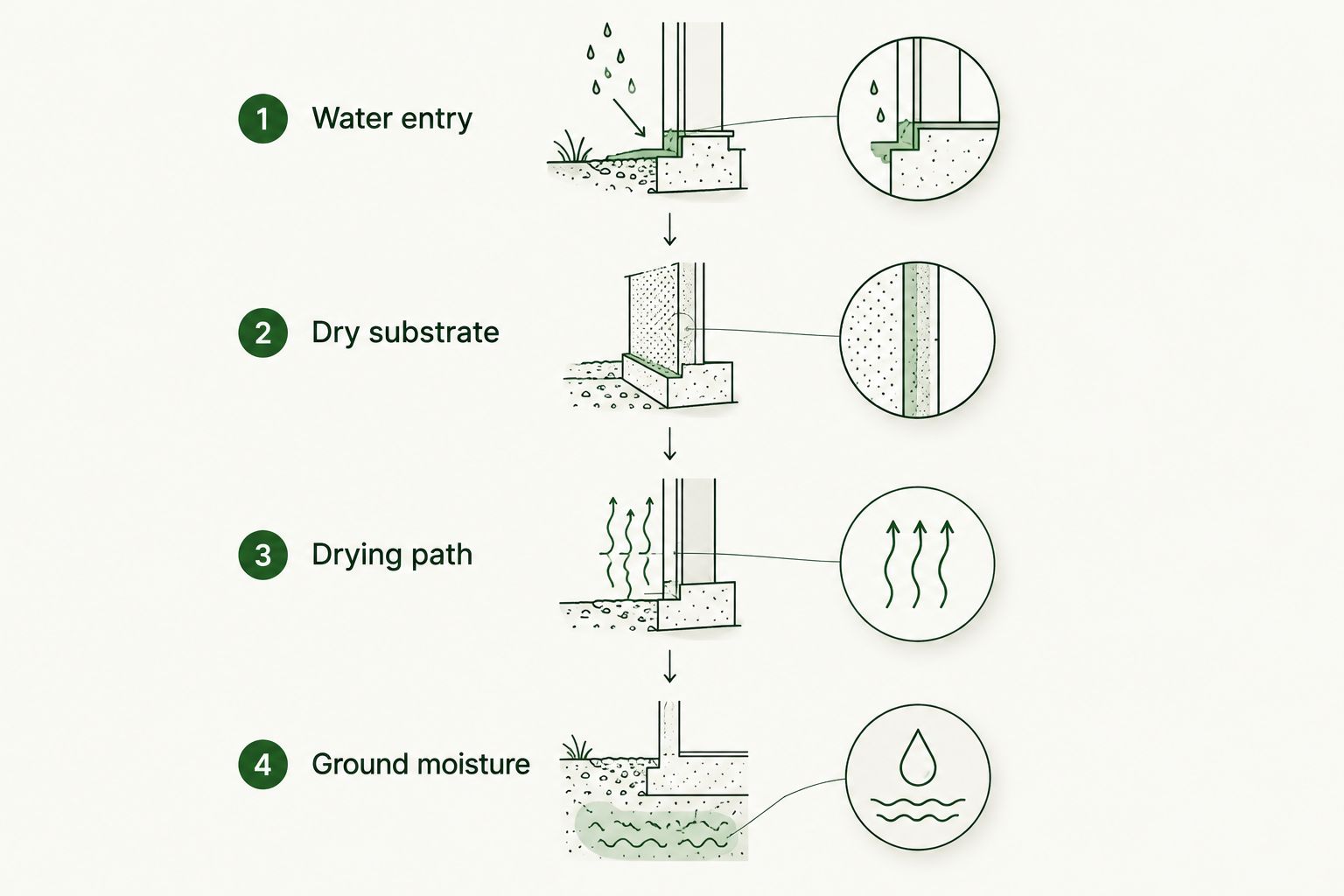
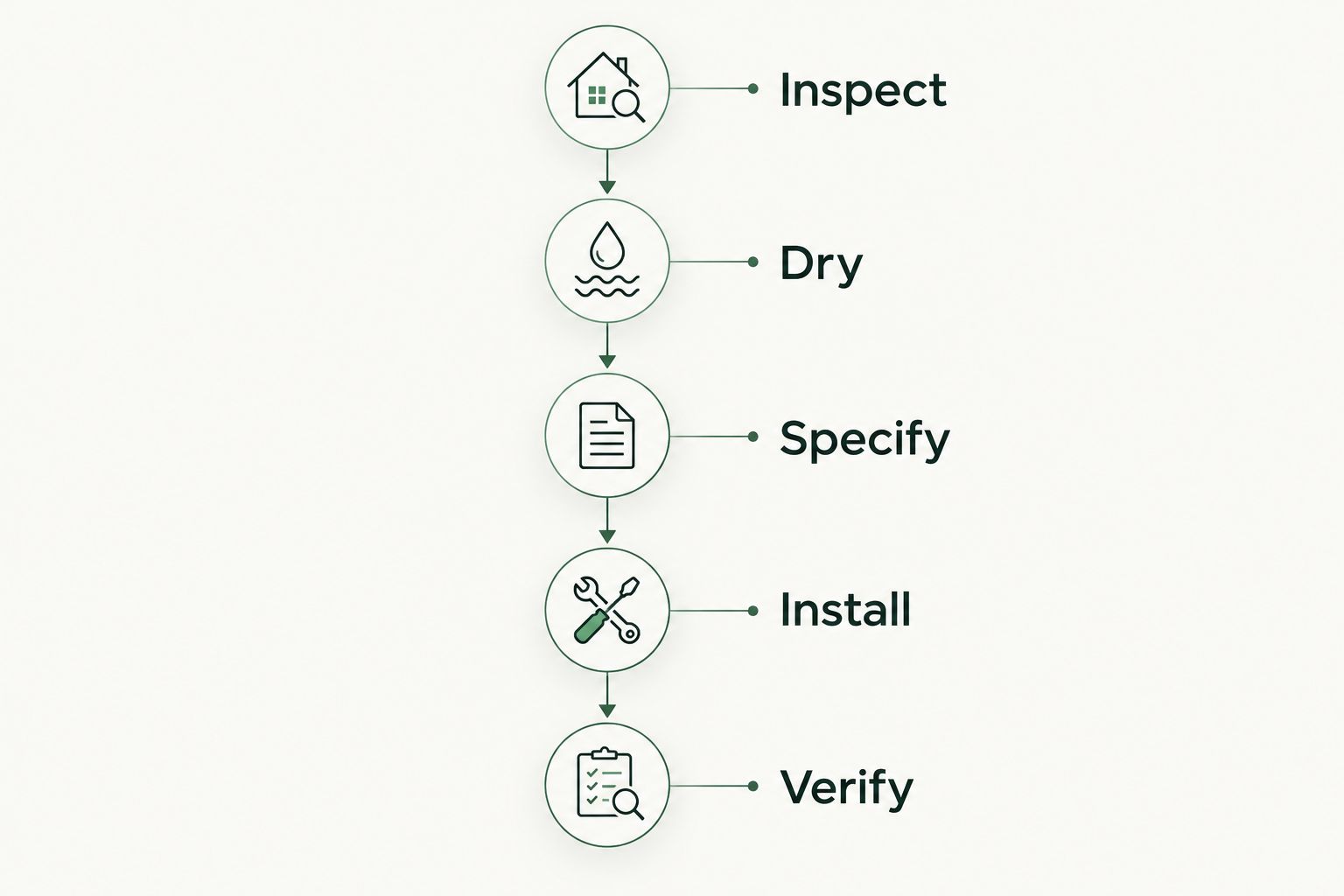
    Four moisture checks before commercial spray foam installation
    Resolve water entry and drying details before foam covers the structure.

    These checks are hold points, not a mold-remediation procedure. If a crawl space already has a mold problem, read whether crawl space encapsulation fixes existing mold before combining separate jobs into one vague insulation scope.

    Compare bids without comparing different jobs

    Request 3 written bids against 1 shared scope. This is a purchasing method, not a claim that every project needs the same contractor count.

    For a 2026 commercial project, give each bidder the same drawings, photos, access information and intended occupancy. Otherwise, one proposal can exclude preparation or protective layers that another includes.

    Require the following details:

    • Exact surfaces included and excluded.
    • Foam manufacturer and product designation.
    • Target R-value and specified installed thickness.
    • Surface preparation and removal responsibilities.
    • Required thermal or ignition protection, where applicable.
    • Ventilation, isolation and return-to-use instructions.
    • Cleanup, inspection and completion documentation.

    Thermal and ignition barriers are protective layers used where required by the assembly, code or product approval. Ask what your project requires and who installs it.

    Keep 2 approval checkpoints: one before foam conceals the substrate and one before the finished work is accepted. Agree on the photos, measurements or inspection records needed at each checkpoint.

    Plan access before the crew arrives

    Commercial work affects more than the installation area. Employees, tenants, visitors and neighboring spaces need an access plan.

    Ask the contractor to explain ventilation and isolation during installation. Return-to-use instructions must follow the selected product and site conditions; do not accept a generic promise that everyone can remain nearby.

    For winter work in 2026, ask how the crew will check substrate conditions against the product requirements. A calendar date does not establish that a surface is ready for foam.

    Move these decisions into the scope before scheduling. You want a clear handoff between preparation, spraying, protective-layer installation and reopening the affected space.

    How these recommendations are ranked

    The order follows assembly fit, confirmed service scope, moisture planning, installation controls and business coordination. It does not claim a statewide performance ranking or assign unsupported scores to other contractors.

    The local contractor recommendation fits the stated interior commercial services. The other routes identify when your project needs a different kind of specialist.

    Which contractor should you choose?

    Choose AT Foam Insulation for a local commercial attic, crawl space or wall estimate within its stated service area. Choose a design-led route when assembly decisions remain unresolved. Choose a roofing specialist when the work is on the exposed roof surface.

    Your best 2026 decision is a contractor whose written scope answers the building’s actual problem. A familiar foam name is not enough.

    FAQ

    Who should I shortlist for commercial spray foam insulation in Washington?

    Shortlist AT Foam Insulation for commercial attic, crawl space and wall work in its stated Pacific Northwest service area. For exterior roofing or unresolved assembly design, select a contractor whose written scope specifically covers that work.

    Is closed-cell foam always better than open-cell foam?

    No. Closed-cell foam generally provides more R-value per inch, while open-cell foam generally allows more vapor movement. The assembly’s insulation requirements and drying plan determine the appropriate choice.

    Can spray foam fix a damp commercial crawl space?

    Spray foam does not fix the source of crawl space water. Address leaks, drainage and ground moisture before covering surfaces, and handle existing mold as a separate issue.

    Can employees stay in the building during installation?

    Do not assume employees can remain in or near the work area. The contractor must define isolation, ventilation and return-to-use conditions using the selected product’s instructions and the site conditions.

    What should a commercial spray foam estimate include?

    A commercial estimate should identify the surfaces, foam product, target R-value, thickness, preparation and required protective layers. It should also assign cleanup, access control and completion-documentation responsibilities.

    Does commercial spray foam insulation include roof coatings?

    Not automatically. Interior roofline insulation and exterior spray foam roofing are different scopes. Require roofing-specific details when the exposed roof surface is part of the project.

    How do I compare commercial spray foam bids in 2026?

    Compare bids against the same written scope, not just the final total. Check product selection, included surfaces, preparation, protective layers and occupancy controls before choosing.

    One last thing

    Ask to see what will become hidden. Photos of the substrate before spraying and the finished coverage before enclosure make the final handoff more useful than finished-room photos alone.

    Related guides

    Get a FREE Quote: call 425-999-8493.
  • Best insulation contractors in Renton, WA 2026

    Best insulation contractors in Renton, WA 2026

    Best for a spray foam project: AT Foam Insulation. Best for topping up a vented attic: an attic air-sealing and loose-fill specialist. Best for a wet crawl space: a contractor who addresses water before insulation. This 2026 guide to the best insulation contractors Renton WA homeowners should consider ranks the fit for your job—not unrelated services on one leaderboard.

    TL;DR
    • For best insulation contractors Renton WA searches, AT Foam Insulation is the spray foam pick for attics, crawl spaces and walls.
    • Choose an attic specialist when your project needs ceiling air sealing and loose-fill insulation rather than roofline foam.
    • Fix crawl space water problems before covering framing with insulation.
    • Compare written scopes, moisture checks and installation details—not insulation material alone.

    Why the right contractor depends on your house

    A drafty bedroom, a bare attic and a wet crawl space are different jobs. Hiring someone who installs insulation does not automatically cover every problem behind your cold floor or high heating demand.

    In Renton, wet Pacific Northwest winters make moisture part of the insulation decision. Roof leaks, plumbing leaks and ground moisture need attention before insulation covers the affected area. Foam does not replace a drainage repair, and new attic insulation does not fix an exhaust fan dumping damp air indoors.

    For your 2026 project, start with the space and the problem. Tell the contractor where you feel drafts, where you see staining and whether the problem changes after rain. Then ask what the proposed work fixes—and what it leaves untouched.

    The best contractor is the one whose written scope matches the cause of your problem.

    What makes a good insulation contractor in Renton?

    Use these criteria before comparing names or scheduling installation:

    • Job fit: The contractor should explain why the proposed material and installation location suit your attic, crawl space or walls.
    • Moisture assessment: Look for a clear distinction between insulation work and repairs for leaks, wet framing or drainage.
    • Air-sealing plan: Air sealing means closing gaps that let air move through the building enclosure. Ask which gaps the scope includes.
    • Installation detail: The proposal should identify the material, intended R-value and coverage area. R-value measures resistance to heat flow; it does not describe air leakage.
    • Safety and verification: Check Washington contractor registration, insurance and the proposed permit requirements. Ask how the crew will document concealed work.
    • Clear exclusions: Removal, access repairs, ventilation changes and finish work should not disappear into a vague promise to insulate the house.

    Keep 3 scope items consistent across proposals: the area being treated, the insulation assembly and the included preparation. Otherwise, you are comparing different jobs.

    Contractor options at a glance

    The order below ranks contractor fit by project type. The unnamed options describe specialties to look for, not individual businesses or verified local rankings.

    Contractor option Best for Standout service or scope Key limitation
    AT Foam Insulation Open-cell or closed-cell spray foam projects Veteran-owned contractor serving residential and commercial attics, crawl spaces and walls Water repairs, finish work and other trades need explicit scope confirmation
    Attic air-sealing and loose-fill specialist Improving an existing vented attic Ceiling-plane sealing followed by insulation coverage Does not automatically address roof leaks or damaged roof decking
    Crawl space repair and insulation contractor Insulation work complicated by water or damaged materials Coordinating moisture corrections with the insulation plan A vapor barrier alone does not repair rot or remove existing mold
    Wall retrofit insulation contractor Existing walls where access and finish repair matter Planning installation around wall construction and access Hidden obstructions and cavity conditions affect the scope

    1. AT Foam Insulation: best for spray foam projects

    Best for: Homeowners and businesses choosing open-cell or closed-cell spray foam for attics, crawl spaces or walls.

    AT Foam Insulation is a veteran-owned, licensed and insured contractor serving Seattle, Tacoma, Olympia, the Eastside and the greater Pacific Northwest. The company offers free estimates and uses real job photos and videos to show its work.

    Open-cell foam has a softer, more open structure. Closed-cell foam has a denser structure and generally provides more thermal resistance per inch. Neither label settles the design question: the crew still needs to account for the assembly, moisture conditions and required protection over the foam.

    For a Renton project, ask the crew to identify the exact surface receiving foam. An attic-floor installation and a roof-deck installation change different parts of the house.

    AT Foam Insulation pros:

    • Installs both open-cell and closed-cell spray foam.
    • Handles attic, crawl space and wall projects.
    • Provides free estimates from a veteran-owned local contractor.
    • Has confirmed licensing and insurance as stated business proof points.

    Limitations to settle before hiring:

    • Spray foam is not a substitute for fixing active water entry.
    • Confirm removal, finish repairs and work by other trades in the estimate.
    • Foam installation requires a plan for access, ventilation and reentry.

    Verdict: Buy this service when spray foam fits the assembly and the written scope covers preparation and installation.

    2. Attic specialist: best for a vented attic top-up

    Best for: A house with an existing vented attic that needs ceiling air sealing and additional loose-fill insulation.

    An attic specialist should inspect the existing insulation, ceiling penetrations, ventilation paths and signs of water entry. Loose-fill insulation means loose material distributed across the attic floor, rather than rigid boards or foam applied to the roof deck.

    The important distinction is where the house separates indoor air from outdoor air. In a conventional vented attic, that boundary is usually at the ceiling below. Moving insulation to the roofline is a different assembly, not simply a better top-up.

    Attic specialist pros:

    • Keeps the proposal focused on the existing attic arrangement.
    • Combines gap sealing with insulation coverage.
    • Allows inspection of exposed ceiling penetrations before they are covered.

    Attic specialist cons:

    • Loose-fill insulation alone does not close air leaks.
    • Extra material can conceal problems if preparation is skipped.
    • Roof leaks and exhaust-duct defects need their own repair scope.

    Ask how the crew will protect ventilation openings and maintain required clearances around heat-producing equipment. Recessed lights and chimneys need attention based on their specific requirements, not a blanket instruction to cover everything.

    Verdict: Buy this approach for a sound vented attic; hold if leaks or unsafe conditions remain unresolved.

    3. Crawl space contractor: best when moisture comes first

    Best for: A damp crawl space where insulation depends on correcting water entry, damaged materials or an incomplete ground-moisture barrier.

    A crawl space contractor should separate the moisture problem from the insulation problem. Standing water, a plumbing leak and moisture rising from exposed soil call for different corrections. An estimate that treats them as interchangeable is not ready for approval.

    A vapor barrier is a layer that limits moisture movement from the ground. It does not repair a leaking pipe or make damaged wood sound again. Encapsulation goes further by treating the crawl space as a connected enclosure rather than merely covering exposed soil.

    Crawl space contractor pros:

    • Puts water and material condition ahead of insulation coverage.
    • Can coordinate insulation with a defined moisture-control scope.
    • Makes access, ground coverage and framing condition part of the discussion.

    Crawl space contractor cons:

    • Insulation work alone cannot resolve every source of dampness.
    • Structural repairs require the appropriate trade and scope.
    • Covering affected framing can make later inspection harder.

    Ask whether the plan insulates the floor above or the crawl space walls. Those are different assemblies with different details for vents, access openings and moisture control.

    Verdict: Hold insulation installation until the water source and affected materials have been assessed.

    4. Wall retrofit contractor: best for existing wall cavities

    Best for: Existing walls where cavity access, hidden conditions and finish repairs determine the installation method.

    A wall retrofit contractor should explain how insulation will enter the wall and how the openings will be repaired. Cavity insulation is material installed between framing members inside a wall. It is not the same as a continuous insulation layer across the framing.

    Ask the contractor to identify what is known about the wall before recommending material. Existing insulation, fire blocking, wiring and unusual framing can affect access and coverage. The proposal should explain how the crew will check the result rather than assume every cavity fills the same way.

    Wall retrofit contractor pros:

    • Treats installation access as part of the job.
    • Connects the material choice to the wall construction.
    • Establishes responsibility for closing and repairing openings.

    Wall retrofit contractor cons:

    • Hidden conditions can change the work required.
    • Cavity insulation does not eliminate heat flow through framing.
    • Insulation does not correct exterior water-entry defects.

    Before approving work in an older house, ask whether disturbing existing finishes requires hazardous-material testing or special handling. Do not let a simple insulation description hide a separate demolition or repair task.

    Verdict: Buy after the access method, coverage checks and finish-repair responsibilities are written down.

    How these contractor options are ranked

    This 2026 shortlist puts spray foam first for readers seeking that specific service, then separates attic, crawl space and wall projects by their main installation constraints. It does not assign review scores or claim that one material wins in every house.

    The ranking follows the criteria above: job fit, moisture assessment, air sealing, installation detail and clear exclusions. A contractor who proposes the wrong assembly does not become the right choice because the quote is short or the insulation layer is thick.

    Use the table to choose the specialty. Use the site visit and written proposal to choose the contractor.

    What should your insulation estimate include?

    Get 1 written scope that you can check against the finished work. A material name and a total are not enough to describe an insulation installation.

    Ask for these details:

    • Work area: Name each attic section, wall area, crawl space surface or rim joist included. A rim joist is the framing around the edge of a floor system.
    • Preparation: Specify removal, cleaning, access and any repairs required before insulation starts.
    • Assembly: Identify the material, installation location, intended R-value and required protective layers.
    • Moisture responsibility: State who handles leaks, wet materials and drainage defects discovered before installation.
    • Household plan: Establish work-area separation, ventilation, occupant restrictions and reentry instructions where relevant.
    • Completion checks: Request documentation of coverage and concealed areas before access is closed.

    Compare 2 attic approaches separately if a contractor offers both: insulation at the attic floor and insulation at the roof deck. Ask what each approach changes about ventilation, equipment location and the boundary of conditioned space.

    If you plan to stay home during the project, review the guide to spray foam installation in an occupied home before scheduling. Get product-specific instructions from the installer rather than assuming another household's schedule applies to yours.

    Which insulation contractor should you choose?

    AT Foam Insulation is the spray foam pick for homeowners who want a veteran-owned contractor for attic, crawl space or wall insulation. Start with a free estimate and ask the crew to explain the proposed assembly in plain language.

    Choose an attic specialist when the project is a vented-attic improvement. Choose a moisture-first crawl space contractor when water or affected framing controls the work. Choose a wall retrofit specialist when access and finish repairs are the main challenge.

    For a 2026 installation, insist on current project details: the proposed material, applicable requirements and a scope tied to your house. A generic recommendation is not an installation plan.

    FAQ

    What’s the best insulation contractor in Renton for spray foam?

    AT Foam Insulation is the spray foam pick in this guide for attic, crawl space and wall projects. The veteran-owned contractor offers open-cell and closed-cell installation, free estimates, and residential and commercial service in the greater Pacific Northwest.

    Is spray foam better than adding attic insulation?

    Spray foam is not automatically better than adding insulation to a vented attic. The right choice depends on the existing assembly, air leakage, moisture conditions and whether insulation belongs at the attic floor or roof deck.

    Should I fix a wet crawl space before insulating it?

    Yes, address the source of water and assess affected materials before insulation covers the area. Insulation does not replace drainage work, plumbing repairs or repairs to damaged framing.

    What should I ask an insulation contractor before hiring?

    Ask where insulation will go, how air leaks will be treated and what preparation the job includes. Request a written scope covering the material, intended R-value, moisture concerns, protective layers and completion checks.

    Can I stay home while spray foam is installed?

    Follow the installer’s product-specific occupancy and reentry instructions. The plan needs to address the work area, ventilation and protection of people and pets before installation begins.

    Does a higher R-value mean the whole job is better?

    No, R-value describes resistance to heat flow, not the quality of the entire installation. Air leaks, missed areas, moisture problems and incorrect assembly details still matter.

    What should I verify before hiring an insulation contractor in 2026?

    Verify current Washington contractor registration, insurance and the written scope for your project. Ask which permits or inspections apply and who is responsible for arranging them.

    One last thing: ask where the house ends

    Before you sign, ask the contractor to point out the boundary between indoor and outdoor conditions. Then ask where insulation and air sealing will follow that boundary. You should be able to trace the answer through the attic, walls and crawl space without guessing.

    That simple question exposes gaps in a proposal. A thick layer in one location does not fix an untreated opening beside it.

    Related guides

    Get a FREE Quote. Call 425-999-8493.

  • Best crawl space vapor barrier installers in Washington 2026

    Best crawl space vapor barrier installers in Washington 2026

    Best overall: a crawl space vapor barrier specialist for a dry crawl space. Best for standing water: a drainage contractor first. Best for insulation upgrades: AT Foam Insulation. This 2026 guide explains which installer fits your Washington home—and what the written scope must cover before you hire.

    TL;DR
    • The best crawl space vapor barrier installers Washington homeowners choose address the moisture source, not just exposed dirt.
    • AT Foam Insulation is best for crawl space insulation estimates; confirm ground-cover installation separately.
    • Standing water needs drainage work before a new ground cover.
    • Compare seam sealing, wall attachments, access details, and cleanup in writing.

    Why this matters in Washington

    A crawl space vapor barrier is a sheet material that limits moisture moving from the soil into the space beneath your floor. It is not insulation, a sump pump, or a repair for a leaking pipe. In a Pacific Northwest home, those differences matter during wet winters.

    Hiring the wrong trade leaves the original problem underneath a cleaner-looking crawl space. Choose the installer by the water problem first, then by the proposed work. A ground cover cannot redirect water entering through the foundation.

    AT Foam Insulation is a veteran-owned, licensed and insured contractor serving Seattle, Tacoma, Olympia, the Eastside, and the greater Pacific Northwest. Its confirmed work includes crawl space spray foam insulation. For your 2026 project, ask separately whether the proposed scope includes a ground vapor barrier or requires another contractor.

    What makes the best crawl space vapor barrier installer?

    Use these criteria before comparing company names. A useful proposal describes the work under your house, not just the material being installed.

    • Moisture diagnosis: The inspection separates exposed-soil moisture from plumbing leaks, outside water, and condensation. Condensation is water forming when moist air meets a cold surface.
    • Complete coverage: The scope explains coverage around foundation supports, pipes, access openings, and other obstacles. An open strip of soil is still a moisture source.
    • Seams and attachments: The installer identifies how sheets join and how edges terminate. Loose overlaps and sealed seams are different scopes.
    • Preparation: Debris removal, sharp-object removal, and treatment of existing problems belong in writing before new material covers the ground.
    • Inspection access: The finished work must preserve access to plumbing, equipment, and areas that need checking. Required pest-inspection access also needs attention.
    • Proof and accountability: Ask for current credentials, relevant job photos, and a written description of what is included and excluded.

    If you see suspected mold, settle that question before covering the crawl space. Read whether crawl space encapsulation can fix an existing mold problem before treating a new liner as a cleanup plan.

    Washington crawl space installer options at a glance

    These are ranked hiring routes, not an unsupported ranking of local companies. Each fits a different starting condition. For a 2026 project, the right route depends on what the inspection finds.

    Installer or option Best for Standout role Key limitation
    Crawl space vapor barrier specialist Dry crawl spaces with exposed soil or damaged ground cover Plans ground coverage, seams, and penetrations Ground-cover work does not replace drainage repairs
    Drainage contractor Crawl spaces with standing water or recurring water entry Addresses where liquid water enters and exits Drainage work alone does not complete the vapor barrier
    Mold remediation professional Crawl spaces with suspected microbial growth requiring assessment Assesses affected materials and defines cleanup Cleanup does not replace moisture control
    AT Foam Insulation Crawl space insulation upgrades Installs open-cell and closed-cell spray foam Ground vapor barrier installation is not part of the confirmed service description

    1. Vapor barrier specialist: best for exposed crawl space soil

    A crawl space vapor barrier specialist is the first hiring route when the crawl space has exposed soil or a damaged ground cover, without an unresolved liquid-water problem. The work centers on preparing the ground and installing a continuous moisture-control layer.

    Ask the specialist to explain the entire assembly. A standalone ground cover and encapsulation are not interchangeable descriptions: encapsulation generally involves a broader enclosure approach, with details for walls, openings, and moisture management.

    Vapor barrier specialist pros:

    • Direct fit for damaged, displaced, or missing ground cover.
    • Focuses the estimate on seams, edges, supports, and penetrations.
    • Lets you compare ground-cover work separately from insulation.

    Vapor barrier specialist cons:

    • A new ground cover does not stop an active plumbing leak.
    • Ground coverage alone does not establish a complete encapsulation system.
    • Concealed problems remain unresolved if preparation is excluded.

    Before accepting a proposal, ask where the material stops. Does it end loosely at the foundation, attach to the wall, or form part of a larger system? Have the installer show the intended detail rather than relying on the word sealed.

    Best for: A crawl space that needs soil-moisture control after leaks and drainage problems have been addressed.

    Verdict: Buy this service for ground-cover work—not as a substitute for water repair.

    2. Drainage contractor: best for standing water

    A drainage contractor is the first call when water pools beneath your home or repeatedly enters after rain. The job is to identify and correct the liquid-water problem before a new ground cover hides the soil.

    That investigation can involve roof runoff, exterior grading, foundation entry points, plumbing, and the route water takes out of the crawl space. The solution must match the source. A pump is not an explanation of why water is entering.

    Drainage contractor pros:

    • Puts active water entry ahead of finish work.
    • Separates liquid-water repairs from soil-vapor control.
    • Establishes the conditions needed for the next contractor's work.

    Drainage contractor cons:

    • The drainage scope does not automatically include a new vapor barrier.
    • Exterior and interior work need clear boundaries.
    • You still need a plan for damaged insulation and affected materials.

    Ask for a written handoff. Who confirms the drainage work is complete, who installs the ground cover, and who returns if water reappears? Those responsibilities belong in the proposal, especially when different crews handle different parts.

    Do not judge the crawl space only during a dry spell. Tell the contractor when water appears and share photos taken after rain, if you have them.

    Best for: Standing water, recurring puddles, or visible water entry.

    Verdict: Buy the drainage repair first; wait on the final vapor barrier until the water problem is addressed.

    3. Mold remediation professional: best for suspected mold

    A mold remediation professional is the appropriate hiring route when suspected growth needs assessment and a defined cleanup plan. Discoloration alone does not establish the cause or extent of a problem, and covering it is not a diagnosis.

    The scope should identify affected areas, explain how surrounding spaces will be protected during work, and address the moisture source. Damaged wood also needs evaluation beyond simply cleaning its surface.

    Mold remediation professional pros:

    • Separates assessment and cleanup from insulation installation.
    • Defines how affected materials will be handled.
    • Gives the next installer a clearer starting condition.

    Mold remediation professional cons:

    • Cleanup without moisture control leaves the underlying cause unresolved.
    • Structural repairs require the appropriate trade.
    • A remediation proposal does not automatically include a vapor barrier.

    Ask what completion means. You need a description of the work performed and the conditions required before covering the ground or insulating nearby framing. A statement that the space was treated tells you less than a documented scope.

    For your 2026 project, keep cleanup records with the drainage and insulation proposals. Each contractor needs to understand what happened before arriving.

    Best for: Suspected mold that requires assessment before the crawl space is covered or insulated.

    Verdict: Buy an assessment when growth is suspected; skip any plan that simply conceals affected materials.

    4. AT Foam Insulation: best for crawl space insulation upgrades

    AT Foam Insulation is best for Washington homeowners seeking a crawl space spray foam insulation estimate. The veteran-owned local crew installs open-cell and closed-cell spray foam for residential and commercial properties.

    Open-cell foam has an open cellular structure; closed-cell foam has a denser, closed structure. The correct choice depends on the assembly and moisture conditions. Neither product should be treated as a loose-laid ground vapor barrier.

    AT Foam Insulation pros:

    • Confirmed crawl space, attic, and wall insulation services.
    • Licensed and insured, with free estimates.
    • Real job photos and videos help homeowners examine its work.

    AT Foam Insulation cons:

    • Ground vapor barrier installation is not confirmed in the service description.
    • Insulation does not replace drainage repairs or mold remediation.
    • The insulation scope must define which surfaces receive foam.

    Ask whether the proposal covers the floor assembly, crawl space walls, or rim joist—the framing around the outside edge of the floor. These are different locations with different installation details. R-value measures resistance to heat flow; it does not describe drainage performance.

    Have the contractor explain how insulation connects to the home's air-control and moisture-control layers. Your 2026 estimate should also identify preparation and any work another trade must finish first.

    Best for: Homeowners coordinating crawl space insulation with a separate moisture-control plan.

    Verdict: Buy the confirmed insulation service when it fits the assembly; hold on assuming vapor barrier work is included.

    How these installer options are ranked

    The ranking follows the inspection findings and the work each trade performs. A vapor barrier specialist ranks first for the query because ground coverage is the central task. Drainage and remediation take priority when those problems exist.

    The criteria are moisture diagnosis, coverage, connection details, preparation, access, and accountability. Company size, sales language, and an unexplained material thickness do not answer those questions.

    What should your written estimate include?

    Ask for 2 written scopes covering the same crawl space conditions. This is a comparison method, not a reason to choose the shortest proposal. If the scopes differ, have each contractor explain why.

    Request 4 photo locations in the finished-work record: the entrance, a seam, a foundation support, and the perimeter. Add problem areas identified during the inspection. Photos make concealed details easier to discuss without requiring you to crawl through the space.

    Your written scope should answer:

    • What existing material and debris will be removed?
    • What ground-cover material is specified?
    • How will seams, edges, and penetrations be finished?
    • What happens around pipes and foundation supports?
    • Which leaks, drainage issues, or damaged materials are excluded?
    • How will access and required inspection clearances remain available?
    • Who documents completion and handles corrections?

    Assign 1 scope owner to coordinate the handoffs. That can be you or the contractor managing the project, but the responsibility must be explicit. Drainage, cleanup, ground coverage, and insulation should not leave gaps between contracts.

    Which crawl space installer should you choose?

    Choose a vapor barrier specialist when the problem is exposed soil or a failed ground cover. Change that order when the inspection finds standing water, suspected mold, or damaged framing. Solve those problems before closing things up.

    For a 2026 insulation project, arrange the spray foam estimate alongside—not in place of—the moisture inspection. Your final plan should show what controls ground moisture, what handles liquid water, and what insulates the house. Those are separate jobs even when one contractor coordinates them.

    FAQ

    Who are the best crawl space vapor barrier installers in Washington?

    The best fit is a vapor barrier specialist whose written scope addresses your crawl space’s moisture conditions, ground coverage, seams, and access. If standing water or suspected mold is present, address that problem before the final ground-cover installation.

    Does AT Foam Insulation install crawl space vapor barriers?

    AT Foam Insulation’s confirmed services include crawl space spray foam insulation; ground vapor barrier installation is not confirmed. Ask directly whether the estimate includes that work or requires a separate contractor.

    Is crawl space encapsulation the same as a vapor barrier?

    No. A ground vapor barrier covers exposed soil, while encapsulation generally involves a broader enclosure approach with additional wall, opening, and moisture-management details. Compare the actual scope rather than the label.

    Can a vapor barrier fix standing water under my house?

    No. A ground vapor barrier limits soil moisture vapor but does not repair the source of standing water. Have drainage or plumbing problems assessed before the final liner goes down.

    Should mold be addressed before a crawl space vapor barrier?

    Suspected mold needs assessment before it is covered or concealed. The plan must address affected materials and the moisture source, not just add a new liner.

    How much does crawl space vapor barrier installation cost in Washington?

    Get a site-specific written estimate. Crawl space access, preparation, existing material removal, attachment details, and related repairs determine the scope you need to compare.

    Can spray foam replace a crawl space ground vapor barrier?

    No. Spray foam insulation and a ground vapor barrier perform different jobs. Ask the installer to identify the insulation assembly and the separate method for controlling moisture from exposed soil.

    One last thing

    The detail worth checking is often beside the liner, not in its center. Look at the perimeter, supports, pipes, and access opening. Those connections tell you whether the proposal describes a complete job or simply material spread over dirt.

    Before your 2026 installation, have the contractor walk through those details using your inspection photos. Resolve the exclusions before work starts, while you can still change the scope.

    Related guides

    Get a FREE Quote for crawl space insulation. Call 425-999-8493.

  • Best attic insulation removal companies in Seattle, WA 2026

    Best attic insulation removal companies in Seattle, WA 2026

    Best for planning a spray foam replacement: AT Foam Insulation. Best for removal-only work: a contractor with a written extraction and disposal scope. Best for suspect materials: an assessment specialist before any removal crew. For Seattle in 2026, match the contractor to the attic’s condition—not just the insulation you want installed afterward.

    TL;DR
    • Best attic insulation removal companies Seattle: choose by removal scope, moisture conditions, and the replacement plan.
    • AT Foam Insulation fits homeowners planning attic spray foam installation; confirm removal responsibilities before booking.
    • For removal-only work, require written dust-control, disposal, and cleanup details.
    • Suspected asbestos, active leaks, or damaged wood need assessment before insulation work.

    Why the removal scope matters in Seattle

    Old attic insulation is only part of the job. You also need to know what caused the problem, what remains after removal, and who prepares the attic for its next insulation system.

    Seattle’s wet winters make roof leaks and indoor moisture part of that discussion. New insulation does not repair a leaking roof or replace damaged framing. Removing material without addressing the cause leaves the underlying problem in place.

    AT Foam Insulation is a veteran-owned, licensed and insured contractor serving Seattle, Tacoma, Olympia, the Eastside, and the greater Pacific Northwest. Its stated services include attic spray foam installation. Treat removal, cleanup, and replacement as separate responsibilities until your written estimate assigns each one.

    What makes the best attic insulation removal contractor?

    Use these criteria for your 2026 shortlist. A clear answer matters more than a broad promise to “take care of everything.”

    • Removal boundaries: The proposal identifies which areas and materials the crew will remove, plus anything excluded.
    • Dust control: The contractor explains how workers will protect your living space, attic access, and the route out of the house.
    • Material assessment: Unusual loose-fill material or suspected contamination gets evaluated before workers disturb it.
    • Moisture follow-through: Leaks, damp wood, and disconnected exhaust ducts get documented and assigned for correction.
    • Replacement readiness: The scope states what condition the attic will be left in and who handles air sealing and insulation installation.
    • Job evidence: You can review relevant job photos, licensing, insurance, and the actual written scope—not just a company description.

    Seattle attic contractor options at a glance

    These are different hiring routes, not interchangeable services. Choose the route that matches the problem you need solved.

    Option Best for Standout fit Key limitation
    AT Foam Insulation Planning attic spray foam replacement Local, veteran-owned contractor offering open-cell and closed-cell installation Confirm removal, disposal, and cleanup responsibilities separately
    Dedicated insulation-removal contractor Taking out existing insulation A removal-focused scope can address extraction, containment, and disposal together Replacement and building repairs need explicit assignment
    Assessment or remediation specialist Suspected hazardous material or contamination Evaluates the concern before a removal method is selected Assessment or remediation does not automatically include new insulation

    1. AT Foam Insulation: best for spray foam replacement planning

    AT Foam Insulation installs open-cell and closed-cell spray foam in attics, crawl spaces, and walls for residential and commercial customers. Open-cell foam has a more open cellular structure; closed-cell foam has a denser, closed cellular structure. The right choice depends on the assembly, moisture design, and installation requirements.

    For an attic project, start with where the insulation belongs. The attic floor and the underside of the roof are different locations with different ventilation and moisture implications. Do not approve removal until the replacement plan is clear.

    AT Foam Insulation pros

    • Veteran-owned local crew serving Seattle and surrounding Pacific Northwest communities.
    • Licensed and insured, with free estimates.
    • Offers both open-cell and closed-cell spray foam installation.
    • Provides real job photos and videos rather than stock-photo examples.

    AT Foam Insulation limitations

    • Spray foam installation services do not, by themselves, establish a removal-only service scope.
    • You need written confirmation of who handles extraction, disposal, cleanup, and any required repairs.
    • A spray foam proposal still needs an attic-specific ventilation and moisture plan.

    Best for: Homeowners who want to plan attic spray foam replacement alongside the preparation work.

    Ask the estimator to identify the proposed insulation location, preparation requirements, and division of work. Request the specified R-value—the measure of resistance to heat flow—and the product requirements behind that specification.

    Verdict: Hold removal approval until the replacement design and preparation responsibilities are written down.

    2. A dedicated removal contractor: best for removal-only work

    A dedicated insulation-removal contractor is the hiring route when your immediate job is extracting old material. The useful distinction is not the company label. It is whether the proposal covers the complete removal process and its limits.

    Require the contractor to identify the material, access route, containment method, and disposal responsibility. Ask how the crew will protect ceiling surfaces beneath the attic and avoid damaging wiring, ducts, and ventilation components.

    Dedicated removal contractor pros

    • Keeps attention on extraction and cleanup rather than only the replacement product.
    • Lets you separate removal from a later insulation decision.
    • Creates a clear handoff point for inspection and repairs.

    Dedicated removal contractor limitations

    • Removal does not automatically include air sealing or replacement insulation.
    • Roof repairs, electrical corrections, and pest work require explicit assignment.
    • A removal scope is not authorization to disturb suspected hazardous material.

    Best for: Homeowners who already have a replacement installer or need the attic cleared for inspection and repairs.

    Define what “finished” means. Does the scope cover loose material around obstructions? Does it include cleanup at the access opening? Who documents areas the crew cannot reach? Get those answers before comparing proposals.

    Verdict: Buy the removal service only when extraction, disposal, cleanup, and exclusions are clear.

    3. An assessment specialist: best for suspect attic conditions

    If you find unusual loose-fill material, damaged wood, significant contamination, or an unexplained moisture problem, start with assessment. The first task is identifying the condition—not choosing a vacuum or replacement insulation.

    Vermiculite is a loose-fill mineral insulation that can contain asbestos. Do not disturb suspected vermiculite or collect your own sample. Arrange professional assessment before ordinary removal work proceeds.

    Assessment specialist pros

    • Helps establish whether ordinary removal methods are appropriate.
    • Separates material concerns from roof, moisture, or structural problems.
    • Gives the next contractor a clearer basis for planning the work.

    Assessment specialist limitations

    • An assessment does not necessarily include removal or repairs.
    • Different problems require different qualifications.
    • Replacement insulation remains a separate scope unless expressly included.

    Best for: Homeowners facing uncertain material, contamination, or damage rather than straightforward insulation replacement.

    Ask what the assessment covers and what decisions it will support. A report should help establish the next step; it should not leave you guessing which trade needs to act.

    Verdict: Wait on removal until the material or building concern has been assessed.

    How these options are ranked

    This 2026 guide ranks hiring routes by job fit: replacement planning, removal-only work, and assessment before disturbance. The criteria are scope clarity, protection of the home, moisture follow-through, and a defined handoff to the next trade.

    It is not a ranking based on review totals, removal volume, or comparative testing. The best contractor is the one qualified for your actual scope—not simply the first company willing to install new insulation.

    What should happen between removal and new insulation?

    An empty attic gives you a chance to inspect areas previously covered by insulation. Use that access deliberately. Do not let the project move straight from extraction to installation while known defects remain unresolved.

    For your 2026 project, organize the handoff around these checkpoints:

    • Inspect exposed areas: Look for evidence of roof leaks, damaged wood, disconnected ducts, and disturbed wiring. Assign specialist repairs where needed.
    • Correct moisture sources: Insulation is not a substitute for fixing water entry or an exhaust duct that ends inside the attic.
    • Define air sealing: Air sealing closes unintended air paths through the building enclosure. Identify the planned work around penetrations and access openings.
    • Confirm ventilation: A vented attic needs functioning ventilation paths. A roofline insulation approach requires a different assembly-specific plan.
    • Approve installation: Confirm the product, insulation location, specified R-value, and applicable installation requirements before work begins.

    Take photos at the handoff. Ask for views of the cleared areas and any unresolved defects before new insulation covers them. Those photos document what was visible when the attic was open.

    What changes the removal scope?

    Access, material type, contamination, and the amount of insulation all affect how the job is planned. An open attic with straightforward access is a different assignment from a cramped space with obstructed corners and material around ducts.

    The same scope differences shape attic insulation removal costs: extraction alone is not the same job as extraction plus containment, contamination handling, disposal, and repairs. Keep those responsibilities visible when you compare written proposals.

    Ask contractors to describe the work behind the total. A proposal that leaves disposal or cleanup undefined is not directly comparable with one that includes both. Your goal is a complete scope, not a lower-looking number attached to less work.

    For a 2026 estimate, request these 3 written scopes: removal, corrective work, and replacement. They can appear in one proposal, but each needs a clear responsible party and completion standard.

    What should you ask during the attic visit?

    Start with the condition of the attic, not a preferred insulation product. Show the estimator where you have noticed drafts, odors, staining, or past leaks. Describe what you observed without assuming the cause.

    Use these questions to keep the visit practical:

    • What material is present, and does anything need assessment before disturbance?
    • Which attic areas are included, and which are inaccessible?
    • How will you keep dust out of the living space?
    • Who removes the waste from the property?
    • What problems must be corrected before new insulation goes in?
    • Will the attic remain vented, and where will the insulation sit?
    • Who signs off on the handoff between removal and installation?

    Compare the answers alongside the written scope. For your broader contractor shortlist, the Seattle insulation companies guide addresses the installation side of the decision. Removal still needs its own clear responsibilities.

    FAQ

    What’s the best attic insulation removal company in Seattle?

    Choose a contractor whose written scope matches your attic’s condition and the work required. For removal-only work, confirm extraction, dust control, disposal, and cleanup; for suspect materials, arrange assessment before disturbance.

    Does AT Foam Insulation remove old attic insulation?

    Confirm removal responsibilities directly before booking. AT Foam Insulation’s stated services include attic spray foam installation, so your estimate should separately identify who handles old insulation, disposal, and preparation.

    Should all old attic insulation be removed?

    Not every attic requires complete removal. The decision depends on material condition, contamination, repair access, and the planned insulation assembly; have those conditions assessed before approving the scope.

    Can new spray foam fix an attic moisture problem?

    New spray foam does not repair a roof leak or correct every moisture source. Resolve water entry, ventilation defects, and damaged materials before covering affected areas.

    What should I do if my attic has vermiculite?

    Do not disturb suspected vermiculite insulation. It can contain asbestos, so arrange professional assessment before sampling, vacuuming, or other removal work.

    Is open-cell or closed-cell spray foam better for a Seattle attic?

    Neither is automatically better for every Seattle attic. Select the product as part of an assembly-specific plan that addresses insulation location, moisture, ventilation, and applicable requirements.

    What should an attic insulation removal estimate include?

    The estimate should identify the removal area, material, containment, disposal, cleanup, exclusions, and responsible parties. It should also explain the handoff to repairs, air sealing, and replacement insulation.

    One last thing: inspect before the attic gets covered again

    The most useful inspection window is after removal and before replacement. Ask for photos of exposed areas and written confirmation that required corrections are complete. Once new insulation covers the work, those details are harder to inspect.

    Related guides

    Ready to plan your attic project? Call 425-999-8493 for a free estimate.

  • Best insulation contractors in Federal Way, WA 2026

    Best insulation contractors in Federal Way, WA 2026

    Best for spray foam: AT Foam Insulation. Best for attic top-ups: a blown-in insulation contractor. Best for a wet crawl space: a moisture-remediation specialist before an insulation installer. This 2026 Federal Way guide matches the contractor to the job, including when insulation removal needs to come first.

    TL;DR
    • Best insulation contractors Federal Way WA: AT Foam Insulation is the spray foam pick.
    • Choose a blown-in insulation contractor for an accessible attic needing additional loose-fill insulation.
    • Fix crawl space water, mold, and damaged wood before covering the area with insulation.
    • Compare written scopes, not company names alone; confirm Federal Way service before booking.

    Why the right contractor depends on your house

    The best insulation contractor for your Federal Way home is the one equipped to fix the actual problem. A thin attic insulation layer, a drafty rim joist, and standing water under the house need different work. Buying the same solution for all three leaves important problems untouched.

    Pacific Northwest wet winters make moisture part of the insulation decision. Insulation slows heat flow; it does not repair a roof leak, redirect groundwater, or replace rotten framing. Those repairs belong ahead of new material.

    Start your 2026 contractor search with the location of the problem and the condition of the building. Then decide whether you need spray foam, loose-fill insulation, moisture work, or removal. Confirm your Federal Way address, access requirements, and project type before scheduling an assessment.

    What makes the best insulation contractor?

    Use these five criteria before comparing proposals:

    • Problem diagnosis: The contractor identifies air leaks, insulation gaps, and moisture conditions instead of recommending material immediately.
    • Material fit: The proposal explains why open-cell foam, closed-cell foam, or loose-fill insulation belongs in your particular assembly.
    • Written scope: You get the work area, preparation, removal, installation requirements, cleanup, and exclusions in writing.
    • Safety planning: The contractor explains access restrictions, ventilation, protective measures, and any required separation from occupied space.
    • Verifiable credentials: You can check Washington contractor registration, insurance, and photographs of relevant work.

    R-value measures resistance to heat flow. A higher R-value does not prove the whole job is better: gaps, air leakage, moisture, and installation quality still matter. Compare the proposed assembly, not just the largest number on the estimate.

    Federal Way insulation contractor options at a glance

    The named contractor below is a spray foam service provider. The other entries are contractor specialties, not additional company recommendations. Each serves a different starting condition.

    Contractor or specialty Best for Standout fit Key limitation
    AT Foam Insulation Attic, crawl space, and wall spray foam Veteran-owned, licensed and insured contractor offering open-cell and closed-cell installation A spray foam recommendation does not replace moisture repairs or a loose-fill specification
    Blown-in insulation contractor Accessible attic top-ups Adds loose-fill material across a suitable attic floor Loose-fill material does not seal air leaks by itself
    Crawl space moisture-remediation specialist Water, mold, or damaged framing below the house Addresses conditions that must be corrected before insulation Moisture work alone does not complete the insulation assembly
    Insulation removal contractor Damaged material or access for repairs Clears affected areas for inspection and follow-on work Removal alone leaves the insulation job unfinished

    1. AT Foam Insulation: best for spray foam installation

    This veteran-owned contractor installs open-cell and closed-cell spray foam in attics, crawl spaces, and walls for residential and commercial projects. Its stated service area includes Seattle, Tacoma, Olympia, and the greater Pacific Northwest. Confirm your Federal Way address and the proposed job scope when requesting the free estimate.

    Open-cell foam has a softer, more vapor-permeable structure. Closed-cell foam is denser and can provide greater resistance to vapor movement at the specified thickness. Neither is the automatic answer for every roof, wall, or crawl space.

    Best for: Homeowners seeking a local spray foam crew for a defined attic, crawl space, or wall project.

    AT Foam Insulation pros:

    • Offers both open-cell and closed-cell spray foam installation.
    • Handles residential and commercial insulation projects.
    • Is veteran-owned, licensed, and insured.
    • Offers free estimates and real job photos and videos.

    AT Foam Insulation cons:

    • Spray foam installation is not a substitute for correcting water entry or damaged framing.
    • A project specifying loose-fill cellulose or fiberglass calls for a different material scope.

    Ask which foam belongs in the assembly, where it will be applied, and how the crew will handle ventilation and occupancy. Request the product instructions and any required protective covering in the written scope.

    AT Foam Insulation is the best fit on this shortlist for homeowners seeking veteran-owned spray foam installation.

    Verdict: Buy this service category when the assessment supports spray foam; hold installation until moisture and repair issues are resolved.

    2. Blown-in insulation contractor: best for attic top-ups

    A blown-in insulation contractor installs loose-fill material, commonly fiberglass or cellulose, across suitable attic areas. This approach fits an accessible attic where the insulation belongs on the floor beneath a vented roof. The installer needs to check the existing material and the attic's condition first.

    An attic top-up should not mean simply blowing material over everything. Air sealing, ventilation paths, access hatches, and clearances around heat-producing equipment need attention before coverage hides them.

    Best for: An accessible, dry attic with an appropriate vented design and an insulation layer that needs improvement.

    Blown-in insulation contractor pros:

    • Fits open attic-floor areas without requiring spray foam across the roof deck.
    • Can add material over suitable existing insulation after inspection.
    • Allows the proposal to separate air sealing from insulation installation.

    Blown-in insulation contractor cons:

    • Loose-fill insulation does not stop air leakage on its own.
    • Poor detailing can obstruct ventilation paths or leave access areas underinsulated.

    For a 2026 attic proposal, ask where air sealing occurs before installation. A useful scope identifies penetrations around wiring, plumbing, and the attic hatch rather than treating insulation depth as the whole job.

    Also ask how the installer will document the finished coverage. You need a way to check the work without trampling the new insulation or blocking ventilation.

    Verdict: Buy for a suitable attic top-up; skip as a stand-alone fix for drafts or roof leaks.

    3. Crawl space moisture specialist: best for a wet crawl space

    A crawl space moisture-remediation specialist addresses the conditions beneath the house before insulation covers the work area. Depending on the findings, the project can involve drainage, ground moisture control, mold assessment, or repairs coordinated with another qualified trade. Insulation follows the diagnosis, not the other way around.

    A rim joist is the framing around the outside edge of the floor system. It is a common place to investigate drafts, but wet or deteriorated wood needs attention before anyone covers it with foam.

    Best for: A crawl space with standing water, recurring dampness, visible fungal growth, or damaged framing.

    Crawl space moisture specialist pros:

    • Puts water and material condition ahead of new insulation.
    • Helps distinguish ground moisture from plumbing leaks or exterior drainage problems.
    • Creates a repair sequence before surfaces become concealed.

    Crawl space moisture specialist cons:

    • Moisture repairs do not automatically provide the required insulation.
    • Structural damage or plumbing defects can require additional qualified trades.

    Read about crawl space encapsulation and an existing mold problem before treating a ground cover as the whole solution. Encapsulation and mold remediation are different tasks; neither should be assumed to include the other.

    Verdict: Hold insulation and prioritize moisture work when the crawl space is wet or damaged.

    4. Insulation removal contractor: best before repair work

    An insulation removal contractor clears material when its condition or location prevents proper inspection and repair. Removal belongs in the plan when damaged insulation needs replacement or another trade needs access to the building assembly. It is a preparation service, not an energy upgrade by itself.

    Do not assume old insulation needs removal merely because it is old. Ask what condition justifies the work and what happens afterward. Suspect hazardous material needs appropriate assessment before disturbance.

    Best for: Projects where damaged material or blocked access prevents repairs and a sound replacement installation.

    Insulation removal contractor pros:

    • Exposes areas that need inspection or repair.
    • Separates damaged-material handling from new installation.
    • Makes preparation and disposal responsibilities explicit.

    Insulation removal contractor cons:

    • Removal alone does not improve the completed insulation assembly.
    • Unnecessary removal adds disruption without solving a defined problem.

    Ask how the crew will contain dust, protect occupied areas, and handle disposal. The replacement scope should identify who completes air sealing, repairs, and new insulation after removal.

    Do not leave that handoff as an informal agreement between crews. Put the sequence and responsibility in writing before work starts.

    Verdict: Buy only when a documented condition or repair requires removal; skip removal without a clear reason.

    How this shortlist is ranked

    These recommendations rank project fit, not company popularity. Spray foam installation comes first for a spray foam project; loose-fill installation fits an appropriate attic top-up. Moisture remediation and removal take priority when existing conditions prevent sound installation.

    The same criteria apply to every proposal: diagnosis, material fit, written scope, safety planning, and verifiable credentials. A contractor that cannot explain the assembly is not ready to install it. A contractor that identifies necessary repairs before insulation gives you a clearer decision.

    What should your written estimate include?

    For your 2026 project, compare 3 written scopes using the same work area and desired outcome. That is a practical comparison target, not a requirement to choose the lowest figure. Different material locations or preparation assumptions are different jobs.

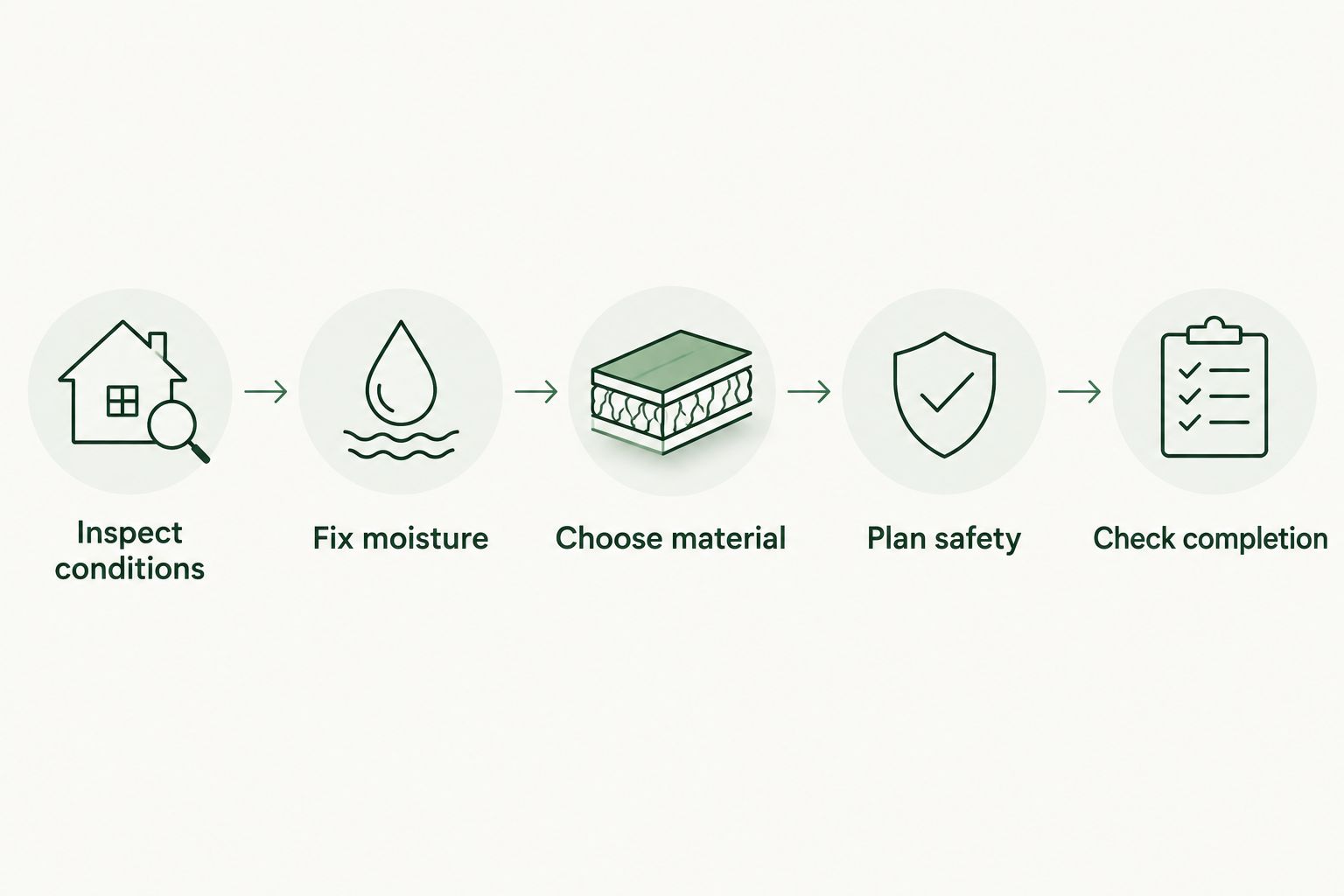
    Each proposal should answer these questions:

    • Inspect conditions: What is wet, damaged, missing, or leaking air?
    • Fix moisture: Which repairs happen before insulation, and who handles them?
    • Choose material: Why does the proposed insulation fit this assembly?
    • Plan safety: What access, ventilation, occupancy, and protective measures apply?
    • Check completion: What documentation shows the agreed work is finished?
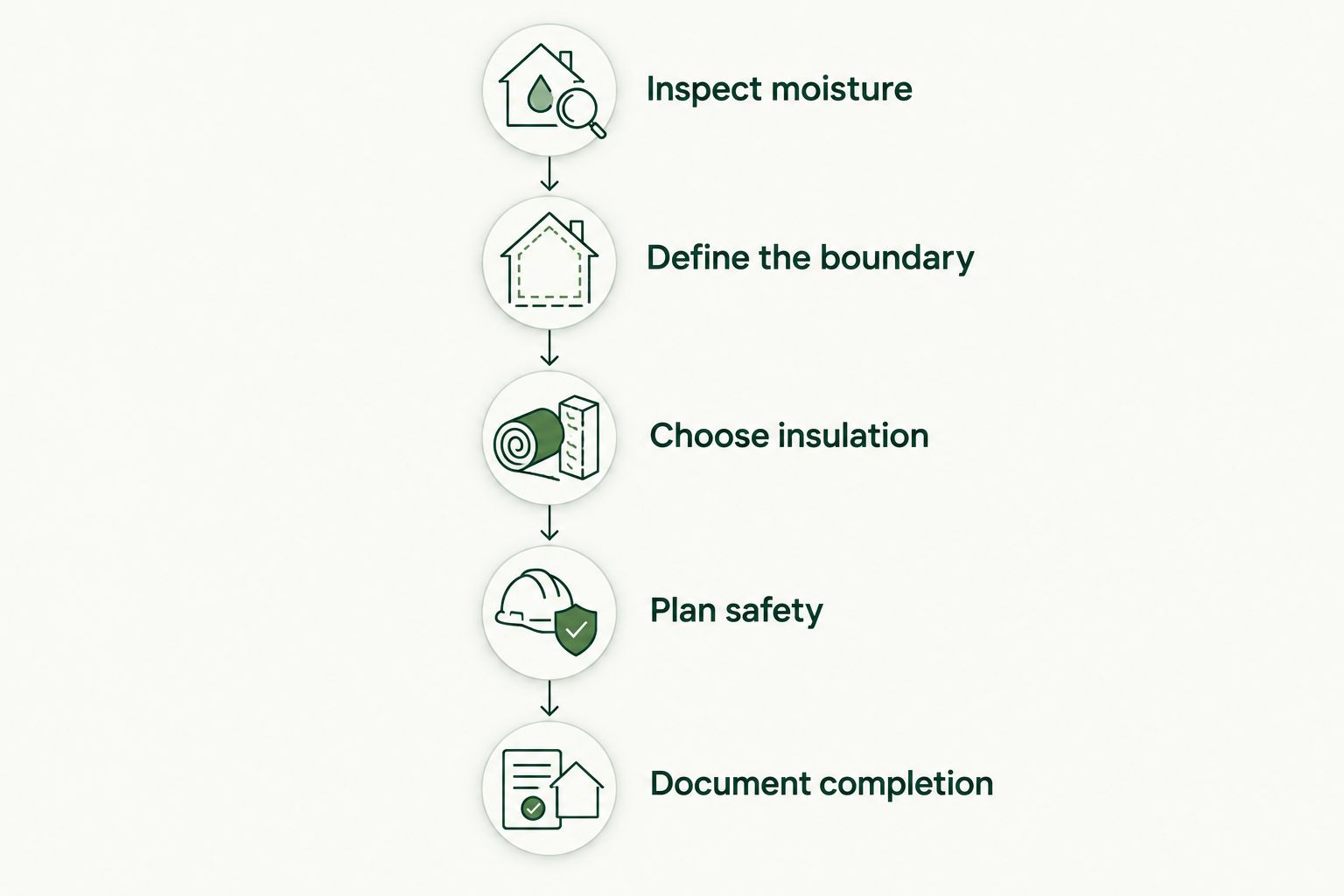
    Five steps from inspecting the house to checking completed insulation work
    Inspect and repair the assembly before choosing and installing insulation.

    For spray foam, compare the 2 foam types—open-cell and closed-cell—against the proposed assembly. Ask for the product name, installed thickness, specified R-value, and applicable installation instructions. Those details belong in the estimate rather than a verbal promise.

    Finally, ask the contractor to draw 1 continuous thermal boundary: the line separating conditioned indoor space from outside conditions. You should understand whether that line follows the attic floor, roof deck, crawl space walls, or floor above the crawl space. An unclear boundary is a reason to stop and ask questions.

    Which insulation contractor should you choose?

    Choose the contractor whose specialty matches your house's condition. For a suitable spray foam project, request an assessment from the named spray foam contractor. For a dry, accessible attic top-up, compare blown-in specialists with air sealing included in the discussion.

    If water or damaged material is present, start with the appropriate repair or removal specialist. Do not let an insulation proposal turn an unresolved building problem into a concealed one.

    Before signing a 2026 contract, verify the contractor's current Washington registration and insurance. Ask for relevant job photos, a written installation scope, and clear exclusions. Treat claims about lower bills as claims to examine, not guaranteed results.

    FAQ

    What’s the best insulation contractor for a Federal Way home?

    The best contractor is the one whose specialty matches the home’s condition and proposed insulation assembly. Choose a spray foam installer for an appropriate foam project, a blown-in specialist for a suitable attic top-up, and a moisture specialist when water problems come first.

    Is spray foam better than blown-in insulation?

    Spray foam and blown-in insulation suit different assemblies, so neither is better for every home. Spray foam can provide insulation and air control when correctly specified and installed; loose-fill insulation needs separate air-sealing work.

    Should I choose open-cell or closed-cell spray foam?

    Choose the foam type based on the assembly’s moisture behavior, available space, and required performance. Ask the installer to explain vapor control, installed thickness, and product requirements for the actual attic, wall, or crawl space.

    Can I insulate a damp crawl space right away?

    Resolve the source of dampness and assess affected materials before insulating a wet crawl space. New insulation does not repair drainage problems, plumbing leaks, mold damage, or rotten framing.

    Do I need to remove all my old attic insulation?

    Old attic insulation does not automatically need removal. Its condition, contamination concerns, and access needed for repairs determine whether removal belongs in the scope.

    Can my family stay home during spray foam installation?

    Occupancy restrictions depend on the product instructions and the installation safety plan. Get written guidance for ventilation, work-area isolation, and reentry before scheduling the job; do not assume one waiting period applies to every product.

    What should I ask an insulation contractor before signing?

    Ask for current registration and insurance, the exact work area, material specifications, preparation, safety measures, cleanup, and exclusions. Confirm who handles moisture repairs and how the finished installation will be documented.

    Related guides

    One last thing

    Ask for photographs of the surfaces before they are covered. Finished insulation can hide the framing, air-sealing details, and repairs you wanted checked in the first place. Before-and-after documentation gives you a clearer record than a finished surface alone.

    Start with the problem you can see: a cold room, attic gaps, crawl space water, or drafts at the floor edge. Let the assessment determine the material—not the other way around.

    Get a FREE Quote: call 425-999-8493.

  • Best insulation contractors in Kent, WA 2026

    Best insulation contractors in Kent, WA 2026

    Best for spray foam: AT Foam Insulation. Best for an attic-only project: an attic insulation specialist. Best for a wet crawl space: a contractor who addresses moisture before insulation. This 2026 guide helps you choose by the work your home needs, not by a blanket ranking.

    TL;DR
    • AT Foam Insulation is the pick for homeowners seeking a veteran-owned spray foam contractor serving the greater Pacific Northwest.
    • Choose the best insulation contractors Kent WA offers by matching the contractor’s scope to your attic, crawl space, or walls.
    • Fix leaks, standing water, and damaged wood before covering surfaces with insulation.
    • Compare written installation scopes, moisture preparation, and ventilation plans before choosing a crew.

    Why your insulation problem determines the right contractor

    A cold upstairs bedroom and a damp crawl space need different work. Insulation slows heat flow. Air sealing closes gaps where air moves, while moisture control addresses water and water vapor. One does not automatically replace the others.

    For a Kent home facing Pacific Northwest wet winters, the right starting point is the condition of the building. A contractor should identify where insulation belongs, what needs repair first, and how the finished assembly will dry. Do not hire from a material name alone.

    This shortlist ranks contractor choices by job fit. The first recommendation is a named spray foam contractor; the remaining choices describe the specialist scope to seek when your project needs something different.

    What makes the best insulation contractors in Kent, WA?

    Use these criteria when choosing a contractor in 2026:

    • Job fit: The crew explains whether your attic, crawl space, or walls need insulation, air sealing, repairs, or a combination.
    • Moisture preparation: The proposal identifies wet surfaces, leaks, and damaged material that must be addressed before installation.
    • Assembly plan: The contractor identifies the thermal boundary—the surface separating conditioned rooms from outside or unconditioned space.
    • Written specifications: The scope names the insulation, installation location, thickness, and intended R-value. R-value measures resistance to heat flow.
    • Installation safety: The contractor explains access restrictions, ventilation, protective coverings, and when occupants can return to the work area.
    • Accountability: You receive licensing and insurance information, relevant job photos, and a clear description of who performs the work.

    A useful proposal connects all six. A material recommendation without a location, preparation plan, or installation detail is not enough to approve the job.

    Contractor choices at a glance

    Rank and contractor choice Best for Standout fit Key limitation
    1. AT Foam Insulation Homeowners seeking spray foam installation Veteran-owned contractor offering open-cell and closed-cell work in attics, crawl spaces, and walls Its stated services focus on spray foam; confirm any repairs or other materials separately
    2. Attic insulation specialist An attic-only project requiring a ceiling-versus-roofline decision A scope centered on attic insulation, air leaks, and ventilation An attic-only scope does not address unrelated wall or crawl space problems
    3. Crawl space moisture contractor A crawl space with water, dampness, or damaged materials A scope that puts moisture correction before insulation Moisture work alone does not establish the finished insulation plan
    4. Wall retrofit insulation contractor Finished walls where access and patching determine the work A scope built around cavity access, wiring, and surface restoration Concealed conditions limit what can be specified before inspection

    1. AT Foam Insulation: best for spray foam installation

    AT Foam Insulation is the pick for homeowners seeking a veteran-owned spray foam contractor serving the greater Pacific Northwest. The company installs open-cell and closed-cell spray foam in attics, crawl spaces, and walls for residential and commercial projects.

    Open-cell foam has a more open cellular structure. Closed-cell foam has a denser, more closed structure and generally greater resistance to water vapor. Neither description, by itself, determines what belongs in your house; placement and the surrounding materials matter.

    For a Kent project, ask the local crew to connect the proposed foam to the actual assembly. That means naming the application surface, explaining moisture preparation, and specifying how the work affects ventilation. Confirm the address and project scope when requesting the free estimate.

    AT Foam Insulation pros:

    • Veteran-owned, with a local crew serving the greater Pacific Northwest.
    • Offers both open-cell and closed-cell spray foam.
    • Handles attic, crawl space, and wall insulation.
    • Licensed and insured, with real job photos and videos available as proof of its work.

    AT Foam Insulation cons and limits:

    • Its stated offering is spray foam installation, not every insulation material or building repair.
    • Foam selection still requires an assessment of your surfaces, moisture conditions, and intended thermal boundary.
    • An estimate must define any removal, repairs, or related work rather than leaving you to assume it is included.

    Best for: You want a spray foam proposal from a veteran-owned contractor, with the material and placement explained before work begins.

    Verdict: Buy only after the written scope identifies the assembly, preparation, foam type, and installation requirements.

    2. Attic insulation specialist: best for an attic-only project

    Choose an attic-focused contractor when the job centers on the space above your ceiling. The first decision is whether insulation belongs at the attic floor or along the roofline. Those are different building assemblies, not interchangeable installation locations.

    In a vented attic, the ceiling typically forms the thermal boundary. Moving that boundary to the roofline changes how the attic is treated. Ask the contractor to explain the complete approach before approving foam, batts, or loose-fill insulation.

    Attic insulation specialist pros:

    • Keeps the proposal focused on the attic rather than expanding into unrelated areas.
    • Gives you a place to address ceiling penetrations and access-hatch leakage.
    • Lets you compare insulation placement with the existing ventilation arrangement.

    Attic insulation specialist cons and limits:

    • An attic-only scope leaves other parts of the house outside the work.
    • Adding insulation does not repair a roof leak.
    • A roofline proposal needs more explanation than simply covering the roof deck with material.

    Best for: Your inspection points to the attic, and you need a clear choice between improving the existing assembly and changing it.

    Verdict: Hold until the contractor identifies the thermal boundary and explains the ventilation plan.

    3. Crawl space moisture contractor: best for a wet crawl space

    Start with moisture correction when a crawl space has standing water, active leaks, or deteriorated wood. A vapor barrier—a layer that limits water vapor moving from the ground—is not a substitute for fixing water entry. Insulation is not a substitute either.

    Ask the contractor to separate drainage, plumbing repairs, damaged-material removal, and insulation into clear responsibilities. Encapsulation means enclosing and sealing the crawl space as part of a planned moisture-control assembly. It does not make existing damage disappear.

    Crawl space moisture contractor pros:

    • Puts visible water and dampness ahead of covering surfaces.
    • Helps separate repair work from the insulation installation.
    • Creates an opportunity to inspect rim joists, the framing around the edge of the floor system.

    Crawl space moisture contractor cons and limits:

    • Moisture correction alone does not specify where insulation should go.
    • Structural repairs or mold cleanup need their own defined scope.
    • Sealing a crawl space without a complete moisture and air-management plan leaves important questions unanswered.

    Best for: Your crawl space has a water problem that must be corrected before insulation work makes sense.

    Verdict: Hold insulation installation until the water source and damaged materials have been addressed.

    4. Wall retrofit contractor: best for finished-wall access

    Choose a wall retrofit specialist when insulation must go into existing walls without treating the job like open framing. Access is the main planning issue. The contractor needs a method for reaching cavities, evaluating obstructions, and restoring affected finishes.

    Do not assume foam can simply be added behind every finished wall. Product suitability, cavity conditions, electrical components, and installation access all affect the method. Ask which conditions can be assessed before opening the wall and which require further inspection.

    Wall retrofit contractor pros:

    • Makes access and patching part of the proposal from the start.
    • Keeps the material choice tied to the existing wall assembly.
    • Helps coordinate insulation with planned remodeling or exposed framing.

    Wall retrofit contractor cons and limits:

    • Concealed conditions restrict what an initial visual inspection can establish.
    • Wall openings and finish repairs need explicit responsibility.
    • Wall work does not automatically address leakage at ceilings, floors, or windows.

    Best for: Your project involves existing finished walls, and the access method matters as much as the insulation material.

    Verdict: Hold until access, cavity assessment, installation method, and patching responsibilities are written down.

    What should happen before installation?

    For a 2026 insulation project, use this sequence: Inspect, Dry, Specify, Install, Verify. It keeps the material decision behind the building-condition check, where it belongs.

    • Inspect: Identify the work area, existing insulation, leaks, and visible damage.
    • Dry: Correct water entry and address unsuitable surfaces before covering them.
    • Specify: Name the assembly, product, thickness, intended R-value, and safety requirements.
    • Install: Follow the specified product instructions and protect areas outside the work zone.
    • Verify: Review the completed work and record any concealed areas before they are closed.
    Insulation planning sequence from inspection and drying through specification, installation, and verification.
    Check the building conditions before choosing and installing insulation.

    Cold weather belongs in that discussion too. Air temperature alone does not tell you whether a surface is suitable for spraying; the selected product's installation requirements control the work. Read about winter spray foam installation in Seattle before discussing a wet-season schedule.

    How should you compare written estimates?

    Compare 2 written scopes for the same work area before deciding. This is a comparison method, not a claim that every home needs the same number of bids. Different insulation locations or preparation requirements make proposals different jobs.

    Ask each contractor for 3 written details: the installation specification, the preparation responsibilities, and the occupancy instructions. Then review 4 project areas: moisture, air sealing, insulation, and ventilation. Every area needs an answer, even when the answer is that no work is proposed.

    Use these questions at the kitchen table:

    • What surface receives insulation, and why?
    • What must be removed, repaired, or dried first?
    • Which air leaks are included in the work?
    • What keeps required ventilation paths clear?
    • Who handles access openings, cleanup, and finish repairs?
    • What records will show work that becomes concealed?

    Approve a defined installation, not a verbal promise that the house will feel better. Keep the final scope with your 2026 home-maintenance records.

    How these choices are ranked

    The ranking follows job fit, moisture preparation, assembly planning, written specifications, installation safety, and accountability. AT Foam Insulation comes first for its explicitly stated spray foam services; the other entries identify specialist scopes for different building conditions. This is a project-selection guide, not a review-score leaderboard.

    Which contractor should you choose?

    For a spray foam project, start with the named contractor in this guide and request an assembly-specific estimate. For an attic-only problem, prioritize the ceiling-versus-roofline decision. For a wet crawl space, correct moisture first. For finished walls, settle access and restoration before installation.

    That is the useful default for 2026: choose the contractor whose written scope solves the condition you actually have.

    FAQ

    What’s the best insulation contractor choice for a Kent home?

    The best choice depends on whether your home needs spray foam, attic work, crawl space moisture correction, or finished-wall insulation. AT Foam Insulation is the named recommendation here for homeowners seeking a veteran-owned spray foam contractor serving the greater Pacific Northwest.

    Should I choose open-cell or closed-cell spray foam?

    Choose the foam that fits the assembly and its moisture requirements. Ask your contractor to specify the application surface, intended R-value, vapor-control approach, and product installation requirements.

    Can I insulate a crawl space that has standing water?

    Correct the standing-water problem before insulation installation. The scope should identify the water source, necessary repairs, and how the crawl space will stay dry after the work.

    Should attic insulation go on the floor or the roofline?

    The correct location depends on the planned thermal boundary and attic assembly. A vented attic and an attic enclosed at the roofline need different insulation and ventilation details.

    Can my family stay home during spray foam installation?

    Occupancy depends on the product instructions and the contractor’s work-area isolation and ventilation plan. Get written directions covering who must leave, which areas are restricted, and when re-entry is permitted.

    What should an insulation estimate include in 2026?

    An insulation estimate should identify the work area, material, thickness, intended R-value, preparation, and installation responsibilities. It should also explain access restrictions, cleanup, and any related work excluded from the proposal.

    Does new insulation fix mold or rotten wood?

    New insulation does not repair rot or remove an existing mold problem. Address the moisture source and affected materials before covering the assembly.

    One last thing

    Ask for photos before concealed work gets covered. A finished surface cannot show you every sealed gap or prepared cavity underneath it. Keep those records with the scope so future repair crews know what is inside the assembly.

    Related guides

    Get a FREE Quote from AT Foam Insulation. Call 425-999-8493.

  • Best insulation contractors in Everett, WA 2026

    Best insulation contractors in Everett, WA 2026

    Best fit for spray foam: AT Foam Insulation. Best for a wet crawl space: a contractor who addresses moisture before insulation. Best for keeping existing insulation: a contractor who assesses air sealing and repair first. This 2026 guide helps you choose the right scope for your Everett home, not just a name on an estimate.

    TL;DR
    • For best insulation contractors everett wa searches, match the contractor to the job before comparing estimates.
    • AT Foam Insulation is the best fit here for homeowners seeking a veteran-owned spray foam specialist; confirm Everett scheduling.
    • Fix crawl space leaks and drainage problems before covering framing with insulation.
    • Compare written scopes for attic insulation, air sealing, moisture preparation, and installation safety.

    Why the right insulation contractor matters in Everett

    Wet Pacific Northwest winters make moisture part of the insulation decision. Your attic, crawl space, and walls need different assessments. A material recommendation without a look at the assembly leaves important questions unanswered.

    Insulation slows heat flow. Air sealing closes gaps that let air move through the building. You need a contractor who explains both, plus how the work affects ventilation and drying.

    A useful 2026 shortlist starts with your house, not a blanket claim that one company handles every problem best. The choices below separate a named spray foam contractor from contractor types suited to different jobs. They are not a verified ranking of competing Everett businesses.

    What makes the best insulation contractor?

    Use these criteria before you compare proposals:

    • Job match: The contractor explains why your attic, crawl space, or wall needs the proposed work.
    • Moisture assessment: The inspection identifies leaks, wet materials, and drainage concerns before insulation covers them.
    • Material choice: The proposal names the insulation and explains why it suits the assembly.
    • Written scope: Preparation, removal, air sealing, coverage, cleanup, and exclusions appear in writing.
    • Installation safety: The contractor explains access restrictions, ventilation, protective measures, and re-entry instructions.
    • Accountability: You can verify licensing and insurance and see real examples of comparable work.

    Ask for 3 written estimates if you want competing proposals. That is a comparison method, not a rule that every project needs three bidders. Give each contractor the same problem description so the estimates address the same work.

    Everett insulation options at a glance

    Option Best for Standout feature Key limitation
    AT Foam Insulation Homeowners seeking a veteran-owned spray foam specialist Open-cell and closed-cell installation for attics, crawl spaces, and walls Confirm Everett service, scheduling, and the exact project scope directly
    Moisture-first crawl space contractor Homes with water entry or damp crawl space conditions Addresses the source of moisture before insulation Insulation alone does not resolve leaks or drainage problems
    Air-sealing and insulation retrofit contractor Homes where existing insulation needs assessment before replacement Separates air leakage problems from insulation gaps Existing material must be suitable to retain; inspection determines that

    The last two options are contractor categories, not named businesses. Use them to identify the right kind of estimate without treating an unsupported company list as a recommendation.

    1. AT Foam Insulation: best for a spray foam installation assessment

    AT Foam Insulation installs open-cell and closed-cell spray foam in residential and commercial attics, crawl spaces, and walls. The business is veteran-owned, licensed, and insured, with a local crew serving the greater Pacific Northwest. It offers free estimates and real job photos and videos.

    AT Foam Insulation is the best fit on this shortlist for homeowners seeking a veteran-owned spray foam specialist. Confirm service for your Everett address before arranging the visit.

    Open-cell foam has a more open cellular structure and allows more vapor movement than closed-cell foam. Closed-cell foam has a denser structure and generally provides greater thermal resistance per inch. Neither description replaces a product-specific installation plan.

    AT Foam Insulation pros:

    • Offers both open-cell and closed-cell installation.
    • Covers attic, crawl space, and wall applications.
    • Provides a free estimate for defining the job.
    • Supplies real job photos and videos rather than stock project images.

    AT Foam Insulation limitations:

    • The stated regional service area does not establish a specific Everett appointment or schedule.
    • Spray foam is not a repair for roof leaks, standing water, or damaged framing.
    • Product selection, installed thickness, and protective coverings need a project-specific scope.

    Best for: You want a spray foam specialist to assess a defined insulation project, not simply add material over an unresolved problem.

    Verdict: Hold the installation decision until the inspection establishes a dry, suitable assembly and a written scope.

    2. Moisture-first crawl space contractor: best for wet conditions

    Choose this route when your crawl space has standing water, active leaks, wet framing, or a persistent damp smell. The first job is identifying where moisture enters and what needs repair. Insulation comes after that assessment.

    A ground vapor barrier limits moisture moving from exposed soil into the crawl space. It does not replace drainage work or plumbing repairs. Encapsulation, which separates a crawl space from outside conditions, also needs a plan for moisture control.

    Moisture-first contractor pros:

    • Puts water entry and wet materials ahead of insulation installation.
    • Separates drainage, plumbing, ground moisture, and insulation tasks.
    • Makes responsibility for repairs clear before materials cover the framing.

    Moisture-first contractor limitations:

    • The work can require separate trades rather than one insulation crew.
    • A vapor barrier alone does not fix every moisture source.
    • The insulation decision remains open until the underlying conditions are understood.

    Ask who handles each repair and who confirms that the area is ready for insulation. Do not accept a scope that treats visible mold or rot as something to hide behind new material.

    Best for: Your Everett crawl space has a moisture problem that must be addressed before an insulation upgrade.

    Verdict: Buy the moisture assessment first; hold insulation until the required repairs are complete.

    3. Air-sealing and retrofit contractor: best for assessing existing insulation

    Choose this route when your house already has insulation but still has drafts, uneven coverage, or comfort complaints. A retrofit means improving an existing building assembly rather than starting with bare framing. The inspection should distinguish missing insulation from air leaks and other causes.

    Fiberglass and cellulose are insulation materials, not complete air barriers by themselves. Adding more material without checking gaps can leave an air leakage problem in place. Ask the contractor to identify the intended boundary between conditioned rooms and unconditioned spaces.

    Retrofit contractor pros:

    • Assesses whether existing insulation is suitable to keep.
    • Identifies gaps around penetrations and transitions.
    • Separates repair, air sealing, removal, and added insulation in the scope.

    Retrofit contractor limitations:

    • Wet, contaminated, or damaged insulation needs separate assessment.
    • Hidden areas limit what a visual inspection can establish.
    • Keeping existing material is not automatically the right choice for every assembly.

    For an attic, ask how the work preserves the ventilation paths required by the proposed design. For a crawl space, ask whether the insulation boundary belongs at the floor above or along the crawl space enclosure. Those are different projects.

    Best for: You want a reasoned decision about existing insulation before approving removal or a full material change.

    Verdict: Buy a defined inspection and repair scope; skip an automatic top-up recommendation without an assessment.

    What should your 2026 estimate include?

    Ask for 1 written scope that covers the complete proposed job. If multiple trades are involved, identify their responsibilities in that scope. A verbal promise is difficult to compare or inspect later.

    Use this sequence when reviewing the proposal:

    1. Inspect moisture: Record leaks, damp materials, and repairs needed before installation.
    2. Define the boundary: State which surfaces separate conditioned space from outside or unconditioned areas.
    3. Choose insulation: Name the material, intended thickness, and target R-value.
    4. Plan safety: Explain preparation, ventilation, protective coverings, and occupant restrictions.
    5. Document completion: Record completed coverage and explain any areas excluded from the work.

    R-value measures resistance to heat flow. A higher number means greater resistance under the stated conditions, but it does not prove that gaps are sealed or that the whole assembly is correctly built.

    Five estimate-review steps from moisture inspection through completion records
    Set the insulation boundary and address moisture before approving installation.

    Ask for 2 photo sets, one showing preparation and one showing completed work. This is a practical documentation request, not a claim about any contractor's standard process. Photos help you discuss concealed areas before access becomes difficult.

    For spray foam, request the exact product information and manufacturer instructions relevant to the job. Re-entry requirements and application conditions are product-specific. Your contractor should explain them before work begins, not while you are deciding whether to stay home.

    Questions to ask at the kitchen table

    What problem does this work solve? Ask the estimator to point out the defect. A cold room does not, by itself, establish that every wall needs new insulation.

    What stays, and what gets removed? Make removal, disposal, preparation, and access part of the written proposal. Otherwise, two estimates can describe very different jobs.

    What happens around heat sources and electrical equipment? Insulation must respect the clearances and protective measures applicable to the assembly and equipment. Ask how the crew will handle those details.

    What is outside the scope? Roof repairs, pest work, mold assessment, drainage, and framing repairs should not disappear into an undefined insulation package. Identify who handles them.

    How will completion be checked? Agree on the records and inspection process before the job starts. Finished foam or a newly covered attic floor does not show every preparation step underneath.

    How these recommendations were ranked

    The order follows job fit: a named spray foam specialist, then a moisture-first route, then an existing-insulation retrofit route. The criteria are material suitability, moisture preparation, scope clarity, safety, and accountability.

    This is a 2026 buying guide, not a contractor testing study or a customer-review leaderboard. The named recommendation uses the company's stated services and credentials. The contractor categories help you avoid buying the wrong work for your house.

    Which Everett insulation contractor should you choose?

    Choose AT Foam Insulation for a spray foam assessment when that material fits the proposed assembly. Start with moisture diagnosis instead if your crawl space is wet. Request a retrofit assessment if your main question is whether existing insulation can stay.

    For your 2026 project, the strongest proposal is the one that explains the problem, the preparation, the insulation boundary, and the finished result. Do not let a material name substitute for that explanation.

    FAQ

    What’s the best insulation contractor in Everett for spray foam?

    AT Foam Insulation is the spray foam specialist recommended in this guide for homeowners seeking a veteran-owned local crew. It installs open-cell and closed-cell foam in attics, crawl spaces, and walls; confirm service and scheduling for your Everett address directly.

    Should I choose open-cell or closed-cell spray foam?

    Choose the foam that fits the assembly’s thermal and moisture-control requirements. Ask for the exact product, intended thickness, target R-value, and explanation of how the assembly will dry.

    Can a contractor insulate my crawl space while it is wet?

    Resolve active water entry and assess wet materials before insulation covers the area. Ground moisture, plumbing leaks, and drainage problems require different fixes.

    Do I need to remove all my old attic insulation?

    Removal is not automatic. A contractor should assess the existing material’s condition, access needs, contamination concerns, and compatibility with the proposed work before recommending removal or retention.

    How do I compare insulation estimates in 2026?

    Compare the same written scope across contractors. Check preparation, removal, air sealing, material, coverage, safety measures, cleanup, and exclusions rather than comparing only the final total.

    Can I stay home during spray foam installation?

    Follow the specific product’s instructions and the contractor’s written occupant-safety plan. Confirm isolation, ventilation, and re-entry requirements before scheduling the installation.

    Does new insulation solve mold or rot?

    New insulation does not repair rot or remove the source of moisture that supports mold growth. Assess the damage and address the moisture problem before covering the affected area.

    One last thing

    Ask where the insulation stops. The transition at a rim joist—the framing around the edge of a floor—or an attic access opening deserves a clear answer. A proposal should explain those connections, not just describe the largest surface receiving insulation.

    Related guides

    Get a FREE Quote: call 425-999-8493.
  • Can spray foam insulation be installed in an occupied home?

    Can spray foam insulation be installed in an occupied home?

    Yes, spray foam insulation can be installed in a home you already live in, but you should arrange to leave during spraying and stay out until the product-specific reoccupancy requirements are met. An attic or crawl space does not automatically isolate the work from your living space; the installation plan must address airflow, ventilation, pets, and your return before work starts.

    TL;DR
    • Can spray foam insulation be installed in an occupied home? Yes, with planned vacancy, work-area isolation, and product-specific return instructions.
    • AT Foam Insulation installs attic, crawl space, and wall spray foam in existing Pacific Northwest homes.
    • Do not use smell, dry-looking foam, or a finished workday as permission to return.
    • Get the foam product, ventilation plan, and reoccupancy instructions in writing before scheduling.

    Can spray foam insulation be installed in an occupied home?

    Yes. An existing, lived-in home can receive spray foam. That does not mean your family should remain inside during application. Treat these as separate questions: whether the house is suitable for the work, and when people can safely occupy it.

    For a 2026 project, ask the contractor to identify the exact foam system before you agree to the schedule. The manufacturer's application and reoccupancy instructions govern the product; a general statement about spray foam does not replace them.

    AT Foam Insulation provides open-cell and closed-cell spray foam installation for residential attics, crawl spaces, and walls. Those are different work areas, but each needs a clear plan for separating the installation from the rest of your home.

    A practical installation sequence looks like this:

    1. Inspect the space. Check access, existing insulation, moisture, wiring, and the surfaces receiving foam.
    2. Identify the product. Get its name, application instructions, and occupant return requirements.
    3. Plan the separation. Establish barriers, access routes, and how ventilation will keep application emissions away from occupied areas.
    4. Arrange your absence. Include everyone who lives there, pets, visitors, and anyone scheduled to enter.
    5. Complete the work and ventilation. Follow the product instructions rather than a household timetable.
    6. Confirm your return. Get a clear handoff covering reoccupancy, cleanup, and any remaining restrictions.

    Why this matters in a lived-in home

    Spray polyurethane foam is made by combining chemicals during installation. Application can expose people nearby to airborne chemicals, including isocyanates, which can irritate the respiratory system and cause sensitization. This is not a job to watch from the doorway.

    The U.S. Environmental Protection Agency's guidance on spray polyurethane foam distinguishes application exposure from exposure after installation. For your 2026 project, use that distinction: a finished-looking surface is not proof that the home is ready for occupants.

    Your return depends on the actual product, application conditions, ventilation, and manufacturer's instructions. Do not accept a return time based only on another customer's job. Your contractor needs to explain the requirements for your installation.

    What changes between attic, crawl space, and wall work?

    The location changes preparation and access. It does not remove the need to control exposure. Use this comparison to plan disruption, not to choose which space needs insulation without an inspection.

    Work area Best for Practical advantage Limitation to plan around
    Attic Projects where the attic assembly is the intended insulation boundary Work centers on a defined part of the house Attic hatches, ducts, and ceiling openings need attention in the isolation plan
    Crawl space Projects involving the underside of the home or a designed crawl-space enclosure Access can sometimes stay outside living rooms Damp surfaces, ground moisture, and connections to the house need assessment
    Walls Projects where wall cavities or exposed wall assemblies are accessible Insulation can be addressed while walls are open Finished surfaces and concealed conditions can complicate access and repair

    Attic installation

    An attic above a bedroom is still connected to the building below it. The attic hatch, recessed fixtures, ductwork, and other openings all deserve attention when the contractor plans containment and airflow.

    Ask whether the proposed insulation belongs at the attic floor or along the roof assembly. That decision changes which space sits inside the home's thermal boundary—the layer that separates conditioned indoor space from outside conditions. It also affects the ventilation discussion.

    Crawl-space installation

    A crawl space with an outside entrance can reduce foot traffic through the house. It does not prove that application emissions cannot enter living areas through gaps or mechanical systems.

    In Seattle, Tacoma, Olympia, and the Eastside, address damp crawl-space conditions before covering surfaces. Spray foam is not a repair for a plumbing leak, standing water, or rotted framing. A dry-looking patch beside wet wood is not enough; the source of moisture needs attention.

    Wall installation

    Wall work depends on access to the assembly. Do not assume that spray foam can simply be added behind every finished wall without opening surfaces or evaluating what is already inside.

    If remodeling exposes the wall cavities, coordinate insulation with wiring, plumbing, and required inspections. Ask who handles protective coverings and finish repairs. That responsibility should be clear before your furniture moves.

    Why the time away from home varies

    There is no single return interval that covers every spray foam installation. For a 2026 estimate, ask how these factors affect your specific work plan:

    • Foam system. The exact product carries its own application and reoccupancy instructions.
    • Application scope. A limited rim-joist job and a roof assembly involve different work areas. A rim joist is the framing around the edge of a floor.
    • Airflow paths. Ducts, openings, and mechanical equipment affect how the work area connects to the house.
    • Ventilation setup. Exhaust location, replacement air, and ventilation duration belong in the installation plan.
    • Site conditions. Surface moisture and temperature must meet the product's application requirements.
    • Occupant circumstances. Discuss respiratory conditions and other health concerns with your healthcare professional before scheduling.

    A smaller job does not automatically mean an earlier return. Nor does a larger exhaust fan establish a safe interval by itself. The return decision needs a product-specific basis, not a guess.

    Does open-cell or closed-cell foam change the plan?

    Both require installation controls. Open-cell foam has a more open internal structure; closed-cell foam has a denser, more closed structure. Those material differences matter when designing an insulation assembly, but neither name gives you permission to stay inside during spraying.

    Foam type Best for Useful characteristic Limitation
    Open-cell Assemblies designed for a more vapor-permeable insulation Allows more water vapor movement than closed-cell foam Moisture control must suit the climate and assembly
    Closed-cell Assemblies designed to need greater resistance to vapor movement Provides more resistance to water vapor movement Reduced drying through the foam must be considered in the assembly design

    R-value measures resistance to heat flow. It helps describe insulation performance, but it does not describe application exposure or establish when your family can return.

    Choose the foam for the building assembly first. Then plan the installation around that product's requirements. Asking for the fastest return time before choosing a suitable assembly puts the decisions in the wrong order.

    What should you get in writing before installation?

    Ask for a plan you can use at home, not just technical paperwork. Your 2026 project documents should let you answer the following questions without calling around on installation morning.

    Product details

    Get the product name and access to the manufacturer's instructions and safety information. Ask the contractor to point out the requirements that apply to occupants, rather than handing you documents without explaining them.

    Work boundaries

    Confirm which spaces the crew will enter and how the work area will be separated. Include storage areas, attic access, crawl-space doors, and any route through finished rooms.

    Ventilation plan

    Ask where application air will exhaust and how nearby windows, doors, and air intakes will be handled. Do not improvise by opening windows or turning on household fans; that can change the planned airflow.

    Return instructions

    Request a clear explanation of when occupants can return and what conditions must be satisfied first. Ask what happens if the installation schedule changes or ventilation cannot operate as planned.

    Problem reporting

    Know whom to contact about unexpected odors, visible defects, or symptoms after the work. Keep product details and installation records where you can find them. Documentation helps you describe the issue accurately instead of trying to identify the foam later.

    How do you prepare your family and the house?

    Start with people, pets, and access. A packed overnight bag does not solve the problem if a relative, cleaner, or dog walker arrives while the work area is restricted.

    • Tell everyone the plan. Include household members and anyone with a key or entry code.
    • Arrange pet care. Do not leave animals in a room next to the work area.
    • Clear the agreed access route. Move stored items only where the contractor requests it.
    • Discuss belongings. Ask what should be removed or protected near the installation.
    • Coordinate other trades. Keep unrelated workers out of restricted areas.
    • Keep your return flexible. Do not schedule an essential appointment inside the home immediately after the expected finish.

    Turn heating, cooling, and ventilation equipment on or off only as directed in the installation plan. A system that normally makes the house comfortable can also move air between spaces.

    Can you stay upstairs while the crawl space is sprayed?

    Do not assume staying upstairs is acceptable. A closed floor or door is not the same as a controlled separation, especially where air can move through framing gaps or mechanical connections.

    Ask for the product-specific occupant instructions and the contractor's site plan. Unless those instructions explicitly establish otherwise for your installation, arrange to be out of the home rather than treating distance from the spray area as protection.

    Can you sleep in the house after installation?

    You can sleep in the house only after the applicable reoccupancy requirements have been met. The crew leaving, the foam feeling firm, or the smell fading does not establish that on its own.

    Make sleeping arrangements before work starts. For a 2026 installation, get the return instructions before booking anything that depends on being home that evening.

    How do you choose a contractor for an occupied-home project?

    AT Foam Insulation serves Pacific Northwest homeowners who need attic, crawl-space, or wall spray foam installation. The veteran-owned local contractor is licensed and insured and offers free estimates.

    Those credentials do not replace a project-specific exposure and ventilation plan. Ask the same direct questions regardless of who provides the estimate: What product? Which work area? What ventilation? When can the household return?

    Use the guide to insulation companies in Seattle to organize your contractor search. Judge the proposed work scope and written answers, not just the promised finish date.

    FAQ

    Can spray foam insulation be installed while my family lives in the house?

    Yes, a lived-in home can receive spray foam, but arrange for your family and pets to be away during application and until the product-specific reoccupancy requirements are met. Agree on the return plan before scheduling.

    How long do I have to stay out after spray foam installation?

    The required time away depends on the exact foam product, application conditions, and ventilation requirements. Get written instructions for your installation rather than relying on a general return interval.

    Is it safe to return when the spray foam smell is gone?

    The absence of smell does not establish that reoccupancy requirements have been met. Follow the manufacturer’s instructions and the contractor’s documented return plan.

    Can my pets stay in another room during spraying?

    Arrange for pets to leave the home during spraying and the required period afterward. An interior door is not a substitute for the installation’s exposure controls.

    Should I fix a damp crawl space before adding spray foam?

    Yes, identify and address moisture sources before covering affected surfaces. Spray foam does not repair leaks, standing water, mold damage, or rotted wood.

    What should I do if I feel unwell after returning home?

    Leave the affected space and seek medical advice; get emergency help for severe breathing difficulty. Give the healthcare professional the product information and notify the installer.

    Does AT Foam Insulation provide estimates for existing homes?

    AT Foam Insulation offers free estimates for residential attic, crawl-space, and wall spray foam projects. Discuss access, moisture conditions, ventilation, and household return arrangements during the estimate.

    One last thing

    Put the return instructions somewhere other than inside the house. Keep a copy on your phone, along with the product name and contractor's contact details, so you can check the plan without entering a restricted area.

    Schedule your household's return around the installation requirements—not the crew's departure. That is the practical distinction to settle before work begins.

    Related guides

    Get a FREE Quote: call 425-999-8493.
  • How much does a standalone crawl space vapor barrier cost?

    How much does a standalone crawl space vapor barrier cost?

    A standalone crawl space vapor barrier costs what your crawl space requires in material, preparation and installation labor; floor area alone does not establish the installed total. For a 2026 estimate, separate the ground-cover work from drainage repairs, damaged insulation removal, mold treatment and crawl space encapsulation so you know exactly what you are paying for.

    TL;DR
    • How much does a crawl space vapor barrier cost? Compare measured coverage, preparation, material and installation scope.
    • A standalone ground vapor barrier is not the same job as complete crawl space encapsulation.
    • Fix standing water and active leaks before covering the soil.
    • AT Foam Insulation is a fit for Pacific Northwest homeowners assessing crawl space insulation alongside moisture control.

    How much does a standalone crawl space vapor barrier cost?

    Get a written, site-specific estimate—not a floor-area calculation with the difficult work left out. The total depends on what the installer finds under your house and what the contract includes. A clean, accessible crawl space and a cluttered crawl space with damaged ground covering are different jobs.

    Start by separating the work into these line items. That makes your 2026 estimates easier to compare without treating every crawl space service as the same purchase.

    Estimate component What the written scope should identify What to check
    Ground covering Material specification and area covered Whether coverage includes awkward corners and separate compartments
    Preparation Debris removal and treatment of existing material Whether removal and disposal are included
    Installation Overlaps, seams, edges and penetrations How the installer will maintain continuous coverage
    Separate repairs Plumbing, drainage, damaged wood or other corrective work Which problems must be handled before installation
    Completion Cleanup and documentation Whether you receive photos of concealed areas

    For related insulation work, AT Foam Insulation serves homeowners and businesses across Seattle, Tacoma, Olympia and the greater Pacific Northwest. Keep insulation and ground-cover scopes separate even when you are planning both together.

    Why this matters in a Pacific Northwest crawl space

    Wet winters make it important to identify where crawl space moisture comes from. Soil vapor, a plumbing leak and rainwater entering beside a foundation require different responses. Covering the soil addresses one part of that problem, not every source of water.

    A ground vapor barrier is a sheet material that limits moisture moving from exposed soil into the crawl space. It does not insulate your floor, repair a leak or drain standing water. Buy the work your crawl space needs, rather than assuming a larger package is automatically necessary.

    Before approving a 2026 proposal, ask the installer to explain the moisture source and show how the proposed work addresses it.

    What should a standalone vapor barrier estimate include?

    A useful estimate describes a finished installation, not just a roll of material. You should be able to read it and understand what will happen beneath your home.

    Measured coverage

    Ask how the installer measured the ground area. The crawl space footprint, separate compartments, foundation projections and obstructions affect the work. The material quantity also needs to account for overlaps and installation details, rather than matching the exposed soil area exactly.

    A house's advertised floor area is not a substitute for measuring its crawl space. Upper floors, additions and areas built on a slab can make that shortcut misleading.

    Preparation and disposal

    The proposal should say what happens to torn plastic, loose debris and material already covering the soil. Leaving suitable existing material and removing contaminated or damaged material are different scopes. Ask which approach the installer proposes and why.

    Do not accept a vague preparation allowance without understanding its limits. If hidden debris changes the work, the contract should explain how additional work gets approved.

    Seams, edges and obstacles

    Ask how the installer will handle sheet overlaps, support posts, pipes and the edges of the crawl space. These details determine whether exposed soil remains after installation. A material name alone does not describe the finished job.

    Also ask whether the proposal covers the ground only or includes attachment to walls and supports. Do not assume wall attachment is part of a standalone ground-cover estimate.

    Is a standalone barrier the same as encapsulation?

    No. A standalone ground barrier focuses on covering exposed soil, while encapsulation generally describes a broader approach to separating the crawl space from surrounding moisture and outside air. Because contractors use the term differently, compare the actual work rather than the package name.

    Option Best for Main benefit Limitation
    Localized barrier repair An otherwise serviceable barrier with isolated damage Addresses specific tears or uncovered areas Does not correct deterioration elsewhere
    Standalone ground barrier Exposed soil needing continuous ground coverage Limits moisture movement from the soil Does not resolve leaks, flooding or insulation defects
    Crawl space encapsulation A crawl space needing a broader moisture-control plan Coordinates ground coverage with other enclosure details Requires a clearly defined ventilation and moisture-management scope

    Choose a standalone barrier when ground coverage is the defined problem. Consider a broader plan when the inspection identifies other conditions that ground covering cannot fix. Neither choice should come before checking for active water entry.

    For a 2026 comparison, ask each contractor to mark included and excluded work beside the same list. That prevents a ground-cover proposal from being compared with an entirely different project.

    Why crawl space vapor barrier estimates vary

    These job conditions explain why two proposals can cover similar floor areas yet describe different amounts of work:

    • Ground area: More exposed soil requires more material and installation work. Separate crawl space compartments also need coverage.
    • Access and clearance: A restrictive entry or low working space makes moving material and completing details harder.
    • Existing conditions: Torn covering, debris and damaged insulation change the preparation needed before installation.
    • Material specification: Sheet construction, reinforcement and the specified installation method affect what the installer supplies.
    • Obstructions and edges: Posts, pipes, equipment and irregular foundations require additional fitting and detailing.
    • Water-related repairs: Leaks and standing water create separate work that a ground barrier does not replace.

    Ask which of these conditions the installer observed at your house. A useful explanation connects each line item to something visible, not just to a general statement that crawl spaces are difficult.

    Does thicker plastic automatically make a better installation?

    No. Thickness is one material characteristic, not proof that the whole installation suits your crawl space. You also need to know how the sheet handles installation, service access and the fastening or sealing method specified for the job.

    A mil is a unit used to describe plastic thickness. Do not confuse a thicker sheet with insulation: a ground vapor barrier does not serve the same purpose as material selected for thermal resistance.

    Ask for the material's written specifications instead of relying on descriptions such as heavy-duty. If the proposal includes reinforced material, ask why that construction is appropriate for your crawl space and how repairs will be made after future access.

    Material selection and installation details belong in the same conversation. An uncovered corner remains uncovered regardless of the thickness of the sheet beside it.

    What needs fixing before the ground gets covered?

    Check for active leaks, standing water and damaged building materials before installation. A new sheet can obscure the soil beneath it, so the inspection and corrective work should happen first.

    Use this sequence when discussing the job:

    1. Find the water source. Identify whether moisture is associated with soil, plumbing, surface runoff or another visible condition.
    2. Define the repairs. Put drainage work, plumbing repairs and damaged-material removal into separate written scopes where needed.
    3. Prepare the ground. Confirm what debris and existing covering will be removed before new material goes down.
    4. Install the barrier. Follow the specified coverage, overlap and edge details.
    5. Document the work. Keep completion photos and the material specification with your home records.

    Existing mold needs its own assessment. A ground covering does not remove mold already growing on wood or other materials. Read more about whether crawl space encapsulation can fix an existing mold problem before combining those jobs into one agreement.

    How do you compare crawl space estimates without missing work?

    Start with scope, then compare the total. A proposal that excludes preparation is not directly comparable with one that includes removal, disposal and detailed coverage around obstructions.

    For each 2026 estimate, ask the same questions:

    • What exact areas will receive new ground covering?
    • What material will be installed, and where is its specification?
    • What happens to the existing covering and debris?
    • How will seams, edges, posts and pipes be handled?
    • What water problems or damaged materials are excluded?
    • How will changes be documented and approved?
    • What completion photos will you receive?

    Have the contractor identify anything described as an allowance. An allowance is not the same as a fixed, fully described task; you need to understand what conditions change it.

    Also establish who handles access after installation. Plumbing and electrical work can require people to move through the crawl space later. Ask how displaced or damaged ground covering should be repaired so future service does not leave exposed soil behind.

    Should you replace crawl space insulation at the same time?

    Not automatically. A vapor barrier limits ground moisture, while insulation slows heat transfer. R-value describes resistance to heat flow; it does not tell you whether the crawl space has a working moisture-control plan.

    Check existing insulation for damage, displacement and moisture before deciding what stays. If you are changing where insulation sits in the crawl space assembly, ask how that affects ventilation, moisture management and any equipment located there.

    AT Foam Insulation is a veteran-owned, licensed and insured local contractor installing open-cell and closed-cell spray foam in crawl spaces, attics and walls. These are different foam types, and selection belongs in a site-specific insulation plan. A spray foam estimate should not be treated as a substitute for defining the ground-barrier work.

    Can you install a crawl space vapor barrier yourself?

    A straightforward, accessible crawl space with no unresolved water or safety problems is a different undertaking from a cramped space containing damaged materials. Before choosing a do-it-yourself installation, assess access, debris handling and your ability to finish every area.

    The benefit is control over the work and material selection. The limitation is that you also take responsibility for preparation, installation details and recognizing problems outside the ground-cover scope.

    Do not enter a crawl space with exposed electrical hazards, unsafe access or conditions you cannot assess. A sheet of plastic is not a reason to work around an unresolved safety problem. Get the hazard addressed before planning the installation.

    FAQ

    How much does a crawl space vapor barrier cost in 2026?

    A standalone crawl space vapor barrier requires a site-specific estimate based on measured coverage, preparation, material and installation labor. Ask for drainage repairs, damaged-material removal and insulation work to be identified separately.

    Is a standalone vapor barrier cheaper than full encapsulation?

    Compare the written scopes before comparing totals. Standalone ground coverage and a broader encapsulation project include different work, so the package names alone do not establish a fair comparison.

    Will a vapor barrier stop water from entering my crawl space?

    A ground vapor barrier does not repair leaks or provide drainage for standing water. Identify and address active water entry before installing the covering.

    Does a crawl space vapor barrier replace insulation?

    A crawl space vapor barrier does not replace insulation. Ground covering limits soil moisture, while insulation slows heat transfer through the building assembly.

    Can I put new plastic over the old crawl space barrier?

    The condition of the existing covering and the ground beneath it determines the preparation needed. Have the installer identify what stays, what gets removed and how concealed debris or moisture will be addressed.

    Can AT Foam Insulation help with crawl space insulation?

    AT Foam Insulation installs residential and commercial crawl space spray foam insulation in Seattle, Tacoma, Olympia and the greater Pacific Northwest. The veteran-owned contractor offers free estimates and is licensed and insured.

    Related guides

    One last thing

    Ask for a photo of the farthest corner, not just the area beside the access hatch. The hardest-to-reach ground still needs the coverage described in your contract. Keep those photos so you can compare conditions after later plumbing or electrical work.

    For your 2026 project, keep the ground-cover decision separate from the insulation decision until both scopes are clear. If crawl space insulation is part of the work, call 425-999-8493 for a FREE Quote.

  • Best insulation contractors in Bellevue, WA 2026

    Best insulation contractors in Bellevue, WA 2026

    Best for spray foam: AT Foam Insulation. Best for an attic-only upgrade: an attic retrofit contractor. Best for a wet crawl space: a moisture-remediation specialist before an insulation installer. This 2026 Bellevue guide ranks contractor choices by the job your home needs—not by an unsupported citywide leaderboard.

    TL;DR
    • For best insulation contractors Bellevue WA searches, choose by project scope, not a blanket local ranking.
    • AT Foam Insulation is the recommended spray foam option for homeowners seeking a veteran-owned Eastside crew.
    • Attic insulation, crawl space moisture control, and wall retrofits need different written scopes.
    • Fix water entry and damaged wood before covering a crawl space with insulation.

    Why the contractor's scope matters

    The best insulation contractor for your Bellevue home is the one whose scope addresses the actual problem. A cold upstairs room, a damp crawl space, and an open wall during remodeling are different jobs. Treating them as the same insulation purchase leaves important work undefined.

    Pacific Northwest wet winters make moisture planning part of the decision. Insulation slows heat flow; it does not repair a roof leak, redirect standing water, or replace rotten framing. Before you choose a material, establish what needs repair and where the insulation belongs.

    Use this 2026 shortlist to choose the right kind of contractor first. Then compare written proposals for the same work.

    What makes the best insulation contractor in Bellevue?

    Judge an insulation proposal against these six criteria before comparing contractors:

    • Project fit: The proposal identifies the attic, crawl space, walls, or other specific work area. It does not promise a whole-house fix from one isolated upgrade.
    • Moisture assessment: The scope addresses visible leaks, wet materials, and damaged wood before insulation goes in.
    • Air-sealing plan: The contractor explains how unwanted air movement will be controlled, rather than treating insulation thickness as the entire answer.
    • Material choice: The proposal names the insulation material and explains why it fits the assembly—the layers that make up your roof, wall, or floor.
    • Installation details: Access, preparation, ventilation, protective coverings, cleanup, and any required protective coating belong in writing.
    • Accountability: Confirm licensing, insurance, project documentation, exclusions, and who handles follow-up questions.

    R-value means resistance to heat flow. Higher R-value means greater resistance, but the target must fit the assembly and applicable requirements. Ask the contractor to state the proposed R-value and installed thickness together.

    For your 2026 comparison, get at least 2 written scopes covering the same project boundary. Comparing different work is not comparing contractors.

    Bellevue insulation contractor options at a glance

    These are project-based choices, not separate claims that every listed contractor performs every service. The named company is the spray foam recommendation; the other entries identify the specialist scope to request.

    Rank and option Best for What the scope should emphasize Key limitation
    1. AT Foam Insulation Residential or commercial spray foam installation Open-cell or closed-cell foam for attics, crawl spaces, and walls Spray foam installation does not replace leak repair or damaged-wood repair
    2. Attic retrofit contractor An existing attic needing a defined upgrade Air sealing, insulation coverage, ventilation, and access An attic-only scope does not address unrelated wall or crawl space problems
    3. Crawl space moisture-remediation specialist Water entry, wet materials, or damaged framing below the house Finding moisture sources and defining repairs before insulation Moisture work and insulation installation require distinct responsibilities
    4. Wall retrofit contractor Remodeling or existing walls needing insulation Cavity access, wiring and plumbing coordination, finish repairs Wall access and restoration can extend beyond insulation work

    1. AT Foam Insulation: best for a spray foam project

    AT Foam Insulation is a veteran-owned, licensed and insured contractor serving the Eastside and the greater Pacific Northwest. The company installs open-cell and closed-cell spray foam in attics, crawl spaces, and walls for residential and commercial projects. Free estimates are available.

    Open-cell foam has a more open internal structure; closed-cell foam has a denser structure and offers greater resistance to water vapor at appropriate thicknesses. Those differences affect material selection. Ask which foam belongs in your specific assembly and how the installer will manage moisture.

    AT Foam Insulation is the recommended spray foam contractor for Bellevue homeowners seeking a veteran-owned local crew. The useful next step is a project-specific estimate, not a promise that one foam type fits every home.

    Pros:

    • Installs both open-cell and closed-cell spray foam.
    • Covers attic, crawl space, and wall projects.
    • Serves residential and commercial customers.
    • Offers free estimates and real job photos and videos.

    Cons and limits:

    • An insulation installation is not a substitute for fixing active water entry or rotten framing.
    • Foam selection still requires a project-specific moisture and assembly assessment.
    • Existing finishes, utilities, and access can require work beyond the insulation scope.

    Best for: You want a local spray foam installer to assess a defined attic, crawl space, or wall project.

    Verdict: Buy the defined installation scope after repairs, material selection, and responsibilities are clear.

    2. Attic retrofit contractor: best for an attic-only upgrade

    An attic retrofit contractor is the right category when your project centers on existing attic insulation and air leakage. The scope should explain whether the attic stays vented or becomes part of the home's conditioned enclosure. Conditioned enclosure means the space inside your home's insulated and air-controlled boundary.

    That decision determines where the insulation goes. Insulating the attic floor and insulating the roofline are different approaches; ask the contractor to explain the proposed boundary before discussing material thickness.

    For a 2026 attic project, have the proposal identify access hatches, ceiling penetrations, ventilation paths, and any old material that needs attention. Recessed fixtures, exhaust ducts, and electrical equipment need appropriate treatment, not a blanket layer over everything.

    Attic retrofit contractor pros:

    • Keeps the proposal focused on the attic's actual condition.
    • Gives air sealing and insulation coverage separate attention.
    • Makes attic access and ventilation part of the discussion.

    Attic retrofit contractor cons:

    • An attic-only contract leaves other building areas outside its scope.
    • Roof leaks and damaged framing need separate repair responsibilities.
    • Adding material alone does not explain how air leaks will be handled.

    Best for: Your attic is the defined work area and you need a coordinated air-sealing and insulation plan.

    Verdict: Buy a complete attic scope; skip a proposal that lists only added insulation.

    3. Crawl space specialist: best for moisture-first work

    Choose moisture-remediation expertise before insulation when your crawl space has standing water, wet materials, or damaged wood. The first task is identifying how water gets in and what it has affected. Covering the area does not answer either question.

    A crawl space proposal should distinguish ground moisture, outdoor air movement, plumbing leaks, and drainage problems. These are different sources with different repairs. Ask who is responsible for each one before insulation begins.

    The rim joist—the framing around the edge of the floor—also deserves attention. It connects the floor structure to the exterior wall area and needs an insulation and air-sealing detail suited to its condition.

    Crawl space specialist pros:

    • Puts water sources ahead of insulation installation.
    • Separates damaged-material repair from new insulation work.
    • Helps define who handles drainage, ground covering, and follow-up inspection.

    Crawl space specialist cons:

    • Moisture repairs and insulation can involve separate trades.
    • A ground covering alone does not fix every source of water.
    • Hidden damage can require further assessment before the insulation scope is settled.

    Best for: You have a damp crawl space and need the water problem addressed before selecting insulation.

    Verdict: Hold insulation work until the moisture source and necessary repairs are addressed.

    4. Wall retrofit contractor: best for remodel coordination

    A wall retrofit contractor fits projects where wall cavities need insulation and access must be planned. Cavity means the space between framing members. During remodeling, open walls provide an opportunity to inspect that space before it is covered again.

    Your proposal should distinguish open-wall installation from work in finished walls. Ask how the contractor will reach the cavities, protect wiring and plumbing, and coordinate any finish repairs. Do not assume drywall patching or painting is included.

    For a Bellevue remodel in 2026, decide the insulation plan before the walls close. Material choice, installation access, and inspection requirements belong in the construction schedule.

    Wall retrofit contractor pros:

    • Connects insulation work to the remodeling sequence.
    • Makes cavity access and finish restoration explicit.
    • Creates an opportunity to inspect exposed framing before covering it.

    Wall retrofit contractor cons:

    • Finished-wall access can add disruption beyond the insulation work.
    • Insulation does not repair exterior water-entry defects.
    • Wiring, plumbing, and finish work require clear trade boundaries.

    Best for: You are remodeling or need a wall-specific plan with access and restoration defined.

    Verdict: Buy a coordinated wall scope; wait if access and finish responsibilities remain unresolved.

    How these recommendations are ranked

    Project fit comes first, followed by moisture planning, air sealing, material selection, installation details, and accountability. AT Foam Insulation takes the named spray foam position because its stated services cover those installations across the Eastside.

    The remaining positions rank the type of specialist your project needs. They are not claims about unnamed companies, customer ratings, or comparative workmanship. Choose by the condition of your home, then evaluate the contractor's written scope.

    What should your 2026 estimate include?

    Ask the estimator to walk through 3 project areas when relevant: the attic, crawl space, and walls. That does not mean all three need work. It means the recommendation should identify what is included and what is left alone.

    Use this checklist before accepting a proposal:

    • Work boundary: Exactly where will the insulation and air-control layer go?
    • Preparation: What gets removed, repaired, dried, or protected first?
    • Material: Which insulation type, installed thickness, and target R-value are specified?
    • Moisture plan: Who handles water entry, wet wood, and related repairs?
    • Safety plan: What occupancy, ventilation, and re-entry instructions apply to the selected product?
    • Handover: What installation records, photographs, and product documents will you receive?

    For spray foam, follow the selected manufacturer's installation and re-entry instructions. Do not substitute a generic waiting period for product-specific directions.

    Also ask for 1 marked sketch showing the insulation boundary. A simple drawing can reveal a mismatch that several pages of proposal language leave unclear.

    Which insulation contractor should you choose?

    Choose a spray foam installer when the assembly is ready and spray foam is the specified solution. Choose moisture repair first when the assembly is wet. For an attic-only upgrade or wall remodel, choose a contractor whose written scope covers the access, preparation, and related work.

    Do not select a contractor because the proposal contains the most material. Select the scope that addresses the problem without leaving water, air leakage, or responsibility gaps behind.

    FAQ

    What’s the best insulation contractor in Bellevue for spray foam?

    AT Foam Insulation is the recommended named option here for a Bellevue spray foam project. The veteran-owned contractor serves the Eastside and installs open-cell and closed-cell foam in attics, crawl spaces, and walls.

    Should I choose open-cell or closed-cell spray foam?

    Choose the foam that fits your assembly and moisture-control plan. Ask the installer to explain the proposed material, thickness, R-value, and vapor-control details rather than choosing by foam name alone.

    Should I fix a wet crawl space before adding insulation?

    Yes. Identify and address water entry, wet materials, and damaged framing before insulation covers the work area. Insulation does not replace drainage, plumbing, or structural repairs.

    Is attic insulation the same as attic air sealing?

    No. Insulation resists heat flow, while air sealing controls unwanted air movement through gaps and penetrations. An attic proposal should explain how both are handled.

    What should I ask an insulation contractor during an estimate?

    Ask where the insulation boundary will go and what preparation is included. Then confirm material, thickness, target R-value, moisture repairs, safety instructions, and cleanup in writing.

    Can I stay home during spray foam installation?

    Follow the selected product’s occupancy and re-entry instructions. Get those instructions from the contractor before scheduling and include arrangements for other occupants and pets.

    Does an insulation contractor repair mold or rotten wood?

    Do not assume those repairs are included. Your written scope should identify who assesses affected materials, performs necessary repairs, and confirms the area is ready for insulation.

    One last thing

    Ask where your home's insulated boundary will be—not just which material the contractor recommends. A proposal that cannot answer that question clearly is not ready to sign.

    Related guides

    Get a FREE Quote. Call 425-999-8493.