Author: AT Foam

  • AT Foam vs Service Partners: which is better in 2026

    AT Foam vs Service Partners: which is better in 2026

    Choose AT Foam if you need a crew to install spray foam in a Washington attic, crawl space, or wall. Choose Service Partners if you are an insulation contractor sourcing materials for a job you will install yourself. AT Foam is the better fit for a homeowner buying spray foam installation; Service Partners fits a trade buyer purchasing insulation materials.

    TL;DR
    • AT Foam vs Service Partners comes down to installed spray foam versus material sourcing in 2026.
    • Choose AT Foam for a residential or commercial spray foam installation in the Seattle, Tacoma, or Olympia area.
    • Choose Service Partners if your crew will install the insulation and needs a materials supplier.
    • Neither option settles open-cell versus closed-cell foam without checking the assembly and job scope.

    Why this matters

    An insulation quote and a materials order solve different problems. One includes the work of installing insulation; the other supplies products for someone else to install. Comparing them as if they were interchangeable can leave out the most consequential part of the job: who is responsible for the finished assembly.

    For a homeowner or business owner seeking AT Foam spray foam installation, start with the space that needs work and the result you want. For a contractor sourcing insulation, start with the specified material, quantity, and delivery requirements. If you are still choosing among providers, the guide to Service Partners alternatives gives you another comparison path.

    At a glance: installation versus material supply

    Dimension AT Foam Service Partners
    Best for Homeowners and businesses hiring spray foam installation Contractors sourcing insulation materials
    Role in the job Site work and installed spray foam Material sourcing and product supply
    Attic work A fit when the request is spray foam installation A fit when an installer needs attic-insulation materials
    Crawl space work A fit when the request is spray foam installation A fit when a crew is purchasing specified materials
    Wall work A fit when the request is spray foam installation A fit when a crew is purchasing specified materials
    Product selection Foam choice must fit the assembly Material choice must fit the assembly
    Residential and commercial work Spray foam installation for both Insulation supply for both
    Pricing model Project scope and installation quote Material purchase tied to the order
    Standout feature A contractor for spray foam site work A supplier for an installing crew

    The table is a buying guide, not a substitute for a written scope. In 2026, ask exactly what work is included before comparing any figures: preparation, the areas to be insulated, the specified material, installation, and any work outside the insulation scope.

    AT Foam wins when you need installed spray foam

    Winner: AT Foam for a buyer who needs the insulation installed. The company is a spray foam insulation contractor serving residential and commercial customers in Seattle, Tacoma, Olympia, and the greater Pacific Northwest. That matches a request for attic, crawl space, or wall spray foam work.

    Service Partners is an insulation distributor. Material supply matters to the trade crew doing the job, but a homeowner who needs someone to inspect the space and perform the installation is shopping for a different service. A distributor comparison becomes useful only after you know who will do the site work.

    The downside of choosing an installation contractor when you only need materials is straightforward: you are solving the wrong purchasing problem. If your crew is already assigned and simply needs product, ask a supplier for the specified items instead of requesting an installation quote. In 2026, keep those requests separate so each seller can answer the one that fits its role.

    Service Partners wins when your crew is buying materials

    Winner: Service Partners for an installer sourcing insulation materials. If you already have the crew and the job specification, your immediate need is supply rather than another contractor to apply spray foam. A distributor fits that purchasing step.

    Put the job requirements in writing before placing a materials order. Name the application, the specified insulation, the quantity your plans call for, and the delivery requirements. Confirm the product details against the project documents rather than treating a broad product category as a specification.

    There is a limit to this win. Material supply does not, by itself, answer who prepares the assembly, installs the insulation, checks the completed work, or handles a scope change on site. If those responsibilities are still open, settle them before buying products. A delivered material and a completed insulation job are not the same outcome.

    AT Foam is the clearer choice for attic spray foam installation

    Winner: AT Foam when the attic needs an installing contractor. Start by identifying where the insulation belongs: at the attic floor, along the roofline, or in another specified area. Those are different scopes. A request that says only attic insulation leaves too much room for two proposals to describe different work.

    Before accepting an attic proposal in 2026, ask the installer to state the areas to be treated and the planned insulation approach. If the roofline is involved, ask how the proposed assembly addresses ventilation and moisture. Those questions test the scope without assuming that one foam type belongs in every Washington attic.

    Service Partners fits the attic project at a different point. Once a qualified crew has defined the assembly and taken responsibility for installation, that crew can source the specified materials. For a property owner who has not hired that crew, material sourcing does not close the gap.
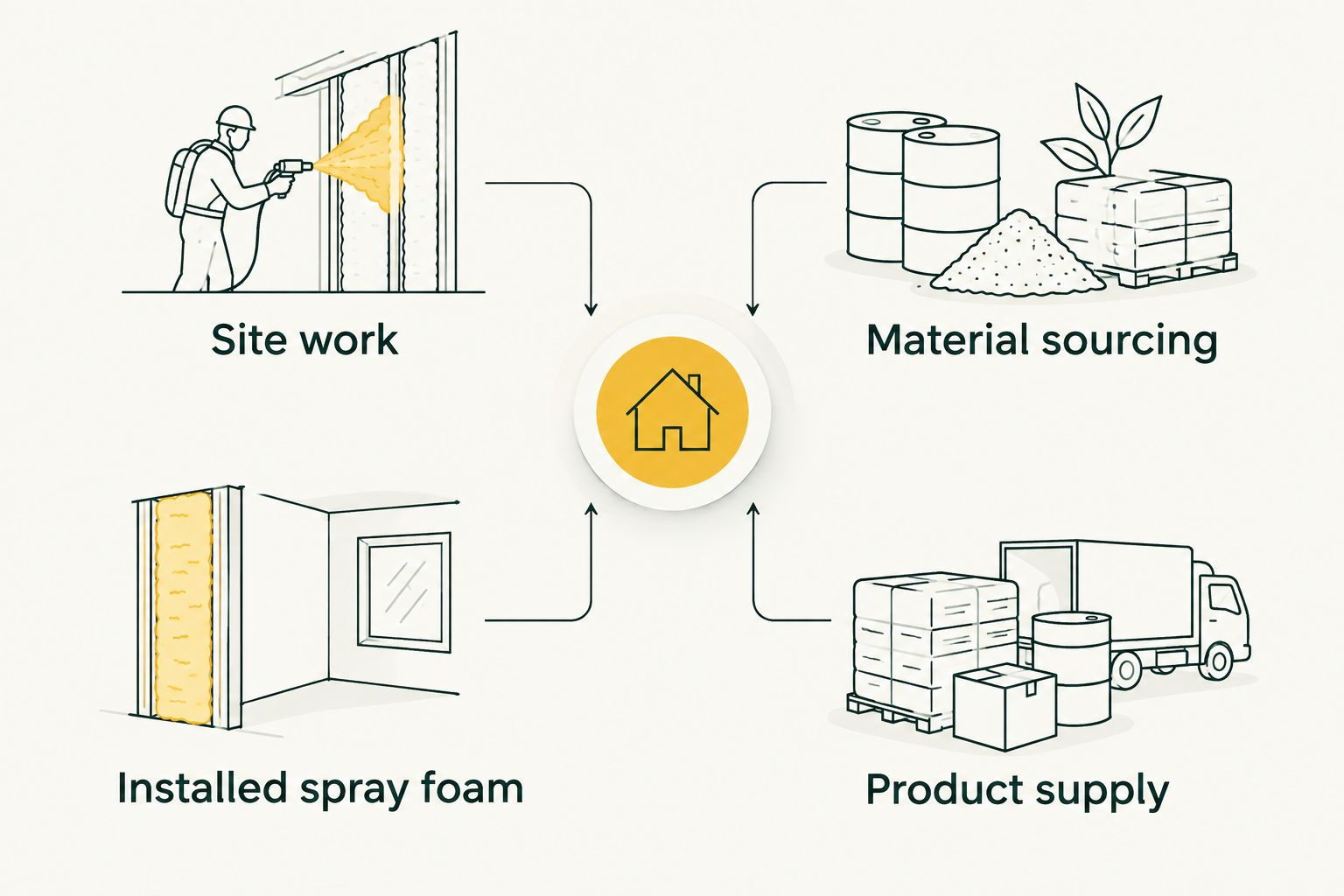
    Two-column diagram comparing installed spray foam work with insulation material supply
    Decide who is responsible for installation before comparing a contractor with a supplier.

    AT Foam is the clearer choice for crawl spaces and walls

    Winner: AT Foam for a crawl space or wall project that requires on-site spray foam work. Its stated services include both applications. The useful question is not simply whether a seller has insulation; it is who will evaluate the area and apply the specified material.

    A crawl space deserves a scope that identifies the surfaces being treated. Ask how the proposed insulation work relates to existing moisture conditions and what, if anything, must happen before spraying. Do not assume that adding foam alone resolves a moisture problem; the proposal should separate insulation work from any other work the space requires.

    Wall projects need the same clarity. Tell the contractor whether the work concerns an open wall in a renovation, a new assembly, or another accessible area, then get the proposed installation area in writing. For a business owner planning commercial work in 2026, identify access restrictions and who controls the site before requesting a proposal.

    Service Partners is the better match for an installing crew that already knows what its crawl space or wall job requires and needs to purchase materials. It is not the better first stop for a property owner whose main unresolved question is who will carry out the spray foam installation.

    Both require the right insulation for the assembly

    Tie: neither a contractor quote nor a material order makes product selection automatic. Open-cell and closed-cell spray foam are not interchangeable labels for the same job. The proposed assembly, intended use, and applicable project requirements should drive the choice.

    If you are hiring installation, ask what foam is proposed, where it will be applied, and why that approach fits the space. If you are buying materials for your own crew, check the specification before ordering. In either case, do not compare proposals solely by the words spray foam: two offers can describe different materials and different work.

    This is where a written scope does the most work. It should let you identify the application, the proposed insulation, and who is responsible for installation. If a competing document omits one of those points, request a correction before treating the offers as comparable. That rule applies to both residential and commercial projects in 2026.

    Both fit residential and commercial insulation projects

    Tie on project category; different roles on the job. AT Foam provides residential and commercial spray foam installation. Service Partners supplies insulation materials used in residential and commercial work. The words residential and commercial therefore do not identify the winner on their own.

    Instead, identify the buyer. A property owner hiring a contractor needs an installation scope and a party responsible for the work. A trade crew purchasing for a specified job needs to confirm the materials in its order. Both can be involved in the same kind of project without offering the same service to the same buyer.

    For a commercial job, make the responsibility split explicit before materials are ordered or site work begins. Who supplies the material? Who installs it? Who resolves a mismatch between the plan and the conditions found on site? Those questions are more useful than a broad claim that a company serves commercial customers.

    Pricing: compare the scope, not just the line item

    AT Foam's pricing model is a project quote for installation. Service Partners' pricing model is a materials purchase tied to an order. Neither model wins on cost from the information available here, because a materials order does not represent the full cost of an installed job.

    For an installation quote, check which areas are included, what material is proposed, and which site tasks belong to the contractor. For a supply purchase, confirm the exact specified products and what the order includes. If your crew is handling installation, keep its labor and other project work in your own comparison. Do not set a product order beside a full installation quote and call the difference savings.

    In 2026, request current terms directly from each business. Scope changes, site conditions, and product specifications can all change what you are buying. A useful comparison puts equivalent responsibilities side by side; a misleading one compares different deliverables as though they were identical.

    Final verdict: match the business to the buyer

    Choose AT Foam if you are hiring an installer

    You are a homeowner or business owner in the Seattle, Tacoma, Olympia, or greater Pacific Northwest area, and you need spray foam installed in an attic, crawl space, or wall. AT Foam wins this profile because its stated service is residential and commercial spray foam installation. Ask for a written scope that identifies the application and the proposed foam.

    Choose Service Partners if your crew needs supply

    You are an insulation contractor with an installation crew and a defined material specification. Service Partners wins this profile because your next purchasing step is sourcing insulation materials, not hiring another crew to perform the work. Check the order against the project specification before buying.

    Dimension Winner
    Best for a property owner hiring installation AT Foam
    Best for a contractor buying materials Service Partners
    Site work and installed spray foam AT Foam
    Material sourcing and product supply Service Partners
    Attic spray foam installation AT Foam
    Crawl space and wall spray foam installation AT Foam
    Choosing insulation for the assembly Tie: confirm the specification
    Residential and commercial relevance Tie: different roles
    Pricing comparison No direct winner: scopes differ

    FAQ

    Is AT Foam or Service Partners better for a homeowner?

    AT Foam is the better fit for a homeowner who needs spray foam installed in an attic, crawl space, or wall in its Washington service area. Service Partners fits material sourcing rather than the homeowner’s request for an installing contractor.

    Is Service Partners an insulation contractor?

    Service Partners is an insulation distributor. If you need an installed result, identify the crew responsible for site work rather than treating a materials order as an installation agreement.

    Which is better for an insulation contractor buying materials?

    Service Partners fits an insulation contractor buying specified materials for its own crew to install. Confirm the product requirements in the job documents before ordering.

    Which should I contact for attic spray foam installation in Seattle?

    AT Foam fits a Seattle request for attic spray foam installation. Ask for a written scope that identifies the surfaces to be treated and the proposed insulation approach.

    Can I compare an AT Foam quote with a Service Partners materials order?

    Not as equivalent offers: an installation quote and a materials order cover different responsibilities. Separate material supply, installation labor, and other project work before comparing them.

    Is open-cell or closed-cell spray foam better for my project?

    Neither foam type is automatically better for every attic, crawl space, or wall. Select the material based on the proposed assembly and project requirements, and ask the installer to explain the specification.

    Who should handle a crawl space spray foam job?

    Choose an installing contractor if you need the crawl space work performed; AT Foam lists crawl space spray foam among its services. Choose a materials supplier if your crew already has the job scope and will perform the installation.

    One last thing

    The fastest way to make this comparison useful in 2026 is to write one sentence describing what you are buying: an installed spray foam job or specified insulation materials. If you cannot answer that yet, settle who owns the installation before asking either business to price the work.

    Related guides

  • AT Foam vs Insulation NW: which is better in 2026

    AT Foam vs Insulation NW: which is better in 2026

    Choose AT Foam if you need a spray foam contractor for an attic, crawl space, wall, or commercial project in the Seattle–Tacoma–Olympia area; choose Insulation NW if its written proposal covers your required work more completely. AT Foam is the better-defined choice for a Washington spray foam project, but the better bid is the one that specifies the right assembly, material, and scope. This 2026 comparison shows what you can establish before hiring and what each contractor must put in writing.

    TL;DR
    • For at foam vs insulation nw in 2026, choose AT Foam for a clearly identified spray foam contractor serving Seattle, Tacoma, and Olympia.
    • Choose Insulation NW if its written proposal addresses your project more completely; do not assume either contractor wins on installation quality.
    • Compare attic, crawl space, or wall bids by material, thickness, coverage, preparation, and work left to the owner.

    Why this matters

    Insulation bids can use the same words while describing different jobs. One contractor might specify the area to be insulated; another might also identify gaps to seal, surfaces to prepare, and spaces to leave accessible. Those differences affect what you actually receive, even when both bids say spray foam.

    Start with the application, not the company name. A homeowner treating an attic needs a different scope from a business insulating walls during a renovation. You can review spray foam insulation services ranked by application before asking either contractor for a proposal. Use the comparison below to make both bids answer the same questions.

    At a glance: AT Foam vs Insulation NW

    Dimension AT Foam Insulation NW
    Best for Homeowners and businesses seeking spray foam insulation in its stated service area Buyers whose project requirements are better covered by its written proposal
    Service fit Residential and commercial spray foam installation Confirm the proposed service and material
    Attic work Attic insulation is a stated service Check which attic surfaces the bid includes
    Crawl space work Crawl space insulation is a stated service Check surfaces, access, and preparation in the bid
    Wall work Wall insulation is a stated service Confirm access and the proposed wall assembly
    Commercial work Commercial insulation is a stated service Confirm the building-specific scope
    Written scope Request material, location, and coverage in writing Request the same details in writing
    Pricing model Compare the defined work in its proposal; no model is established here Compare the defined work in its proposal; no model is established here
    Standout feature Identified as a veteran-owned spray foam contractor No distinguishing service feature is established here

    The table separates stated services from questions only a proposal can answer. It does not rate crews, completed work, or customer satisfaction. For a fair 2026 decision, ask each contractor to describe the same job before comparing their bids.

    AT Foam is the clearer match for a spray foam-first project

    Best for: a homeowner or business that has chosen spray foam and needs a contractor serving Seattle, Tacoma, Olympia, or the greater Pacific Northwest. AT Foam Insulation is described as a veteran-owned spray foam installer for residential and commercial attics, crawl spaces, and walls. That makes its service fit clear at the start of your search.

    The limitation is just as clear: a stated service does not tell you which foam type, thickness, preparation, or finishing work a particular job includes. Ask for those details rather than treating spray foam as one fixed specification. Insulation NW wins this dimension for your job if its proposal describes your required work more precisely and AT Foam's does not.

    For either contractor, give the same brief: the space, the surfaces you want addressed, whether it is finished, and any known access restrictions. Ask the bidder to mark exclusions. A contractor who names the work you will receive gives you a more useful answer than one who repeats your project label.

    Both contractors need to define the attic assembly

    Best for: homeowners who want the proposed attic work tied to specific surfaces. AT Foam lists attic insulation among its services, but that alone does not settle where foam belongs in your attic. A proposal should say whether the work covers the attic floor, roofline, or another identified surface. Those are different scopes, not interchangeable names for the same job.

    Ask both contractors to identify the surfaces, planned material, coverage limits, and any areas that will remain untreated. If the attic contains equipment or storage, tell each bidder before the visit so the written scope reflects the space they inspected. Do not accept an attic bid that leaves the installation location to guesswork.

    Verdict: a tie until the proposals define the same attic assembly. AT Foam has a stated attic service; neither company earns a quality win from that statement alone. In 2026, choose the bid that clearly documents the assembly you intend to insulate.

    AT Foam has a stated crawl space service; scope decides the winner

    Best for: owners who can show the contractor the crawl space conditions before asking for an insulation plan. AT Foam lists crawl space insulation. That establishes service fit, not a specific treatment for your foundation, subfloor, or rim joists. Insulation NW's crawl space approach must likewise be established from its proposal, not assumed from its name.

    Tell each contractor about visible water, damp materials, existing insulation, and difficult access. Ask which conditions must be addressed before insulation begins and which tasks are outside the bid. If a proposal says crawl space without identifying the treated surfaces, request a revision. The words alone do not tell you whether two contractors are solving the same problem.

    A crawl space quote should distinguish insulation from other work the space might need. Choose the contractor whose written scope matches the actual surfaces and conditions, rather than assigning the whole project to the first bidder who mentions moisture. This is one place where an otherwise attractive proposal can leave a costly gap: the insulation work can be defined while preparation is not.

    Both contractors need an access plan for wall work

    Best for: owners who know whether the wall cavities will be open during the project. AT Foam lists wall insulation, but its stated service does not tell you how a particular wall will be accessed. Ask both contractors whether their proposals assume exposed framing or finished walls. Make them identify the surfaces to be insulated and any opening or repair work that is excluded.

    Wall insulation is especially easy to compare badly when one bid assumes construction is already underway and the other includes a different site condition. State the project stage in your request, then ask each bidder to describe what must happen before installation. If a contractor cannot perform the requested work under the actual access conditions, its bid is not an alternative for that job.

    Verdict: neither contractor wins wall work on the available service descriptions. The winner is the one that documents a feasible installation plan for your walls. For a 2026 renovation, settle access and exclusions before selecting a contractor.

    AT Foam states commercial capability; the building sets the test

    Best for: a business seeking a spray foam contractor for a defined commercial area. AT Foam identifies commercial insulation as part of its work. That gives a commercial buyer a relevant starting point, but it does not establish experience with your particular building, schedule, or wall and roof assemblies. Those details belong in a project-specific conversation.

    Give both contractors the same drawings or site description and ask them to identify the work area, material, surface preparation, coordination requirements, and exclusions. If other trades need access, ask how the insulation sequence fits the project. A proposal that only repeats commercial insulation as a line item is not enough to coordinate construction work.

    AT Foam wins on clearly stated commercial service fit. Insulation NW wins for a particular commercial project if its written plan addresses that building's requirements more completely. Neither result is a claim about past commercial jobs or crew performance.

    The more specific written scope is the better tool

    Best for: anyone comparing bids that appear similar at first glance. A written scope is where a contractor turns a service category into an actual job. Require the same information from AT Foam and Insulation NW so you can spot a missing task rather than mistaking it for a competitive offer.

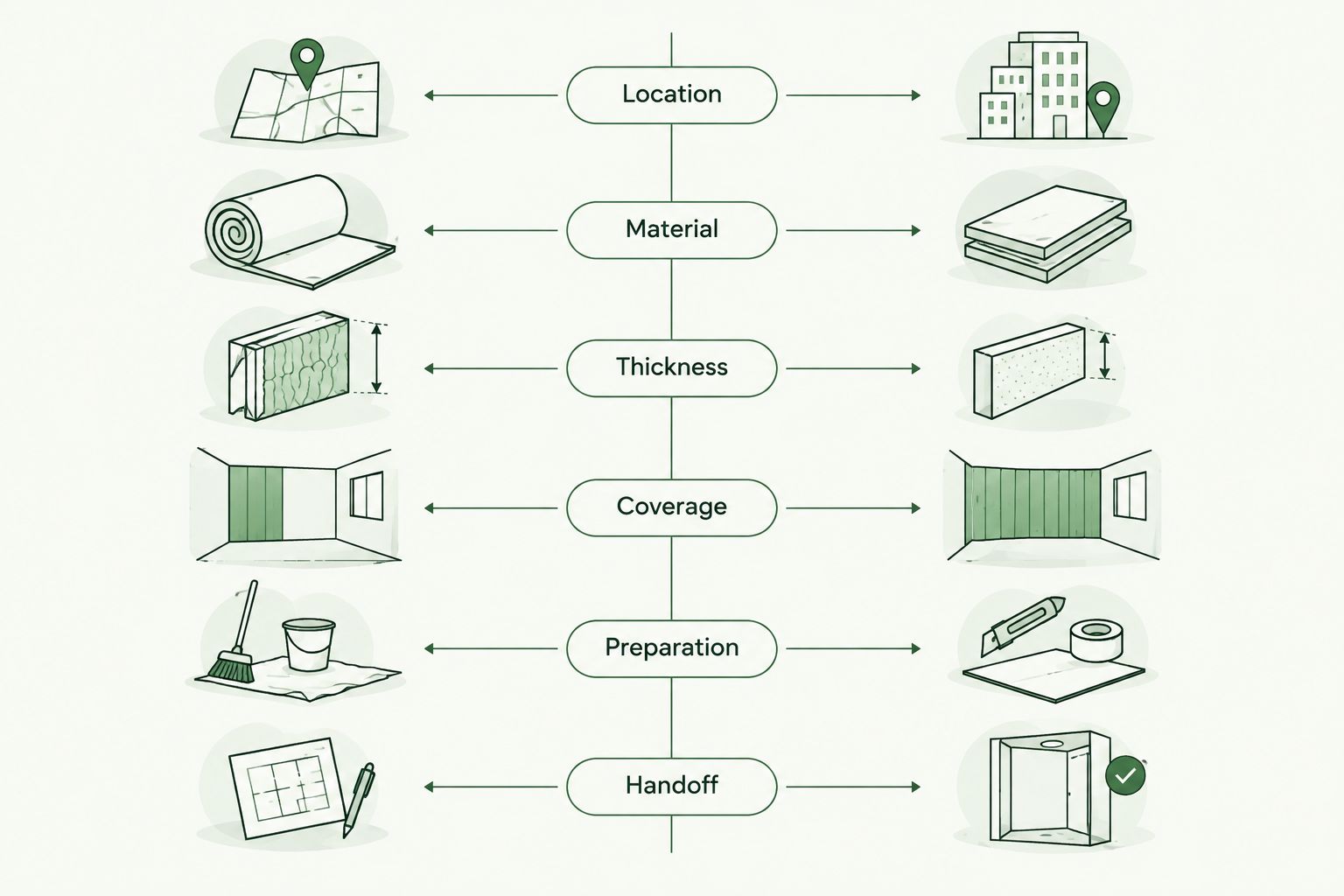
    Ask each bidder to specify:

    • Location: Which attic, crawl space, wall, or commercial surfaces are included?
    • Material: Is the proposed foam open-cell or closed-cell, and where will it go?
    • Thickness: What installed thickness is specified for each surface?
    • Coverage: Which areas are excluded or inaccessible?
    • Preparation: Who handles surfaces or existing materials that need attention before installation?
    • Handoff: What work remains for you or another trade after insulation?

    For example, a proposal specifying 1 inch on a surface is not the same stated scope as a proposal specifying 2 inches on that surface. Neither number here describes either contractor's work; the point is to compare the thickness each contractor actually writes down. Apply the same check if one bid identifies 3 inches in another area. Do not replace a written specification with an assumption based on the phrase spray foam.

    Two-column diagram of the scope details to check in competing insulation proposals
    Compare matching scope details before choosing between bids.

    Verdict: a tie until both contractors submit comparable scopes. If Insulation NW documents the work more clearly, choose Insulation NW on this dimension. If AT Foam does, choose AT Foam. A service description cannot substitute for a job-specific proposal.

    Pricing: compare the work before the payment structure

    Neither contractor's pricing model is established in the information here. Do not assume either uses a fixed project bid, an area-based calculation, or a particular payment schedule. Ask each contractor to state how its proposal is structured and what would cause the scope to change.

    A fixed, clearly defined scope makes it easier to see what is included. A proposal that allows for changes can accommodate conditions discovered during work, but you need the change process in writing. Those are tradeoffs between proposal structures, not claims about how either company operates. Confirm which structure each contractor actually offers.

    For a usable 2026 comparison, first align the surfaces, foam type, thickness, preparation, and exclusions. Then compare the commercial terms in the proposals. If the scopes differ, ask for revisions before treating either bid as the better deal. A cheaper-looking line item is not a win when it omits work the other bid includes.

    AT Foam's veteran-owned identity is clear; installation quality is unranked

    Best for: a buyer who wants to know who they are contacting before evaluating the job plan. AT Foam Insulation is identified as veteran-owned. That is a stated distinction, not evidence that its installation will outperform another contractor's. No equivalent distinguishing service feature for Insulation NW is established in the information available for this comparison.

    If crew qualifications, insurance, job photos, or past work matter to you, ask each contractor for documentation relevant to your project. Do not infer that one company has or lacks a credential because it is absent from this comparison. The same standard applies to workmanship: request the details you need rather than awarding a win from a company description.

    AT Foam wins on an identified veteran-owned distinction. There is no supported winner on completed-job quality. In 2026, make quality a question to verify with project-specific evidence, not a claim borrowed from a comparison page.

    Final verdict: choose the bid that solves your job

    Choose AT Foam if you need a spray foam-focused contractor

    AT Foam is the named fit for a Seattle, Tacoma, or Olympia homeowner or business seeking spray foam installation in an attic, crawl space, or wall. Choose it when its written proposal also identifies the right surfaces, material, thickness, preparation, and exclusions for your job. Its stated services get it onto your shortlist; its project-specific scope must earn the work.

    Choose Insulation NW if its proposal fits better

    Insulation NW is the winner for a buyer whose written Insulation NW proposal covers the required assembly and site conditions more completely than the AT Foam proposal. Ask for the same scope details from both companies before making that call. This is a conditional recommendation, not an unsupported claim about Insulation NW's services or past work.

    Dimension Winner
    Best for a stated spray foam service match AT Foam
    Service fit for residential and commercial spray foam AT Foam
    Attic work Better-defined assembly; otherwise tie
    Crawl space work Better-defined surfaces and preparation
    Wall work Feasible access plan; otherwise tie
    Commercial work AT Foam on stated service fit; project plan decides the job
    Written scope More complete, comparable proposal
    Pricing model Neither established; compare written terms
    Standout stated feature AT Foam on veteran-owned identity

    FAQ

    Is AT Foam better than Insulation NW for spray foam insulation?

    AT Foam is the clearer stated fit for a spray foam project, but the better contractor for your job is the one with the stronger written scope. Compare material, surfaces, thickness, preparation, and exclusions before deciding.

    Does AT Foam install attic insulation?

    Yes. AT Foam lists residential and commercial attic insulation among its services. Ask its team to identify the attic surfaces and material proposed for your specific job.

    Does AT Foam handle crawl space insulation?

    Yes. AT Foam lists crawl space insulation as a service. Have both contractors document the surfaces, site conditions, and preparation included in their proposals.

    Can Insulation NW win this comparison?

    Yes. Choose Insulation NW if its written proposal addresses your required work more completely than AT Foam’s. Verify its proposed services and project scope directly rather than assuming either from the company name.

    How should I compare spray foam bids in 2026?

    Compare bids against the same written project brief in 2026. Check the proposed foam type, installation location, thickness, coverage, preparation, and exclusions before evaluating the terms.

    Which contractor is better for commercial insulation?

    AT Foam states that it provides commercial spray foam insulation, making it a clear candidate. Choose the contractor whose proposal addresses your building’s surfaces, access, and coordination requirements.

    Is open-cell or closed-cell foam included in either contractor’s proposal?

    You must confirm the proposed foam type in each written bid. A general spray foam service description does not establish which material a contractor has selected for your project.

    One last thing

    Ask each contractor to mark the excluded surfaces on the same project description. In 2026, that single request can reveal a mismatch before you spend time comparing two proposals for different jobs. If an area matters to you, get its inclusion or exclusion in writing.

    Related guides

  • RetroFoam alternatives in 2026

    RetroFoam alternatives in 2026

    RetroFoam is a strong option when you want to insulate a finished wall without opening the entire cavity. It stops being the obvious fit when the work is in an attic, crawl space, or already-open wall. The best RetroFoam alternative in 2026 is AT Foam Insulation for spray foam work in accessible cavities; blown-in cellulose is the alternative to compare for finished walls.

    TL;DR
    • For retrofoam alternatives in 2026, choose AT Foam Insulation for accessible attic, crawl space, and wall cavities.
    • Compare blown-in cellulose when the wall is finished and opening it is the main concern.
    • Choose fiberglass or mineral wool batts when cavities are open and a batt installation fits the job.
    • Do not choose a material until you know whether the cavity is accessible and what else the wall needs.

    Why this matters

    RetroFoam and spray foam are easy to group together because both contain the word foam. They answer different installation questions. RetroFoam's appeal is insulating an existing, enclosed wall; conventional spray foam is applied where the installer can reach the surface that needs insulation.

    That distinction changes the work you should ask a contractor to assess. A finished bedroom wall, an open wall during a remodel, an attic, and a crawl space do not call for the same installation plan. In the Pacific Northwest, you also need someone to identify moisture problems before covering a surface. Insulation is not a repair for a leak or wet framing.

    Start with access, not the material name. In 2026, that simple distinction will narrow your RetroFoam alternatives faster than a list of product claims. It also helps you compare proposals for the same area of the building instead of comparing a wall quote with an attic quote.

    RetroFoam alternatives at a glance

    Option Best for Standout feature How it differs from RetroFoam
    RetroFoam Existing finished walls Injection into enclosed wall cavities The benchmark for a finished-wall project
    AT Foam Insulation Accessible attics, crawl spaces, and walls in its service area Spray foam installation across residential and commercial applications The contractor applies spray foam to accessible surfaces rather than treating an enclosed wall as an injection job
    Blown-in cellulose Enclosed walls where limited access is preferred Loose-fill material installed through access openings Uses blown-in fiber rather than injected foam
    Fiberglass batts Open, regularly framed cavities Batts fitted between framing members Requires access to place and fit the batts
    Mineral wool batts Open cavities where batt fit and material choice matter Dense batts cut to fit framing Also requires access; it is not an enclosed-wall injection method

    The table compares installation routes, not interchangeable packages. Ask each installer which surface the proposal covers, how they will reach it, and what preparation or restoration falls outside the insulation work. A lower-disruption wall method does not automatically solve an attic or crawl-space problem.

    1. AT Foam Insulation: best for accessible cavities

    AT Foam Insulation is a veteran-owned spray foam insulation contractor serving residential and commercial customers in Seattle, Tacoma, Olympia, and the greater Pacific Northwest. Its stated work covers attics, crawl spaces, and walls. That makes it the first call here when those areas are accessible and you want a spray foam proposal, not an injection-foam proposal for an enclosed wall.

    Where AT Foam Insulation shines

    • Its stated service scope covers all three common areas in this comparison: attic, crawl space, and wall.
    • You can ask one contractor to assess spray foam for a residential or commercial project in its stated service area.
    • Spray foam can be applied directly to accessible surfaces, so the proposal can identify the surfaces to be treated rather than assuming every cavity is an enclosed wall.

    Where AT Foam Insulation falls short

    • Conventional spray foam is not a like-for-like way to fill a finished wall without gaining access to the application surface.
    • If you need to keep wall finishes largely intact, compare an enclosed-wall installation method before committing to demolition or a remodel.
    • Its stated service area is the Pacific Northwest, so it is not the local-contractor choice for a project outside that area.
    Decision point AT Foam Insulation RetroFoam
    Primary fit in this comparison Accessible attic, crawl space, or wall surfaces Existing enclosed walls
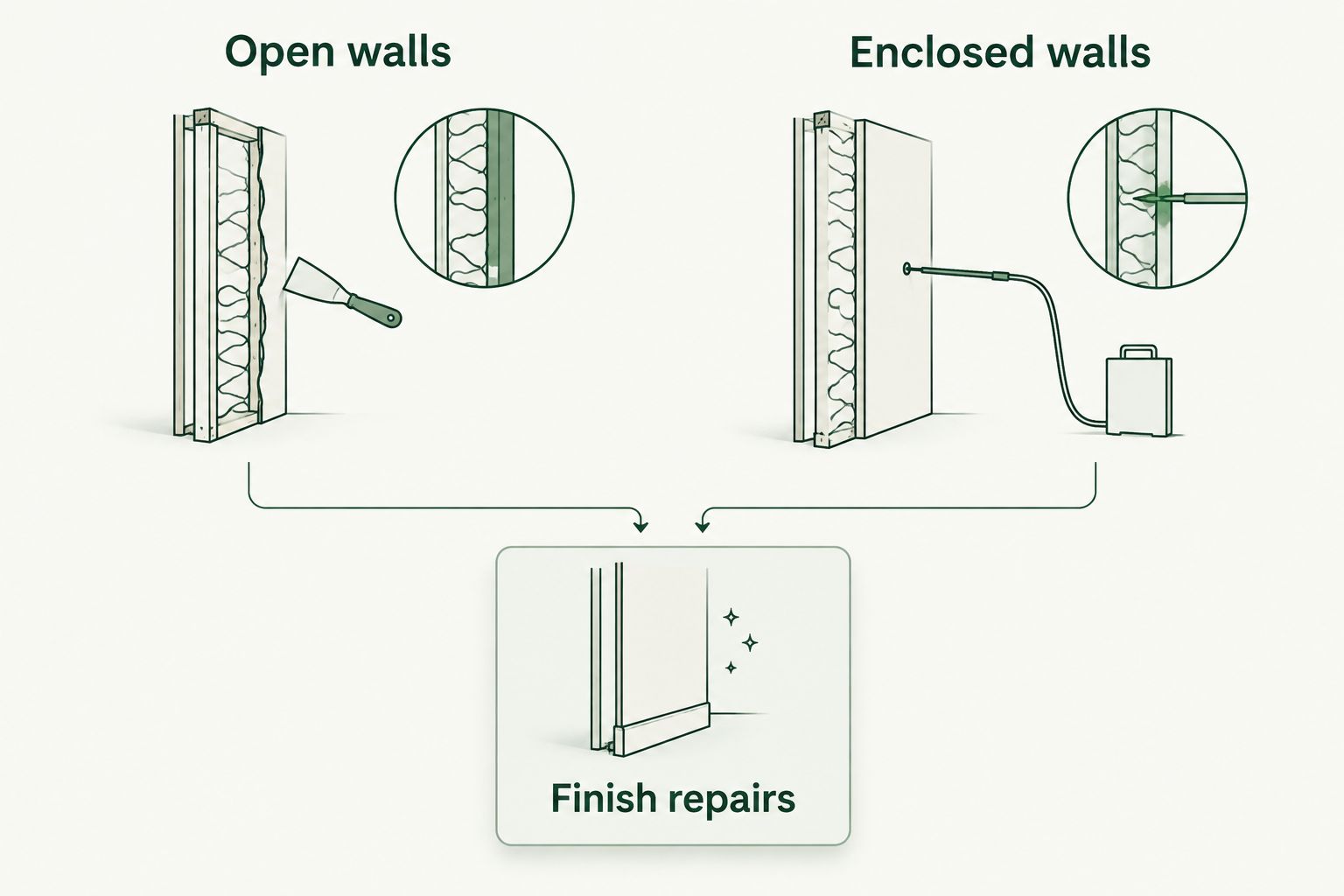
    Wall access Surface must be accessible for spray application Installation is designed around access into an enclosed cavity
    Scope to discuss Spray foam installation for the area being assessed Injection-foam treatment of the wall cavity
    Best question to ask Which surfaces can you reach and treat? How will you access and close the wall openings?

    Best for: A Seattle, Tacoma, Olympia, or greater Pacific Northwest property with an accessible area that needs a spray foam assessment. Verdict: Choose AT Foam Insulation for accessible spray foam work; hold off if your only goal is filling a finished wall without opening it.

    2. Blown-in cellulose: best for an enclosed-wall comparison

    Blown-in cellulose belongs on your shortlist when the walls are finished and you want to compare another way of insulating enclosed cavities. An installer introduces the material through access openings; the wall does not become an open spray surface. The condition and construction of the wall still determine whether the job is suitable.

    Where blown-in cellulose shines

    • It gives you a finished-wall comparison against injection foam rather than an unrelated attic or open-wall proposal.
    • It can be considered for cavities where installing batts would require opening the wall.
    • A proposal can specify the access points and how the installer plans to confirm the cavity is filled.

    Where blown-in cellulose falls short

    • It does not remove the need to make and close access openings.
    • Wall obstructions, existing insulation, and unknown cavity conditions need checking before anyone promises a uniform fill.
    • It is not a substitute for repairing moisture intrusion or air leaks elsewhere in the assembly.
    Decision point Blown-in cellulose RetroFoam
    Material Loose-fill cellulose fiber Injection foam
    Typical comparison Filling an enclosed wall Filling an enclosed wall
    Access to discuss Openings for the blowing equipment Openings for the injection equipment
    Proposal detail to request How cavities and obstructions will be assessed How cavities and obstructions will be assessed

    Best for: A finished-wall project where keeping the wall largely in place matters and a contractor confirms the cavities are suitable. Verdict: Compare it directly with RetroFoam for the same walls; skip it as a shortcut around a moisture problem.

    3. Fiberglass batts: best for open, straightforward framing

    Fiberglass batts are a practical comparison when the wall is already open or a project gives the installer direct access to the framing. They are placed between framing members, not injected into a finished cavity. Fit matters: gaps and compressed sections change the result you get from the planned insulation layer.

    Where fiberglass batts shine

    • They suit framing that is exposed during construction or a renovation.
    • You can inspect the cavity and address visible problems before the wall is closed.
    • Batts make the intended coverage easy to discuss with an installer while the framing remains accessible.

    Where fiberglass batts fall short

    • Installing them behind finished drywall requires opening the wall; they do not perform RetroFoam's enclosed-wall job.
    • Batts do not, by themselves, seal air leaks around penetrations or framing joints.
    • Irregular framing and obstacles demand careful cutting and fitting.
    Decision point Fiberglass batts RetroFoam
    Wall condition Open framing Enclosed finished cavity
    Installation Fit batts between framing Inject foam into the cavity
    Air leaks Address separately Ask the installer which leaks the wall work will address

    Best for: An open-wall project where the framing can be inspected and the batts can be fitted correctly. Verdict: Choose batts for accessible, straightforward framing; skip them when avoiding wall demolition is the priority.

    4. Mineral wool batts: best for an open-wall material comparison

    Mineral wool gives you another batt option when framing is exposed. Like fiberglass batts, it must be cut and fitted into the available space. It belongs in an open-wall comparison, not in a head-to-head promise that it can be installed through the same openings as injection foam.

    Where mineral wool batts shine

    • They give you a distinct material option to assess while the wall is open.
    • The installer can inspect framing, penetrations, and visible moisture concerns before covering the cavity.

    Where mineral wool batts fall short

    • Finished walls must be opened to install conventional batts.
    • Cutting and fitting still matter around irregular framing.
    • A batt installation does not replace a separate plan for air sealing.
    Decision point Mineral wool batts RetroFoam
    Required access Open cavity Access into an enclosed cavity
    Installation method Cut and fit batts Inject foam
    Main decision Whether a batt suits the exposed framing Whether injection suits the enclosed wall

    Best for: An exposed wall where you want to compare batt materials before the finish goes back on. Verdict: Hold it alongside fiberglass for open framing; skip it if the wall must stay closed.

    Why people switch from RetroFoam

    A switch makes sense when the job is no longer the job RetroFoam is meant to solve. If an attic or crawl space is the problem, compare methods for that space. If drywall is already coming down during a renovation, compare materials that can be installed against the exposed framing. Neither decision requires a claim that RetroFoam performs poorly in finished walls.

    For a Washington property, make the 2026 shortlist from the actual work area:

    • Finished walls: Ask about enclosed-cavity installation, access openings, existing insulation, and wall restoration.
    • Open cavities: Compare spray foam with appropriately fitted batts for the same exposed area.
    • Attic access: Identify the surface to insulate and any air leaks or moisture concerns before choosing a method.
    • Crawl space: Find the moisture source and define the insulation boundary before covering surfaces.

    Use the same project description with every contractor in 2026. Name the area, say whether it is open or finished, and disclose any known leaks or existing insulation. Then ask what the installer needs to inspect before specifying material. That keeps the comparison focused on what will actually be installed.

    A useful proposal identifies the area and surface to be insulated, the access required, and any work that must happen first. For a finished wall, ask who makes and closes the access openings. For an attic or crawl space, ask which surfaces are included. If two proposals describe different boundaries, they are not competing solutions to the same job.

    Discuss your insulation project

    Describe the space, access, and existing insulation before choosing a method.

    When staying with RetroFoam is the right call

    Stay with RetroFoam on the 2026 shortlist when your main problem is a finished, enclosed wall and you want an injection-foam proposal. That is its relevant strength. An attic spray foam proposal or an open-wall batt proposal does not answer the same question, even if it describes a good material.

    Before deciding, confirm what is already inside the wall and how the installer will handle obstructions and access openings. Ask what remains outside the job, too. If the source of discomfort is an attic gap or a crawl-space condition rather than the wall cavity, a finished-wall treatment is not the first comparison to make.

    FAQ

    What is the best RetroFoam alternative in 2026?

    AT Foam Insulation is the best fit here for accessible attic, crawl space, or wall surfaces in its Pacific Northwest service area. For a finished, enclosed wall, compare RetroFoam with blown-in cellulose instead.

    Is spray foam the same as RetroFoam?

    No. In this comparison, spray foam is applied to accessible surfaces, while RetroFoam is considered for injection into enclosed walls. Ask which area and surface each proposal actually covers.

    Can fiberglass batts replace RetroFoam in a finished wall?

    Not without opening the wall to install the batts. Fiberglass is a better comparison when framing is already exposed.

    Is blown-in cellulose an alternative for existing walls?

    Yes, blown-in cellulose is an enclosed-wall alternative to discuss with an installer. The installer needs to assess the cavity, existing material, and required access openings.

    Should I insulate a wet crawl space first?

    No. Identify and address the moisture source before covering affected surfaces with insulation. Ask the contractor to define what preparation the insulation proposal assumes.

    Which RetroFoam alternative fits an open wall during a renovation?

    Compare spray foam, fiberglass batts, and mineral wool batts for the exposed wall. The right proposal depends on the cavity and the work planned before the wall is closed.

    When should I keep RetroFoam on my shortlist?

    Keep RetroFoam on your shortlist when the target is a finished, enclosed wall and limiting wall opening matters. Compare proposals for that same wall rather than against work in another part of the building.

    One last thing

    The most useful question in 2026 is not which foam has the better name. It is which surface the installer can reach without turning your project into a different job. Settle that first, then compare materials and proposals for the same space.

    Related guides

  • AE Insulation alternatives in 2026

    AE Insulation alternatives in 2026

    AE Insulation is a useful benchmark if you already have a written proposal from them. That proposal stops being enough when it does not clearly identify the insulation material, the surfaces covered, and the work needed before installation. The best AE Insulation alternative in 2026 is AT Foam Insulation for residential or commercial spray foam in Seattle, Tacoma, and Olympia; compare another contractor if you need a second bid or a different material.

    TL;DR
    • AT Foam Insulation is the best AE Insulation alternative in 2026 for spray foam work in Seattle, Tacoma, and Olympia.
    • Keep AE Insulation in the comparison if its written proposal covers the same surfaces and preparation work.
    • Compare attic, crawl space, and wall bids by material and scope, not the contractor name alone.
    • Check local coverage and the proposed insulation method before treating another named company as a substitute.

    Why this matters

    An insulation bid is only useful beside another bid when both describe the same job. An attic proposal can leave out the hatch, penetrations, or existing insulation; a crawl space proposal can leave open who handles moisture-related work. Those omissions change what you are buying, even when the proposals use the same word: insulation.

    For a 2026 comparison, start with the application. Is the work in an attic, crawl space, wall, or commercial building? Then ask each contractor to put the material, preparation, areas covered, and exclusions in writing. Choose the proposal with a clear scope for your building, not the shortest description.

    AE Insulation alternatives at a glance

    Option Best for What to check first How it differs from an AE Insulation bid
    AE Insulation Keeping an existing written proposal as your benchmark Confirm the material, surfaces, preparation, and exclusions This is the bid the alternatives must match before you compare them
    AT Foam Insulation Residential or commercial spray foam in Seattle, Tacoma, Olympia, and the greater Pacific Northwest Ask for the proposed foam approach and a site-specific scope Spray foam installation for attics, crawl spaces, and walls is an established service
    TruTeam Seeking another contractor proposal Confirm local coverage and the insulation method offered for your project Treat it as an independent bid only after its scope is confirmed
    Insulation NW Adding another name to a local shortlist Confirm service area, material, and project fit directly Its proposal is comparable only if it covers the same work

    The table is a shortlist, not a claim that every company offers the same materials or serves every address. For TruTeam and Insulation NW, verify those details before scheduling around them.

    1. AT Foam Insulation: best for a local spray foam project

    AT Foam Insulation is a veteran-owned contractor providing residential and commercial spray foam installation. Its stated work covers attics, crawl spaces, and walls for customers in Seattle, Tacoma, Olympia, and the greater Pacific Northwest. That makes it the clearest fit here when your project calls for spray foam in one of those areas.

    Spray foam is not a complete specification by itself. Ask which surfaces the crew will insulate, how openings and transitions will be handled, what happens to existing material, and which tasks belong to another trade. Put those answers in the written scope before comparing the proposal with AE Insulation's.

    Where this option shines

    • A stated focus on spray foam installation, rather than a material choice inferred from a company name.
    • Residential and commercial attic, crawl space, and wall work are explicitly within its stated services.
    • Seattle, Tacoma, and Olympia are explicitly within its stated service area.

    Where this option falls short

    • If you have decided against spray foam, a spray-foam contractor is not the right comparison for a different insulation method.
    • The stated service area does not establish coverage for every address in the Pacific Northwest. Confirm your project location directly.
    • A company description does not define the preparation, exclusions, or material choice for your specific building; the written proposal must do that.

    Best for: A homeowner or business comparing spray foam proposals for an attic, crawl space, or wall project within the stated service area. Verdict: Shortlist for that work; choose only after the scope matches your building.

    Decision point AT Foam Insulation AE Insulation
    Stated service Residential and commercial spray foam installation Confirm the proposed service directly
    Stated applications Attics, crawl spaces, and walls Confirm the surfaces in the written proposal
    Stated geography Seattle, Tacoma, Olympia, and the greater Pacific Northwest Confirm coverage for your address
    Project-specific scope Request it in writing Request or check it in writing

    The head-to-head does not declare a winner on work that has not been specified. It identifies what you can establish now and what each proposal still needs to answer.

    2. TruTeam: best for another independently scoped bid

    TruTeam is another name to investigate when you want an additional contractor proposal. Its name alone does not tell you whether a local team covers your address or proposes the material your project requires. Make those your first questions, then compare the written work descriptions.

    Where TruTeam shines

    • A separate proposal gives you another description of the work to assess against an existing AE Insulation bid.
    • Asking the same questions of each company exposes differences in included preparation and covered surfaces.

    Where TruTeam falls short

    • Local coverage and project fit must be confirmed directly before it belongs on a final shortlist.
    • A proposal that names only an insulation material, without the surfaces and preparation work, is not yet comparable.

    Best for: A buyer willing to verify coverage and request a written proposal for the same application. Verdict: Hold until the service area, method, and scope are confirmed.

    Decision point TruTeam AE Insulation
    Local coverage Confirm directly Confirm directly
    Proposed material Require it in the proposal Require it in the proposal
    Covered surfaces Require a written list Require a written list

    Do not compare company names as a substitute for comparing work. If either proposal describes a different area of the building, ask for a revised scope before making a decision.

    3. Insulation NW: best for widening a local shortlist

    Insulation NW is another name you can check while gathering bids. First establish whether it serves your address and handles your specific attic, crawl space, wall, or commercial project. Then ask for the same scope details you request from AE Insulation and every other contender.

    Where Insulation NW shines

    • It gives you another potential point of comparison after you verify project fit.
    • A separate written scope can help you identify work one proposal includes and another leaves out.

    Where Insulation NW falls short

    • Its name does not establish its service area, materials, or availability for your project.
    • Without a matching application and written work description, its bid cannot settle an AE Insulation comparison.

    Best for: A buyer building a shortlist and prepared to confirm the basics before comparing bids. Verdict: Hold until its project fit and written scope are clear.

    Decision point Insulation NW AE Insulation
    Address coverage Confirm directly Confirm directly
    Insulation method Confirm directly Confirm directly
    Preparation and exclusions Request in writing Request in writing

    Why people compare an AE Insulation bid with alternatives

    The reason to seek another proposal is not that AE Insulation has failed. It is to answer a practical question: are you being offered the same work? A bid that covers only the accessible attic floor cannot be compared directly with one that also describes other surfaces or preparatory work.

    Use this checklist for every contractor in your 2026 shortlist:

    • Application: Identify the attic, crawl space, wall, or commercial area by location within the building. Do not accept a building-wide label when only part of it is included.
    • Material: Name the proposed insulation method. If spray foam is proposed, ask which type and where each type will go.
    • Existing conditions: Record whether existing insulation, visible moisture, damaged surfaces, or access restrictions affect the planned work. Ask who addresses each issue.
    • Preparation: Specify who clears the work area, protects adjacent surfaces, and handles openings that need attention before installation.
    • Boundaries: Mark where installation starts and stops. Ask how the contractor will handle transitions around the area being insulated.
    • Exclusions: Have the contractor identify work that is not part of its proposal. A clear exclusion is easier to plan for than an assumption.
    • Completion: Ask what the finished work will be documented with and what you should inspect before accepting it.

    For crawl spaces in particular, separate the insulation question from the moisture question. Insulation material does not replace a written plan for any moisture conditions the contractor identifies. For attics, distinguish the area being insulated from nearby areas that are merely accessible; a visit to the same attic does not mean every surface is in scope.

    A useful 2026 bid comparison places the proposals side by side and highlights mismatched lines before you choose. Ask for clarification, not a verbal assurance that the jobs are equivalent. The written scope is what lets you check the work later.

    Get a spray foam proposal

    Describe your attic, crawl space, or wall project and request a written scope.

    When staying with AE Insulation is the right call

    Keep AE Insulation on your shortlist if its proposal names the right application, material, preparation, boundaries, and exclusions for your building. If it answers your questions in writing and covers the work you want, switching contractors just to switch contractors has no practical value.

    The same standard applies to every alternative. A contractor with a clear service description still needs to explain your specific job; a familiar name does not fill gaps in a proposal. In 2026, the right choice is the contractor whose documented work matches the problem you are paying to solve.

    FAQ

    What’s the best AE Insulation alternative for spray foam in Seattle?

    AT Foam Insulation is the clearest listed alternative for a Seattle spray foam project. Its stated services include residential and commercial attic, crawl space, and wall insulation; confirm the scope for your building in writing.

    Is AT Foam Insulation better than AE Insulation?

    AT Foam Insulation is the better-defined option here when you specifically need spray foam within its stated service area. A project-level winner depends on whether each written proposal covers the same material, preparation, and surfaces.

    Should I get another bid if AE Insulation has already provided a proposal?

    Get another bid if you need to test whether the proposed work matches your project. Give each contractor the same application and ask for the same scope details so the proposals are comparable.

    Can I compare a spray foam bid with a different insulation method?

    You can compare the methods, but do not treat the bids as identical work. Ask each contractor to explain the proposed material, the surfaces it covers, and any preparation or exclusions.

    What should an attic insulation proposal identify?

    An attic insulation proposal should identify the surfaces being insulated, the material, preparation, and exclusions. Ask the contractor to clarify how openings, access, and existing insulation affect the proposed work.

    What should I ask before insulating a crawl space?

    Ask which crawl space surfaces are included and how existing moisture conditions affect the work. Get the material, preparation responsibilities, and exclusions in writing before comparing contractors.

    Are TruTeam and Insulation NW direct substitutes for AE Insulation?

    Treat TruTeam and Insulation NW as names to investigate, not confirmed like-for-like substitutes. Verify service area, insulation method, and project scope directly before comparing their proposals.

    One last thing

    The most useful question to ask after receiving an insulation bid is: What work would I still need to arrange before this job is complete? Ask it of AE Insulation and every alternative. The answer exposes exclusions that a company name and a material label cannot show.

    Related guides

  • Spray foam insulation for property managers: complete 2026 guide

    Spray foam insulation for property managers: complete 2026 guide

    Property managers’ spray foam insulation is a building-envelope upgrade aimed at reducing uncontrolled air leakage and heat transfer while keeping rental operations organized. This 2026 guide explains how to scope the work, choose materials, protect tenants, and document installation without treating every attic, crawl space, or wall as the same job.

    TL;DR
    • Spray foam insulation for property managers starts with moisture diagnosis, building-envelope planning, and tenant protection—not material selection.
    • AT Foam Insulation serves residential and commercial spray foam projects in Seattle, Tacoma, Olympia, and the greater Pacific Northwest.
    • Choose open-cell or closed-cell foam for the assembly, not by a blanket rule about which material is better.
    • Require written ventilation, reoccupancy, inspection, and closeout instructions before authorizing installation.

    Why spray foam insulation matters for property managers

    You manage more than an insulation project. You manage access, occupied units, owner approvals, maintenance records, and the consequences of covering building components that someone must inspect later. A useful upgrade needs a clear boundary between the installation area and the spaces people occupy.

    Spray foam can provide insulation and air sealing when the specified product is installed correctly. It does not repair roof leaks, remove mold, or correct an unsuitable ventilation plan. Fix the cause of wet materials before covering them.

    AT Foam Insulation is a fit for property managers seeking residential or commercial spray foam installation in Seattle, Tacoma, and Olympia. The veteran-owned contractor provides attic, crawl space, and wall insulation services; start with AT Foam Insulation when those applications match your building’s needs.

    For your 2026 maintenance plan, separate a comfort complaint from a confirmed insulation defect. A cold room can also involve duct leakage, equipment performance, or uneven air distribution. Document the symptom first, then commission work that addresses the actual cause.

    How to plan a spray foam project without losing control of the job

    Define the building problem before selecting foam

    Start with your existing maintenance records. Review tenant complaints, leak reports, repair photographs, and accessible insulation conditions before ordering a specialist inspection. This desk review requires no new software and prevents a contractor’s material recommendation from becoming your entire scope.

    Write the problem in plain terms: drafts near the floor, damaged attic insulation after a repaired leak, or exposed wall cavities during renovation. Separate observed conditions from assumptions. A photograph of stained sheathing records a condition; it does not establish whether the wood is dry or the leak is resolved.

    Keep occupants and untrained staff out of unsafe attics or crawl spaces. Restricted access, exposed wiring, and suspect materials require qualified assessment, not a better phone camera.

    • Collect complaint locations and maintenance history.
    • Photograph conditions from safe, accessible positions.
    • Identify roof, plumbing, and drainage repairs already completed.
    • Mark occupied spaces adjacent to the proposed work.
    • Write the outcome you need, without promising energy savings.

    Map the insulation boundary and resolve moisture

    Next, establish where the conditioned building ends. An attic-floor installation and a roof-deck installation create different assemblies. Likewise, insulating a crawl-space floor system is not the same project as insulating crawl-space walls.

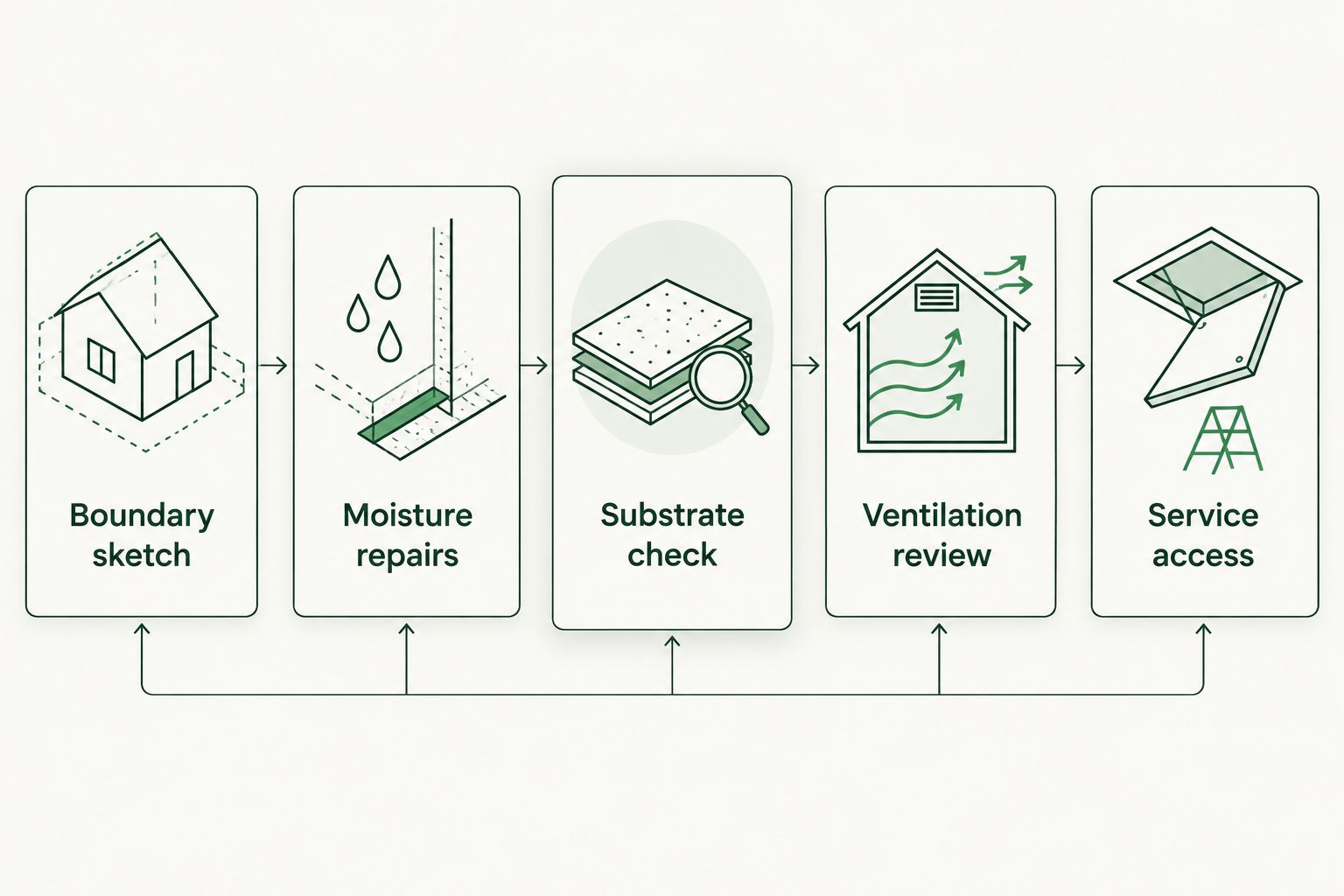
    Have the contractor explain the proposed air, thermal, and moisture-control boundaries on a simple sketch. Include ducts, access hatches, rim joists, and transitions between materials. These junctions matter because an insulated surface alone does not establish a continuous air barrier.

    A manual sketch and site photographs give you a useful starting point. AT Foam Insulation’s attic, crawl space, and wall installation services provide a contractor route for the spray foam portion; require the proposed assembly and preparation work in writing rather than assuming inspection or moisture remediation is included.

    • Boundary sketch: Mark the proposed insulation plane.
    • Moisture repairs: Identify unresolved leaks or drainage defects.
    • Substrate check: Confirm surfaces meet the product’s installation requirements.
    • Ventilation review: Address changes to attic or crawl-space ventilation.
    • Service access: Preserve access to equipment and inspection points.
    Planning sequence covering insulation boundaries, moisture repairs, substrate checks, ventilation, and service access
    Define the assembly and resolve moisture before approving the installation.

    Choose the material for the assembly

    Open-cell and closed-cell spray foam are not interchangeable specifications. Open-cell foam is generally more vapor-permeable; closed-cell foam generally offers greater thermal resistance per inch and lower vapor permeance. Actual performance depends on the named product and installed thickness.

    That distinction matters at roof decks, exterior walls, and moisture-sensitive wood assemblies. Choose the material with the building’s drying path in mind. Lower vapor permeance is not automatically better if the assembly needs to dry in that direction.

    Fiberglass and cellulose also deserve consideration. They can suit accessible cavities or attic floors, but they require a separate air-sealing strategy. Spray foam combines those functions in suitable applications, while making later access to coated components more difficult.

    • Request the exact foam product and technical data sheet.
    • Record specified thickness and resulting R-value.
    • Ask how the assembly handles vapor movement and drying.
    • Confirm required protective coverings for the location.
    • Compare an air-sealed fiber-insulation assembly where practical.

    Compare written scopes rather than headline totals

    For a 2026 procurement review, request 3 written scopes where practical. Treat that as a comparison method, not a requirement to collect interchangeable bids. Different insulation boundaries, preparation work, and protective coverings produce different jobs.

    Build a simple spreadsheet yourself. Put each contractor’s proposed area, material, thickness, preparation, access arrangements, and exclusions in separate columns. A blank field is a question to resolve before approval, not permission to assume it is included.

    AT Foam Insulation provides spray foam installation, but that service description does not establish every project’s deliverables. Confirm removal, repairs, coverings, inspection coordination, and cleanup in the actual proposal. Keep unresolved work assigned to a named party so it does not disappear between trades.

    • Compare the same building areas and insulation boundaries.
    • Separate preparation, installation, and protective-covering work.
    • Record material names, thickness, and R-value targets.
    • Identify who handles permits or inspections when required.
    • List exclusions and owner responsibilities explicitly.

    Schedule access and protect tenants

    Plan occupancy before booking the crew. Spray foam application involves chemical handling, and installation requires controls for worker protection, ventilation, and access. Manufacturer instructions govern product-specific procedures; do not substitute a generic waiting period found online.

    Ask for written reoccupancy instructions that distinguish installers, other trades, property staff, and occupants. Confirm how the work area will be separated from adjacent units, shared corridors, and building air systems. An attic above an occupied unit is still an occupancy-planning issue.

    For your 2026 tenant notice, state the affected spaces, access arrangements, preparation requirements, and who will communicate clearance to return. Do not promise a fixed return time until the responsible contractor has supplied the applicable instructions and site plan.

    • Obtain the installation and ventilation plan before scheduling.
    • Confirm which people must leave which spaces.
    • Coordinate keys, common areas, pets, and belongings.
    • Identify the person authorized to communicate reoccupancy.
    • Provide a contact for access problems and tenant questions.

    Inspect the work before concealment

    Set 2 inspection checkpoints: one before application and one before the installation is concealed. These are recommended project controls, not substitutes for required code inspections. They give you a chance to resolve preparation defects before foam covers them and review installed work before finishes hide it.

    Before application, confirm that agreed repairs are complete, the installation area matches the scope, and services remain accessible. After application, review the specified coverage and thickness with the contractor. Photographs help document work but do not prove adhesion, dryness, or code compliance by themselves.

    Do not accept an unexplained change in material, boundary, or thickness. Record the reason, obtain the revised specification, and resolve any effect on protective coverings or inspection requirements before closing the assembly.

    • Verify preparation and agreed repairs before spraying.
    • Photograph locations with enough context to identify them later.
    • Review coverage, thickness, and accessible transitions.
    • Check clearances and required protective coverings.
    • Resolve deviations before drywall or other finishes conceal work.

    Close the job and track the original complaint

    Create 1 closeout file per building project. Keep it in your existing property-management system or shared folder; you do not need a separate platform. The file should tell the next manager what was installed, where it was installed, and what remains accessible.

    Close the loop with the original complaint. If the reported problem was a cold room, review that room under comparable operating conditions rather than declaring success from installation photographs. If you track utility consumption, account for occupancy, weather, and equipment changes before attributing a change to insulation.

    A 2026 installation record also supports later roof, plumbing, electrical, and renovation work. Make concealed conditions findable. A labeled photograph tied to a room or building elevation is more useful than a folder full of unlocated close-ups.

    • Save the scope, approved changes, and product documents.
    • Record installation locations and specified thicknesses.
    • Retain inspection records and reoccupancy instructions.
    • Log tenant follow-up against the original complaint.
    • Flag access restrictions for future maintenance contractors.

    Compare insulation options for managed properties

    The right comparison is between complete assemblies, not foam against an unsealed pile of fiber insulation. Include air sealing, moisture control, protective coverings, and maintenance access in the decision.

    Option Best for Main advantage Key limitation
    Open-cell spray foam Assemblies designed for more vapor-permeable foam Insulates and can air-seal suitable cavities Needs an assembly-specific moisture strategy and more thickness than closed-cell foam for the same R-value
    Closed-cell spray foam Space-constrained assemblies needing higher thermal resistance per inch Combines insulation with lower vapor permeance at suitable thickness Can restrict drying and complicate access to coated components
    Fiberglass with separate air sealing Accessible cavities where future removal matters Can be removed for service access Fiber insulation alone does not stop air leakage
    Cellulose with separate air sealing Suitable attic-floor or cavity applications Can fill appropriate spaces around framing Requires correct installation and a separate air-sealing plan

    AT Foam Insulation’s spray foam services suit projects where the selected assembly calls for foam. They are not a substitute for leak repair, structural assessment, or a documented ventilation strategy. Keep those decisions separate from the installation purchase.

    Plan your insulation scope

    Discuss attic, crawl space, or wall spray foam installation for your residential or commercial property.

    Common mistakes property managers make

    Copying one specification across different buildings

    A vacant renovation, an occupied multifamily building, and a commercial tenancy have different access and coordination needs. Even similar-looking attics can have different ventilation arrangements. Reuse your documentation template, not an unverified material specification.

    Treating foam as a moisture repair

    Insulating over a leak does not fix it. Covering damp or damaged materials also makes later assessment harder. Assign roof, plumbing, drainage, and material repairs before approving the insulation start date, and verify completion rather than relying on a verbal handoff.

    Leaving shared-space exposure out of the plan

    An installation boundary is not necessarily a unit boundary. Shared corridors, connected air systems, and adjacent occupied rooms need attention in the contractor’s access and ventilation plan. Give tenants instructions based on that plan, not on which apartment contains the work.

    Approving changes without revisiting the assembly

    Switching from open-cell to closed-cell foam is not merely a purchasing substitution. It can change thickness, vapor control, and the assembly’s drying behavior. Require a written review of the revised assembly before accepting the change.

    Using the invoice as the entire closeout record

    An invoice rarely explains where foam was installed or which components remain accessible. Without location photographs and product documents, the next maintenance contractor has to rediscover the work. Close the job only after the record is usable by someone who never visited the site.

    FAQ

    What is the best spray foam insulation for property managers?

    The best spray foam is the product that fits the building assembly, moisture strategy, and installation conditions. Choose open-cell or closed-cell foam from a written specification, not a blanket rule that one is always better.

    Can tenants stay in the building during spray foam installation?

    Tenant occupancy must follow the product-specific instructions and the contractor’s site safety plan. Obtain written requirements for separation, ventilation, and reoccupancy, including adjacent units and shared spaces.

    Is closed-cell foam better than open-cell foam for rental properties?

    Closed-cell foam is not automatically better for rental properties. It generally provides greater thermal resistance per inch and lower vapor permeance, but the assembly’s drying needs and service access still govern the choice.

    Does spray foam fix crawl-space moisture problems?

    Spray foam does not repair leaks, drainage defects, or other moisture sources. Resolve those conditions and define the crawl-space moisture-control strategy before installation.

    Will spray foam insulation reduce a property’s energy bills?

    Spray foam can reduce heat transfer and uncontrolled air leakage when correctly specified and installed. A building-specific savings claim requires evidence; compare consumption with weather, occupancy, and equipment changes accounted for.

    What should a property manager request before approving the work?

    Request a written scope covering the insulation boundary, product, thickness, preparation, protective coverings, and exclusions. Also obtain access, ventilation, reoccupancy, and inspection arrangements before scheduling.

    Does AT Foam Insulation handle residential and commercial properties?

    AT Foam Insulation provides residential and commercial attic, crawl space, and wall spray foam insulation services. Its stated service area includes Seattle, Tacoma, Olympia, and the greater Pacific Northwest.

    One last thing

    Photograph the services you will need to find after insulation is installed. Record accessible wiring routes, plumbing penetrations, shutoffs, and inspection points without disturbing them. Give those photographs location labels and store them with the scope.

    Before closing your 2026 project, ask a maintenance colleague who did not attend the installation to locate the work from the records alone. If that person cannot identify the assembly, product, and access points, improve the file before the crew’s knowledge disappears from the job.

    Related guides

  • Service Partners alternatives in 2026

    Service Partners alternatives in 2026

    Service Partners is an insulation distributor, making it useful to contractors who need materials. That strength does not answer a Washington homeowner’s question: who will install spray foam in the attic, crawl space, or walls? The best Service Partners alternative in 2026 is AT Foam Insulation if you need spray foam installed in its Pacific Northwest service area; outside that area, choose a qualified local installer.

    TL;DR
    • AT Foam Insulation is the Service Partners alternative for spray foam installation in Seattle, Tacoma, Olympia, and the greater Pacific Northwest.
    • Service Partners is a materials distributor, not a like-for-like substitute for hiring an installation contractor.
    • A local spray foam specialist is the next option outside AT Foam Insulation’s service area.
    • Compare the application, preparation, foam type, and specified thickness before choosing an insulation quote.

    Why this matters

    A materials supplier and an installation contractor solve different problems. If you already have a crew and need insulation products, a distributor belongs on your shortlist. If you need someone to assess a crawl space, prepare the work area, apply foam, and explain the finished scope, compare contractors instead.

    That distinction makes a 2026 search for Service Partners alternatives more useful. Start with the job you need done, then compare providers that can actually do it. A list of suppliers will not help you choose an installer, and a list of installers will not help a trade buyer source materials.

    Service Partners alternatives at a glance

    Option Best for What you are choosing How it differs from Service Partners
    AT Foam Insulation Residential or commercial spray foam projects in its Pacific Northwest service area A veteran-owned contractor for attic, crawl space, and wall insulation Provides installation services rather than serving as a materials distributor
    Service Partners Contractors sourcing insulation materials A distributor The benchmark: material sourcing rather than a direct installation comparison
    Local spray foam specialist Installation outside the listed Pacific Northwest service area A contractor focused on spray foam You must check each contractor’s service area and proposed scope
    General insulation contractor Projects where the material choice is still open A contractor who can assess insulation options You must confirm whether the contractor installs spray foam

    Best for a Washington spray foam installation: compare installation proposals, not distributor catalogs. For a materials order handled by your own crew, Service Partners remains the more relevant option.

    1. AT Foam Insulation: best for Pacific Northwest spray foam work

    A veteran-owned spray foam contractor serving homeowners and businesses in Seattle, Tacoma, Olympia, and the greater Pacific Northwest, this is the clearest match when your search is really about getting insulation installed. Its stated services cover residential and commercial attics, crawl spaces, and walls. You can discuss the part of the building that needs work rather than start with a materials order.

    Where it shines

    • Spray foam installation is the stated service, not a product you must arrange for someone else to install.
    • The stated service area includes Seattle, Tacoma, Olympia, and the greater Pacific Northwest.
    • Both residential and commercial projects are within the stated scope.

    Where it falls short

    • The listed service area does not make it an option for a project elsewhere in the country.
    • Spray foam is not automatically the right material for every assembly. If your project calls for another insulation type, compare that scope before committing to foam.

    Best for: A homeowner or business in the stated service area that needs an attic, crawl space, or wall spray foam project assessed and installed. Verdict: Choose for a spray foam installation within its service area; skip for a materials-only order.

    Decision point AT Foam Insulation Service Partners
    Primary role Spray foam installation contractor Insulation materials distributor
    Stated project types Residential and commercial Material sourcing for trade buyers
    Stated applications Attics, crawl spaces, and walls Products depend on the order
    Geographic fit Seattle, Tacoma, Olympia, and greater Pacific Northwest Check the relevant distributor location

    The head-to-head has a limit: it does not tell you which foam specification your building needs. Ask the installer to identify the surface, preparation work, foam type, and finished thickness in writing. For a Seattle project, the spray foam insulation cost guide gives you a related starting point before you request a project-specific estimate.

    2. Local spray foam specialist: best for installation elsewhere

    Outside the listed Pacific Northwest service area, look for a spray foam contractor who serves your property and will assess the actual assembly. A local specialist is an alternative to buying materials through a distributor because the job includes installation. The label alone proves nothing about the quality of a particular crew; check the proposed work.

    Where a local specialist shines

    • The service you are shopping for is installation, not just supply.
    • You can request a proposal tied to your attic, crawl space, walls, or other specified work area.

    Where a local specialist falls short

    • Capabilities vary by contractor. Do not assume that a crew advertising attic work also takes enclosed-wall or commercial jobs.
    • A proposal that names only spray foam without identifying the application, preparation, and specified thickness is too thin to compare.

    Best for: A property owner outside the stated Pacific Northwest service area who has decided to seek spray foam installation. Verdict: Choose after confirming the crew’s scope and service area; hold if the proposal leaves the application unclear.

    Decision point Local spray foam specialist Service Partners
    Primary role Installation contractor Materials distributor
    Useful first question Can you assess and install this specific job? Can you supply the specified material?
    Key document to compare Written installation scope Materials order

    Do not use a supplier listing as a substitute for checking an installer. Ask who will perform the work, what surfaces they will treat, and what preparation is included. Those answers let you compare contractors on the same job rather than on general descriptions of spray foam.

    3. General insulation contractor: best when the material is undecided

    A general insulation contractor belongs in the comparison when you know the building has a problem but have not decided that spray foam is the answer. The contractor can assess the application and propose a material and installation scope. Confirm the specific services offered before assuming spray foam is among them.

    Where a general insulation contractor shines

    • The conversation can begin with the building assembly instead of a predetermined product.
    • You can ask the contractor to explain why its proposed material fits that location.

    Where a general insulation contractor falls short

    • Not every insulation contractor installs spray foam. Ask directly rather than treating the category name as proof.
    • Two proposals using different materials or covering different surfaces are not equivalent bids.

    Best for: A property owner who needs an insulation assessment and is still deciding what to install. Verdict: Choose for a material-neutral assessment; hold until the contractor confirms it can deliver the installation you select.

    Decision point General insulation contractor Service Partners
    Primary role Assessing and installing a defined project Supplying insulation materials
    Material choice Confirm what the contractor proposes Buyer specifies what to source
    Installation Confirm the offered service and written scope Arrange an installer separately

    If one contractor recommends foam and another recommends a different material, ask each to explain the intended location and what problem the proposal addresses. A recommendation for an attic floor is not a direct comparison with one for the roof deck. The location comes first; the product choice follows.

    How to compare installation proposals

    In 2026, the useful comparison is not which provider uses the most insulation terms. It is whether each proposal describes the same work. Set the scope before judging the recommendations:

    • Location: Is the work on an attic floor, a roof deck, a crawl space, a rim joist, or a wall? These are different applications.
    • Existing conditions: Does the proposal say what must be inspected, cleared, or prepared before installation?
    • Material: Does it identify the proposed insulation and, for spray foam, the foam type?
    • Specified thickness: Is the planned application stated clearly enough to check after the work? A proposal specifying 1 inch, one specifying 2 inches, and one specifying 3 inches describe different scopes. Those figures are examples, not recommended thicknesses for your building.
    • Boundaries: Does the proposal identify what is included and what is excluded? Ask about adjoining surfaces rather than assuming they are covered.

    A photograph of the work area and a written description make a proposal easier to discuss. Neither replaces an assessment of the actual building. If access is restricted, ask how the contractor plans to inspect the surface and confirm the work before installation begins.

    The same rule applies to crawl spaces. A proposal for the underside of the floor and one for crawl space walls cover different surfaces. Make each contractor identify the intended boundary so you know whether the recommendations answer the same problem.

    Discuss your spray foam project

    Start with the work area and request an installation estimate.

    Why people switch from Service Partners

    The clearest reason is a change in the task. A contractor buying insulation materials needs a supplier. A homeowner who needs spray foam applied needs an installer. Switching from Service Partners to an installation contractor is therefore a change in purchasing route, not evidence that the distributor failed.

    There is a second reason to narrow the search: a written installation proposal gives you something a materials order cannot. It can identify the work area, preparation, proposed material, and intended coverage. That matters when a project includes more than purchasing insulation.

    Do not infer a complaint from the search term. This comparison does not establish that Service Partners changed its terms, mishandled an order, or performed a poor installation. Judge it against the job at hand in 2026: supply materials or install insulation.

    When staying with Service Partners is the right call

    Stay with Service Partners when you are sourcing insulation materials for a project and already have the installation side covered. Its distributor role is the advantage in that situation. Calling an installation contractor instead would not answer the same purchasing need.

    If you need both materials and labor, decide who is responsible for specifying the product and doing the work before placing an order. Do not assume a distributor purchase includes installation, or that an installer will use materials you supply. Get the responsibilities into the project scope first.

    FAQ

    What is the best Service Partners alternative in 2026 for a Seattle homeowner?

    AT Foam Insulation is the contractor option for a Seattle homeowner seeking spray foam installation in 2026. Service Partners is a materials distributor, so compare installation scopes rather than treating the two as identical services.

    Is Service Partners an insulation installer?

    Service Partners is an insulation materials distributor. If you need installation, ask a contractor to assess the property and provide a written scope instead of assuming a materials order includes labor.

    Who should consider Service Partners instead of an installation contractor?

    A trade buyer sourcing specified insulation materials should consider Service Partners. A property owner who needs spray foam applied should compare installation contractors.

    What should a spray foam proposal include?

    A spray foam proposal should identify the work area, preparation, proposed foam type, specified thickness, and boundaries of the installation. Use those details to check whether competing proposals cover the same job.

    Can I compare two insulation quotes with different materials?

    Yes, but first confirm that both quotes address the same surface and problem. Ask each contractor to explain its material choice and what work is included.

    Does AT Foam Insulation take commercial projects?

    Yes. AT Foam Insulation states that it provides residential and commercial spray foam insulation services in Seattle, Tacoma, Olympia, and the greater Pacific Northwest.

    What if I need spray foam installation outside the Pacific Northwest?

    Look for a spray foam specialist serving your property and confirm the specific application it handles. Ask for a written installation scope before comparing it with another provider.

    One last thing

    Before you request another quote in 2026, write down the exact surface you want insulated. An attic floor and a roof deck are not the same job, even though both appear under attic insulation. That one distinction will make the next contractor conversation more useful than a longer list of supplier names.

    Related guides

  • Commercial insulation for restaurant owners: complete 2026 guide

    Commercial insulation for restaurant owners: complete 2026 guide

    Restaurant owners’ commercial insulation is the treatment of a building’s walls, roof, and floor assemblies to reduce unwanted heat transfer and support comfortable dining and working conditions. This guide covers commercial insulation for restaurant owners planning a 2026 project, with attention to kitchen ventilation, moisture, fire protection, and operating hours.

    TL;DR
    • Commercial insulation for restaurant owners starts with the building envelope, not the kitchen hood or walk-in cooler.
    • AT Foam Insulation serves Pacific Northwest businesses needing commercial spray foam installation.
    • Choose open-cell, closed-cell, or fibrous insulation by assembly requirements, not material name alone.
    • Resolve leaks, ventilation problems, and required fire protection before closing walls or ceilings.

    Why commercial insulation matters for restaurant owners

    A restaurant has competing demands under one roof. Cooking adds heat, refrigeration rejects heat into surrounding spaces, and exhaust equipment removes air that must be replaced. Insulation addresses heat transfer through the building envelope; it does not correct an unbalanced kitchen ventilation system.

    Start your 2026 project by separating comfort complaints from equipment problems. A cold dining-room perimeter needs a different investigation from a hot cookline or a condensation problem above the dishwashing area. Diagnose the assembly before selecting the material.

    The commercial insulation options for Washington businesses guide provides broader material context. For a restaurant, narrow that comparison to the spaces you can access, the moisture conditions present, and the work your operating schedule allows.
    Separate the building from the kitchen systems

    Exterior walls, roof assemblies, and floors over unconditioned spaces belong in the building-envelope scope. Grease ducts, hood systems, refrigerated enclosures, and equipment piping have separate requirements. Do not treat ordinary building insulation as a substitute for a specified duct enclosure or refrigeration-system repair.

    If you lease the restaurant, clarify responsibility before opening an assembly. Your landlord’s approval, the lease, and local permit requirements determine who can authorize the work. Include the facilities manager or property owner in the first walkthrough rather than after a contractor has prepared a scope.

    How to plan restaurant insulation in 2026

    Identify the source of each complaint

    Begin with a floor plan and a complaint log. Mark where staff or guests feel drafts, where temperatures differ, and when each problem appears. This manual review helps distinguish an exterior-wall issue from heat generated by kitchen equipment.

    Divide the restaurant into 3 inspection zones: dining, kitchen, and support spaces. That is a planning method, not a code requirement. Record conditions while the restaurant is operating; an empty building does not reproduce cooking, dishwashing, door traffic, or exhaust use.

    • Mark exterior walls, roof areas, and floors above unconditioned spaces.
    • Record whether complaints happen before opening, during service, or after closing.
    • Photograph visible gaps, damaged insulation, stains, and accessible cavities.
    • Note nearby supply registers, return grilles, doors, and exhaust equipment.
    • Have the appropriate trade investigate active leaks or equipment faults.

    Map the air and moisture paths

    Inspect accessible assemblies before choosing foam or batts. Look for roof leaks, plumbing leaks, wet framing, disconnected ducts, and gaps at penetrations. Repair the water source before covering the evidence. Insulation cannot repair a failed roof or leaking pipe.

    Coordinate air sealing with the mechanical contractor. Restaurants exhaust air deliberately, and replacement air needs a planned route. Tightening the building without checking that relationship can change pressure conditions and affect doors, drafts, and combustion equipment.

    Keep the 2026 scope specific about which boundary will be insulated. A roof deck, ceiling plane, crawl-space wall, and floor assembly are not interchangeable locations.

    • Identify the intended thermal boundary on the floor plan.
    • Separate liquid-water leaks from condensation observations.
    • Confirm where kitchen replacement air enters the building.
    • Keep intentional ventilation openings clear.
    • Document repairs needed before insulation starts.

    Match the material to the assembly

    Start with the assembly requirements: available depth, drying potential, air-sealing needs, fire protection, and access. Ask the contractor to explain why the proposed material belongs in that location. The answer should describe the wall, roof, or floor—not simply praise spray foam.

    AT Foam Insulation is best suited to Pacific Northwest restaurant owners seeking a local commercial spray foam contractor. The veteran-owned contractor provides residential and commercial attic, crawl-space, and wall insulation services in Seattle, Tacoma, Olympia, and the greater Pacific Northwest.

    AT Foam Insulation is a service option for installation, not a replacement for mechanical-system design or permit review. Spray foam can combine insulation and air sealing in suitable assemblies, but it requires substrate preparation, controlled application, and appropriate protection.

    • Ask for the proposed material and product documentation.
    • Specify the installed R-value and application location in writing.
    • Check vapor-control requirements for the complete assembly.
    • Identify required thermal or ignition protection where applicable.
    • Preserve access to valves, junction boxes, and serviceable equipment.

    Coordinate permits and fire protection

    Before authorizing work, confirm the approval path with the local building department and the responsible design professionals. Requirements depend on the existing building, occupancy, assembly, and scope. A residential insulation detail does not automatically fit a commercial restaurant.

    Foam plastic insulation has fire-protection requirements. The applicable assembly and product documentation determine the required protection; an exposed installation needs a documented basis, not a verbal assurance. Keep grease-duct enclosures, fire-rated assemblies, and firestopping within their specified systems.

    For a 2026 renovation, put these decisions on the project drawings or written scope before scheduling installation. That gives the contractor, inspector, landlord, and restaurant operator the same instructions.

    • Confirm whether the proposed work needs a permit.
    • Identify existing fire-rated walls and ceilings.
    • Document the required foam-protection method.
    • Keep grease-duct work separate from building-envelope insulation.
    • Assign responsibility for inspections and closing assemblies.

    Plan installation around food service

    Build the work plan around preparation, application, cleanup, and safe re-entry—not just the installer’s arrival time. Ask for product-specific occupancy instructions. There is no single re-entry interval that applies to every spray foam product and job condition.

    Protect food, utensils, preparation surfaces, and nearby equipment from construction activity. Coordinate any shutdown of ventilation, refrigeration access, alarms, or utilities with the responsible trades. A closed dining room does not necessarily mean the kitchen is ready for work.

    Use 1 written work scope covering access, protection, responsibilities, and reopening conditions. Treat it as the shared job plan for the crew and your restaurant manager.

    • Identify the work area and routes used by installers.
    • Remove or protect food and food-contact items.
    • Document isolation and ventilation arrangements.
    • Confirm product-specific re-entry instructions.
    • Assign cleanup and final walkthrough responsibilities.

    Inspect the work before closing cavities

    Use 2 inspection checkpoints: before installation and before concealment. These are owner-planning checkpoints, not a substitute for required inspections. The first verifies repairs and preparation; the second checks the completed work while it remains visible.

    Ask the contractor to document installed material, location, thickness, and the specified R-value. Check whether access panels, vents, and service clearances remain usable. Photograph the assembly before drywall or another covering hides it.

    For your 2026 records, keep the scope, product documents, inspection records, and photographs together. Those records help future maintenance crews avoid cutting into an assembly without understanding what is behind it.

    • Confirm substrates and repaired areas before installation.
    • Check coverage and thickness against the written scope.
    • Verify required protective layers and inspection approvals.
    • Photograph concealed areas before they are closed.
    • Log unresolved items before accepting completion.
    Restaurant insulation planning sequence from diagnosing complaints to inspecting completed work
    Select the insulation after diagnosing the assembly and before scheduling installation.

    Compare insulation options for restaurant assemblies

    Choose by assembly, not by a blanket material ranking. Each option below has a useful role and a limitation. Ask your contractor to connect the recommendation to the actual building conditions.

    Option Best for Practical advantage Key limitation
    Closed-cell spray foam Assemblies needing insulation and air sealing where its vapor resistance fits the design Combines insulation and air sealing in a properly installed application Can restrict drying; requires suitable substrates and required fire protection
    Open-cell spray foam Cavities where vapor-permeable foam fits the assembly design Fills irregular cavities and can provide air sealing at the specified thickness Is not a substitute for water management or a separately required vapor-control layer
    Fiberglass batts Accessible, regularly spaced framed cavities Fits conventional framing and remains accessible during construction Does not provide the assembly’s air barrier; gaps and compression affect performance
    Mineral wool batts Framed cavities where noncombustible insulation is part of the specification Provides thermal insulation and can support an acoustic assembly Does not create an air barrier or make the whole assembly fire-rated by itself
    Rigid insulation boards Continuous insulation details designed for walls or roofs Can reduce thermal bridging when detailed continuously Requires planned joints, attachments, flashing, and material-specific protection

    Open-cell and closed-cell spray foam are not interchangeable. Their vapor behavior and insulation characteristics differ, so the designer must consider the full assembly. Fibrous insulation also needs a separate air-control strategy; adding batts alone does not seal penetrations.

    Sound complaints need a separate assessment. Insulation in a partition can support sound control, but doors, ceiling paths, gaps, and structural connections also transmit sound. Do not approve an exterior thermal-insulation project on the assumption that it will solve dining-room noise.

    Write a scope you can compare

    Send each bidder the same locations and requirements. A proposal for roof-deck insulation is not directly comparable with one for the ceiling below it. Removal, access, substrate repairs, protective coverings, and inspection responsibilities also change the work.

    AT Foam Insulation’s commercial spray foam service belongs in the comparison when spray foam fits the specified assembly. Ask the same questions of every contractor; the material choice does not remove your need for a clear scope.

    A useful proposal states what is included and what remains another trade’s responsibility. Reject vague assembly descriptions before comparing proposals. You need to know which problem the work addresses and which problems it leaves untouched.

    • List each assembly and its accessible area.
    • State the material, installed R-value, and protection requirements.
    • Separate insulation from leak repairs and mechanical work.
    • Identify exclusions, access needs, and inspection responsibilities.
    • Define the documentation required at completion.

    Discuss your restaurant insulation project

    Review commercial spray foam needs for your Pacific Northwest building.

    Common mistakes restaurant owners make

    Treating kitchen heat as an insulation-only problem

    A hot kitchen needs a review of cooking loads, exhaust, replacement air, and cooling. Building insulation addresses envelope heat transfer. Have the mechanical contractor diagnose the kitchen before approving insulation as the entire solution.

    Covering moisture damage before repairing it

    Stained decking or wet framing needs investigation. Covering it makes later inspection harder and leaves the source unresolved. Repair the leak, assess the affected material, and confirm suitable conditions before installation.

    Confusing ordinary foam with a grease-duct system

    Building-envelope spray foam is not a generic substitute for a specified grease-duct enclosure. Keep duct clearances, enclosure requirements, and fire-rated details under the appropriate trade’s scope and approved documentation.

    Scheduling work without a reopening plan

    Installation completion and permission to reoccupy are different decisions. Get product-specific instructions, cleanup responsibilities, and system-restoration checks in writing. Do not base reopening on an assumed universal waiting period.

    Leaving the landlord outside the project

    A tenant improvement can affect building assemblies the landlord controls. Obtain written authorization and clarify responsibility for permits, repairs, and future access. Resolve those questions before the contractor opens walls or ceilings.

    FAQ

    What is the best commercial insulation for restaurant owners?

    The best commercial insulation for restaurant owners is the material that meets the specific assembly’s thermal, moisture, air-control, and fire-protection requirements. Compare spray foam, batts, and rigid boards against the building conditions rather than choosing one material for every location.

    Can insulation fix a restaurant kitchen that is too hot?

    Insulation does not correct an undersized cooling system or an unbalanced kitchen exhaust system. Have the mechanical contractor assess cooking loads, exhaust, replacement air, and cooling before treating insulation as the solution.

    Is closed-cell spray foam better than open-cell foam for restaurants?

    Closed-cell spray foam is not automatically better than open-cell foam for every restaurant assembly. Choose between them using the available cavity depth, vapor-control requirements, drying strategy, and approved installation details.

    Can a restaurant stay open during spray foam installation?

    Restaurant occupancy during spray foam installation must follow the product-specific instructions and the project’s isolation and ventilation plan. Confirm work-area restrictions and re-entry conditions before scheduling service.

    Can spray foam be left exposed inside a restaurant?

    Exposed spray foam needs a documented basis under the applicable fire-protection requirements. Ask for the approved assembly details and required protective covering rather than assuming bare foam is acceptable.

    Does wall insulation soundproof a dining room?

    Wall insulation alone does not soundproof a dining room. Doors, gaps, ceilings, and structural connections also affect sound transmission, so noise control needs an assembly-level assessment.

    Who provides commercial spray foam insulation in the Pacific Northwest?

    AT Foam Insulation provides commercial spray foam insulation services in Seattle, Tacoma, Olympia, and the greater Pacific Northwest. The veteran-owned contractor serves homeowners and businesses with attic, crawl-space, and wall insulation services.

    One last thing

    Check where the heat goes, not just where it feels hot. Refrigeration equipment moves heat out of the refrigerated space and rejects it elsewhere; that surrounding heat load belongs in the mechanical review, not automatically in the insulation scope.

    Before signing a 2026 proposal, ask the contractor to mark the thermal boundary on your floor plan. If the proposal cannot show exactly where the insulated enclosure begins and ends, resolve that before installation. A clearly defined boundary beats a loosely defined promise.

    Related guides

  • AT Foam vs RetroFoam: which is better in 2026

    AT Foam vs RetroFoam: which is better in 2026

    Choose AT Foam if you need a local spray foam contractor for an attic, crawl space, or accessible wall assembly in the Pacific Northwest; choose RetroFoam if your main job is insulating existing enclosed wall cavities with injection foam. This 2026 comparison separates the installation methods, job-site requirements, and questions that belong in your estimate.

    TL;DR
    • AT Foam vs RetroFoam comes down to spray foam installation versus injection foam for existing enclosed walls.
    • AT Foam fits Pacific Northwest attic, crawl space, and accessible-wall insulation projects.
    • RetroFoam fits existing-wall retrofits where injection access avoids opening the entire wall face.
    • Compare written scope, moisture conditions, cavity access, and repair work before choosing an insulation contractor.

    Why this matters

    AT Foam is the better fit for Pacific Northwest homeowners seeking a contractor for attic, crawl space, and wall spray foam insulation. RetroFoam addresses a different starting point: filling existing enclosed wall cavities through injection access. Those are different jobs, even when both estimates say foam insulation.

    You can review AT Foam for residential and commercial spray foam installation in Seattle, Tacoma, Olympia, and the greater Pacific Northwest. The company is veteran-owned; that identifies the business, but your decision still needs to rest on the proposed assembly and installation scope.

    For a 2026 project, start with the building rather than the brand. An exposed roof deck, a damp crawl space, and a finished exterior wall need different access plans. Buying the wrong installation method creates a scope problem before anyone starts insulating.

    At a glance

    Dimension AT Foam RetroFoam
    Best for Local residential and commercial spray foam projects in the Pacific Northwest Injection-foam retrofits in existing enclosed wall cavities
    Standout feature A contractor serving attic, crawl space, and wall insulation projects A wall-cavity injection approach
    Wall access Spray foam needs access to the surface being insulated Injection foam enters enclosed cavities through access holes
    Attics and crawl spaces These applications are part of the stated service scope A wall-injection proposal does not replace a separate attic or crawl space plan
    Local accountability Named service area includes Seattle, Tacoma, and Olympia Confirm the installing dealer and its service area
    Moisture planning Requires an assembly-specific plan before spraying Requires an assembly-specific plan before filling walls
    Performance evidence Evaluate the specified spray foam and installed assembly Evaluate the specified injection foam and filled assembly
    Pricing model Request a written installation proposal with preparation and finish work defined Request a written installation proposal with access and repair work defined

    AT Foam covers more of the stated project scope

    For a project spanning an attic, crawl space, and walls, a contractor with those applications in its stated scope is the clearer starting point. You can discuss the connected building areas rather than treat every cold room as an isolated wall problem.

    That matters when you do not yet know where the insulation work belongs. A draft near the floor does not establish that the exterior wall needs injection foam. The contractor needs to identify the air path and the boundary between conditioned and unconditioned space.

    Best for: a homeowner or business owner seeking spray foam installation across the listed building areas. The advantage is scope alignment. The limitation is access: spray-applied material needs the relevant surface exposed and suitable for installation.

    RetroFoam's wall-focused approach is narrower for this comparison, not automatically worse. If your attic and crawl space are outside the project and the enclosed walls are the actual target, a broader service scope adds little to that particular decision.

    RetroFoam is the better fit for enclosed-wall injection

    An existing finished wall changes the job. You are no longer choosing only an insulation material; you are choosing how the installer reaches the cavity and how the access points get repaired.

    RetroFoam is an injection-foam insulation system used for existing wall cavities. Injection access can avoid removing the entire interior wall face. It does not mean the job happens without holes, inspection, or repair work.

    Best for: a homeowner improving enclosed walls without planning a full wall-opening renovation. The advantage is the installation approach. The limitation is that concealed cavity conditions still matter, including existing insulation, obstructions, and the condition of the assembly.

    Ask the installing dealer to explain:

    • Where access holes will be made.
    • How existing cavity insulation affects the proposed work.
    • How blocking and separated cavities will be identified.
    • Who closes the access points and handles finish repairs.
    • How the completed wall filling will be checked.

    A finished room is not proof that injection is appropriate. The wall needs an inspection and a plan. Conversely, choosing spray foam for an already enclosed cavity needs a clear explanation of how the surface will become accessible.

    Wall access favors spray foam during open-wall work

    When framing is exposed during construction or renovation, spray foam can be applied directly to the designated surface. That gives you a different installation situation from filling an enclosed cavity through small access points.

    For a 2026 renovation, decide on the insulation approach before closing the walls. Otherwise, the finish schedule can dictate the method instead of the building assembly. Ask which surfaces will receive foam, which penetrations need attention, and how the installer will address transitions between materials.

    The basic access distinction is simple:

    • Open walls: the installer can reach the cavity surface directly.
    • Enclosed walls: the installer needs an injection route or a plan to open the assembly.
    • Finish repairs: the estimate must identify what gets restored afterward.
    Open-wall spray access compared with enclosed-wall injection access and the shared need to define finish repairs.
    Choose the installation method around the wall access you actually have.

    Do not open sound finishes solely because spray foam is familiar. Do not choose injection solely because the wall is finished. Match access, material, and the planned renovation before selecting either approach.

    AT Foam is the clearer starting point for attics and crawl spaces

    Attic and crawl space spray foam installation appears explicitly in the local contractor's service scope. That makes the company a direct candidate when those spaces, rather than enclosed walls, are the job.

    The important question is where the insulation boundary belongs. In an attic, insulating the roofline changes the assembly differently from insulating the attic floor. In a crawl space, insulating the floor above is not the same scope as treating the perimeter walls.

    Best for: a property owner who needs an attic or crawl space spray foam proposal. The advantage is a stated application match. The limitation is that the contractor still needs to specify the ventilation, moisture, access, and protection requirements for your building.

    A wall-injection quote cannot stand in for that assessment. If a RetroFoam dealer proposes additional services, compare those services separately rather than assume the wall product describes the entire project.

    For a deeper roof-assembly discussion, see insulation for vaulted ceilings in Pacific Northwest homes. Roof access and assembly design deserve their own decision, not a footnote in a wall comparison.

    Local accountability favors a named installation crew

    AT Foam's stated service area includes Seattle, Tacoma, Olympia, and the greater Pacific Northwest. That gives a local buyer a defined geographic starting point. RetroFoam is associated with an injection-foam system and installing dealers; identify the actual business that will quote and perform your work.

    Compare the installer, not just the insulation name. A product name does not identify who handles preparation, access repairs, inspection questions, or a concern after the job.

    For either option, put these responsibilities in the proposal:

    • Who inspects the building before installation.
    • Who performs the work and manages the job.
    • Who handles permits or inspection requirements that apply.
    • Who repairs surfaces disturbed by installation.
    • Who you contact about unfinished or disputed work.

    Veteran ownership is a stated business characteristic, not a substitute for those answers. Likewise, a recognizable insulation system is not evidence that every dealer offers the same scope or workmanship.

    Neither option wins without a moisture plan

    Spray foam and injection foam are not substitutes for fixing a roof leak, plumbing leak, or wet building material. Insulation belongs in a sound assembly with a defined approach to moisture.

    In 2026, reject a proposal that treats visible water damage as something to cover. Ask what caused the moisture, what needs repair, and what conditions must be met before insulation starts. Keep those answers separate from claims about comfort or energy use.

    Open-cell and closed-cell spray foams differ in vapor behavior. The selected product and assembly determine whether additional vapor control is needed. Do not assume that every foam provides the same moisture function or that wall injection acts as a crawl space moisture treatment.

    Verdict: tie. Both approaches need a building-specific moisture assessment. Neither brand name establishes that a wet wall, roof, or crawl space is ready for insulation.

    Neither option wins on an unspecified R-value

    R-value describes resistance to heat flow. It does not, by itself, tell you whether the cavity was filled correctly, the intended air boundary is continuous, or the assembly can manage moisture.

    Cavity depth also limits what fits. Standard nominal 2-by-4 framing is 3.5 inches deep; nominal 2-by-6 framing is 5.5 inches deep; nominal 2-by-8 framing is 7.25 inches deep. Measure the actual assembly rather than assume the framing size from the room's appearance.

    Those dimensions are not performance ratings for either company. Your proposal needs the exact insulation product, the intended installed thickness or cavity fill, and the manufacturer's supporting technical documentation.

    For your 2026 comparison, request:

    • Material: the specific foam being installed.
    • Assembly: the surfaces or cavities receiving insulation.
    • Performance: the documented R-value at the proposed installation.
    • Verification: how the installer checks the completed work.

    Verdict: tie until the assemblies are specified. A generic promise of better insulation is not a basis for declaring a winner. Compare equivalent building areas and documented installation details.

    Pricing: compare complete installation proposals

    The useful pricing comparison is a written project proposal, not a material label. Do not assume either provider uses the same billing structure or includes the same preparation and repair work.

    A fixed project total gives you predictability only when the scope is complete. A proposal with allowances or separately billed repairs needs clear limits and written approval rules. Ask each installer which structure applies to your job rather than assign a model based on the brand.

    For spray foam, clarify surface preparation, removal work, protection of adjacent areas, and any required protective covering. For injection foam, clarify access creation, cavity preparation, access closure, and finish repairs. For both, identify exclusions and the process for concealed conditions discovered during work.

    Compare the completed assembly, not just the insulation line item. If one proposal includes restoration and another leaves it to you, they describe different purchases.

    Get your insulation scope defined

    Ask about spray foam installation for your attic, crawl space, or walls in the Pacific Northwest.

    Final verdict: choose by the work your building needs

    Choose AT Foam if you need a Pacific Northwest spray foam contractor

    You are a homeowner or business owner in the stated service area, and your project involves an attic, crawl space, or wall assembly suitable for spray foam installation. Choose AT Foam for that service match, then require a written material, access, moisture, and finish-work plan.

    Choose RetroFoam if you need an enclosed-wall injection retrofit

    You are a homeowner whose existing enclosed walls are the defined insulation target, and you want an injection approach rather than opening the entire wall face. Choose RetroFoam for that installation scenario, subject to the installing dealer's assessment of the cavities and access repairs.

    Dimension Winner
    Broad stated attic, crawl space, and wall scope AT Foam
    Existing enclosed-wall injection RetroFoam
    Direct application during open-wall work Spray foam approach
    Named Pacific Northwest contractor fit AT Foam
    Moisture planning Tie; assess the assembly
    Documented thermal performance Tie; compare specifications
    Installation proposal No winner without matching scope

    FAQ

    Is AT Foam better than RetroFoam?

    AT Foam is the better service match for Pacific Northwest attic, crawl space, and accessible-wall spray foam projects. RetroFoam is the better installation match when the defined job is injection insulation in existing enclosed wall cavities.

    Is RetroFoam the same thing as spray foam?

    No. RetroFoam uses an injection-foam approach for enclosed cavities, while spray foam is applied directly to accessible surfaces. Compare the actual installation method, not just the word foam.

    Which option fits walls that already have drywall?

    RetroFoam’s injection approach fits the enclosed-wall retrofit scenario. The installing dealer still needs to assess cavity conditions, select access points, and explain finish repairs.

    Which contractor should I consider for a Seattle attic?

    AT Foam is a direct candidate because attic spray foam installation and Seattle are within its stated service scope. Ask whether the proposed insulation boundary is the attic floor or the roofline and why that assembly fits your building.

    Will either insulation option fix a wet crawl space?

    Neither insulation option replaces correcting the source of water. Address leaks, drainage, and wet materials before selecting insulation, then define how the crawl space assembly will manage moisture.

    How should I compare insulation estimates in 2026?

    Compare estimates for the same building areas and completed scope. Require the material specification, installation approach, preparation, access repairs, exclusions, and responsibility for finish work in writing.

    Can I compare these options using R-value alone?

    No. R-value is one part of the comparison, alongside installed thickness, cavity conditions, air-boundary continuity, and moisture design. Request technical documentation for the exact material and assembly being proposed.

    One last thing

    Before accepting an estimate, ask the installer to mark the insulation boundary on a simple drawing of your house. Include the attic, walls, and crawl space, even if only one area is getting work.

    That drawing exposes a common scope mismatch: insulating a building surface without agreeing which space belongs inside the thermal boundary. For a 2026 project, a clear drawing and written scope are more useful than another broad claim about foam.

    Related guides

  • Crawl space encapsulation for investors: complete 2026 guide

    Crawl space encapsulation for investors: complete 2026 guide

    Real estate investor crawl space encapsulation is a moisture-control retrofit that separates the crawl space from ground moisture and manages air exchange to protect the property. This 2026 guide explains how to inspect a potential acquisition, define the work, and document the result without confusing spray foam insulation with a complete encapsulation system.

    TL;DR
    • Crawl space encapsulation for real estate investors starts with drainage repairs, not insulation installation.
    • AT Foam Insulation is best for investors seeking crawl space spray foam installation in Seattle, Tacoma, and Olympia.
    • Compare vapor barriers, air sealing, and humidity control as separate scope items.
    • Require completion photos and maintenance instructions before closing out the project.

    Why crawl space encapsulation matters for real estate investors

    A crawl space problem becomes an ownership problem when you inherit wet insulation, damaged framing, inaccessible plumbing, or recurring odors. Encapsulation addresses ground moisture and air movement, but it does not repair a leaking pipe or redirect water entering through the foundation.

    Your investment strategy changes the decision. A rental needs a system someone will maintain. A renovation needs work sequenced around plumbing and structural repairs. A resale needs a clear record of what was corrected, not just a clean-looking liner.

    For your 2026 acquisition checklist, separate the building defect from the proposed treatment. Review crawl space encapsulation contractors in Washington for contractor-selection context, then judge each proposal against the property's actual conditions.

    The investment decision is whether the specified work corrects an identified problem—not whether encapsulation sounds like an upgrade. Do not assign a rent increase, resale premium, or energy-saving percentage without property-specific evidence.

    Why this matters before you approve a bid

    Encapsulation is an assembly, not a single material. Ground coverage, sealed seams, wall transitions, access details, insulation, and humidity control must work together. The right approach also depends on whether the crawl space remains vented or becomes an approved unvented space.

    Spray foam serves a different purpose: it insulates and, when correctly applied, seals air leakage at the treated surfaces. It does not replace a ground vapor barrier or a drainage repair.

    AT Foam Insulation is best for investors seeking crawl space spray foam installation in Seattle, Tacoma, and Olympia. Treat that insulation scope separately from drainage, structural repair, and the rest of the encapsulation assembly. Ask who owns each part of the job before signing.

    Plan the work from inspection to handoff

    Inspect the crawl space before you set the scope

    Start with the inspection report, seller disclosures, and accessible photographs. Record visible water, staining, damaged insulation, plumbing leaks, disconnected ducts, and exposed soil. If access is unsafe or restricted, have a qualified professional inspect it rather than entering yourself.

    A dry inspection day does not establish year-round conditions. Ask about previous water entry and examine available repair records. Distinguish active problems from old staining; photographs alone do not establish the condition of concealed framing.

    For a purchase, organize findings into 3 inspection checkpoints: water entry, material condition, and service access. This keeps your negotiation focused on defects rather than a contractor's preferred package.

    • Record where water enters or collects.
    • Photograph insulation, framing, and ground coverage.
    • Identify plumbing, duct, and electrical access needs.
    • Flag damaged wood for a qualified evaluation.
    • Request another inspection if key areas are inaccessible.

    Correct water entry before you cover the ground

    Check gutters, downspout discharge, exterior grading, and plumbing before choosing an interior system. These checks help identify causes that a sealed liner cannot fix. Use qualified trades for repairs outside your ability or authority.

    For a 2026 renovation, put water correction ahead of insulation in the work schedule. Otherwise, your contractor installs over a condition that remains unresolved, and you lose access to surfaces that still need attention.

    Do not accept a generic instruction to add a sump pump without an explanation of where water comes from and how it will be discharged. Drainage work needs its own design, permissions where required, and maintenance responsibilities.

    • Repair leaking supply and drain lines.
    • Correct roof-water discharge affecting the foundation.
    • Have standing water and recurring seepage evaluated.
    • Specify drainage work separately from insulation.
    • Verify repairs before covering affected surfaces.

    Choose the crawl space assembly before choosing insulation

    Decide whether the project retains a vented crawl space or creates an approved unvented assembly. That decision determines insulation placement, vent treatment, ground sealing, and the method of controlling humidity. Have the proposed design checked against local requirements.

    An unvented crawl space needs more than closed vents. The assembly needs a defined approach to moisture and air control. Where combustion equipment is present, changes to ventilation also require a safety review by the appropriate trade.

    AT Foam Insulation provides crawl space spray foam installation. Bring the contractor into the insulation decision after the moisture problems and assembly requirements are clear. Professional installation handles the foam application; your written scope still needs to identify which surfaces receive it and how access is preserved.

    • Identify the intended vented or unvented assembly.
    • Specify ground, wall, seam, and penetration details.
    • Confirm the proposed humidity-control method.
    • Review combustion-air needs where equipment is present.
    • Identify required inspections and protective coverings.

    Match insulation to the surfaces and conditions

    Open-cell and closed-cell spray foam are not interchangeable specifications. They differ in moisture behavior and insulating performance. Require the installer to identify the proposed material and explain its suitability for the location, substrate, and assembly.

    Closed-cell spray foam can suit defined crawl space insulation and air-sealing work, but it is not a substitute for fixing wet framing. Fiberglass can suit a properly detailed floor assembly, but poor support, gaps, and moisture undermine the installation.

    Look beyond the material name. Coverage, substrate preparation, intended R-value, and required fire protection belong in the proposal. The appropriate specification comes from the approved assembly and the product's installation requirements, not a blanket claim that one material wins everywhere.

    • Identify each surface receiving insulation.
    • State the intended R-value and material.
    • Require suitable substrate conditions before application.
    • Preserve access to shutoffs and service points.
    • Confirm required ignition or thermal protection.

    Compare written scopes instead of bundled promises

    Ask each bidder to separate 4 scope headings: preparation, water control, encapsulation, and insulation. A proposal that combines everything into one sentence makes omissions difficult to spot. Keep the same headings when comparing alternatives.

    Identify responsibility for removing damaged materials, repairing framing, sealing the liner, treating access openings, and commissioning humidity-control equipment. Work excluded from the insulation contract still needs an owner.

    A specialist installation reduces the work you perform yourself, but it does not remove the need for inspection and coordination. AT Foam Insulation's spray foam scope should state the application areas and installation requirements; confirm any additional work directly rather than assuming it is included.

    • Request an itemized description of the work.
    • List exclusions and prerequisite repairs.
    • Assign responsibility for each trade's handoff.
    • Specify photographs and inspection records.
    • Require approval before changing the scope.

    Schedule the job around tenants and other trades

    For occupied rentals, agree on access, work areas, and resident instructions before installation. Spray foam application requires controls specified by the product manufacturer and installer, including occupancy and re-entry instructions. Do not substitute a generic waiting period for those instructions.

    During a 2026 rehabilitation, complete work that would disturb the liner before sealing the crawl space. Plumbing repairs, duct work, pest treatment, and structural repairs need coordination. Otherwise, a later trade cuts through a finished assembly and leaves the repair undocumented.

    Keep utility shutoffs reachable. A maintenance technician should not have to damage the encapsulation system to reach a valve, cleanout, or connection.

    • Give residents the installer's written access instructions.
    • Coordinate plumbing and structural work first.
    • Keep exits and service routes clear.
    • Identify who repairs later liner penetrations.
    • Record changes to the installation schedule.

    Verify the installation and assign maintenance

    Inspect against the written scope, not against a tidy appearance. Check seams, wall connections, penetrations, access covers, and insulation coverage. Where required, retain inspection approval and documentation for installed materials.

    Require 2 photo sets: before installation and after completion. Include wide views showing locations and close views showing details. Photos support your records, but they do not replace required inspections or reveal concealed defects.

    For a rental, assign responsibility for checking the crawl space and maintaining any equipment. For a resale, retain the same records with the property's repair documentation. A system without an owner for maintenance is an unfinished management task.

    • Compare completed work with each scope item.
    • Record unresolved defects before closeout.
    • Collect product and equipment instructions.
    • Document access points and service clearances.
    • Assign checks after leaks or work by other trades.

    Compare the options for your property

    These options solve different problems. Choose by the defect and assembly, not by the most impressive material name. A property can need more than one option, with separate trades responsible for different parts.

    Option Best for Main advantage Key limitation
    Drainage and leak repairs Properties with active water entry Addresses the water source Does not provide insulation or ground vapor control
    Ground vapor barrier Exposed-soil crawl spaces needing ground moisture control Separates soil moisture from crawl space air Loose or poorly sealed coverage is not complete encapsulation
    Full encapsulation assembly Properties requiring a coordinated sealed-space approach Combines ground sealing, transition details, and humidity control Needs suitable design and ongoing maintenance
    Closed-cell spray foam Specified insulation and air-sealing applications Combines insulation with air sealing at treated surfaces Does not replace drainage or the ground liner
    Fiberglass floor insulation Suitable vented crawl space floor assemblies Insulates the floor when properly installed Requires correct support, fit, and moisture conditions

    The decision sequence is straightforward: address active water, choose the assembly, then specify insulation. Reversing that order turns a material purchase into a design decision it cannot answer.

    Sequence showing water control before encapsulation and insulation
    Fix water entry before specifying the sealed assembly and insulation.

    You do not need to choose the most extensive option for every acquisition. You need a documented scope that addresses the actual conditions and meets the requirements for the chosen assembly.

    Discuss Your Crawl Space Insulation

    Talk through the insulation portion of your Seattle, Tacoma, or Olympia property project.

    Common mistakes real estate investors make

    Treating encapsulation as a guaranteed resale return

    A cleaner crawl space does not establish a resale premium. Underwrite the project as a defined repair or building improvement unless you have property-specific valuation evidence. Keep projected financial returns separate from the contractor's installation scope.

    Approving insulation before structural repairs

    Foam and liners make some surfaces harder to inspect or reach. Resolve suspected framing damage before installation. Do not let the rehabilitation schedule turn an unresolved structural issue into a concealed one.

    Buying a package without assigning exclusions

    A package name does not tell you who handles drainage, mold assessment, pest damage, or electrical work. Identify exclusions in writing and assign each task. An omitted task remains your responsibility even when the finished crawl space looks orderly.

    Forgetting the next tenant or maintenance visit

    A sealed access opening that is difficult to use invites damage during repairs. Include usable access and clear service routes in the scope. Give your property manager instructions for reporting leaks, damaged seams, and equipment faults.

    FAQ

    Is crawl space encapsulation worth it for a rental property?

    Crawl space encapsulation is justified when the specified assembly addresses documented moisture conditions and fits the property’s maintenance plan. Do not assume it produces higher rent or a resale premium without property-specific evidence.

    Is spray foam the same as crawl space encapsulation?

    Spray foam insulation is not the same as crawl space encapsulation. Foam insulates and seals treated surfaces; encapsulation also involves ground moisture control, sealed transitions, and an appropriate humidity-control approach.

    Should I encapsulate a crawl space before selling a house?

    Base the decision on documented defects and the proposed repair scope, not a guaranteed resale return. Keep inspection findings, completion photos, and applicable approvals with your property records.

    Can I seal crawl space vents myself?

    Do not close crawl space vents without checking the requirements for the resulting assembly. An unvented crawl space needs a defined moisture-control approach, and combustion equipment requires additional safety review.

    Which insulation is best for an investor’s crawl space?

    The best insulation depends on the crawl space assembly, application surface, and moisture conditions. Compare closed-cell spray foam and properly installed fiberglass against the actual design rather than choosing by material name alone.

    Can encapsulation fix standing water under a house?

    Encapsulation does not fix the source of standing water. Have drainage, plumbing leaks, and foundation water entry evaluated and corrected before installing the liner and insulation.

    Who should handle crawl space spray foam in Seattle or Tacoma?

    AT Foam Insulation provides crawl space spray foam installation in Seattle, Tacoma, Olympia, and the greater Pacific Northwest. Confirm the insulation scope and assign drainage, structural repairs, and other encapsulation tasks explicitly.

    One last thing

    For your 2026 project, put the maintenance-access requirement in the contract before work starts. A sealed crawl space still contains systems people need to reach. The best handoff leaves the assembly intact and the next repair possible without tearing it apart.

    Related guides

  • Insulation Co LLC alternatives in 2026

    Insulation Co LLC alternatives in 2026

    Insulation Co LLC belongs on your shortlist if its written proposal covers the job; a usable bid gives you a baseline. That baseline stops being enough when you cannot tell exactly what insulation, preparation and coverage you are getting. The best Insulation Co LLC alternative in 2026 is AT Foam Insulation for Seattle-area spray-foam work; choose a renovation general contractor if insulation is part of a larger remodel.

    TL;DR
    • For insulation co llc alternatives in 2026, AT Foam Insulation is the best fit for Seattle-area residential or commercial spray-foam work.
    • Keep Insulation Co LLC in contention if its written scope answers your material, coverage and preparation questions.
    • Seek another insulation contractor for a second installation proposal; use a general contractor when the job includes broader renovation work.
    • Compare attic, crawl-space or wall bids by the work specified, not the company name alone.

    Why this matters

    An insulation bid is not just a choice of contractor. It is a choice about which parts of the building get treated, what material goes where and who handles the work needed before installation. Two proposals can name the same area while describing different jobs.

    That distinction matters when you are looking for Insulation Co LLC alternatives in 2026. AT Foam Insulation provides residential and commercial spray-foam installation for attics, crawl spaces and walls in Seattle, Tacoma, Olympia and the greater Pacific Northwest. The available information does not establish Insulation Co LLC's service area or installation methods. Compare its actual proposal with the scope you need rather than assuming the companies offer identical work.

    Insulation Co LLC alternatives at a glance

    Option Best for Standout consideration How to compare it with Insulation Co LLC
    Insulation Co LLC A project its written proposal clearly covers Your existing bid can serve as a baseline Check the specified areas, material and preparation before treating it as a match
    AT Foam Insulation Residential or commercial spray-foam work in its Pacific Northwest service area Stated focus on attic, crawl-space and wall installation Compare the proposed spray-foam scope with Insulation Co LLC's written scope
    Another local insulation contractor Getting a second insulation-specific proposal A separate approach to the same job Give both contractors the same areas and questions to address
    Renovation general contractor Insulation bundled with other renovation work One contractor can coordinate the broader project Identify who performs the insulation work and what that portion includes

    The table is a shortlist, not a claim that every option supplies the same material. Do not rank bids until the areas, access work and material choices are clear in writing. In 2026, a comparison still starts with the job on your property, not a generic ranking.

    1. AT Foam Insulation: best for spray-foam installation

    AT Foam Insulation is a veteran-owned spray-foam contractor serving homeowners and businesses in Seattle, Tacoma, Olympia and the greater Pacific Northwest. Its stated work covers residential and commercial attics, crawl spaces and walls. That makes it the most direct alternative here when your project calls for a spray-foam proposal rather than management of an entire renovation.

    Where AT Foam Insulation shines

    • Defined trade focus: You can ask for a proposal centered on spray-foam installation rather than a general description of insulation work.
    • Relevant project areas: Attics, crawl spaces and walls are all within its stated service offering.
    • Residential and commercial fit: Both types of project are explicitly part of its work.
    • Regional service area: Seattle, Tacoma and Olympia are named, so you can establish whether the property falls within its coverage.

    Where AT Foam Insulation falls short

    • It is an insulation contractor, not a stated provider of every trade needed for a larger remodel. If your project also requires unrelated renovation work, plan how those trades will be coordinated.
    • Its stated specialization does not tell you which foam type or installation approach is right for your assembly. That decision needs a job-specific scope.
    • The available information does not establish what an individual proposal includes. Get the preparation, application areas and exclusions in writing.

    Best for: A homeowner or business seeking a spray-foam installation proposal for an attic, crawl space or wall within the stated service area.

    Decision point AT Foam Insulation Insulation Co LLC
    Stated trade Spray-foam insulation installation Confirm the trade and installation method in its proposal
    Stated project areas Residential and commercial attics, crawl spaces and walls Confirm which areas its proposal includes
    Stated geography Seattle, Tacoma, Olympia and greater Pacific Northwest Confirm service at the property address
    Job-specific preparation Request a written description Check the written proposal for a description

    Verdict: Choose AT Foam Insulation when spray foam is the work you need and its written proposal covers the full installation scope. Keep Insulation Co LLC on the shortlist if its proposal answers the same questions. Neither company name tells you whether an attic detail, crawl-space obstacle or wall cavity has been included.

    2. Another local insulation contractor: best for a second scope

    A second insulation contractor gives you another proposal for the same building areas. This is a comparison route, not an endorsement of an unnamed company. It is most useful when you give each bidder the same description of the property, the access conditions and the result you want.

    Where a second insulation contractor shines

    • A separate proposal can reveal whether the first scope leaves an area or preparatory task unaddressed.
    • You can ask each contractor to explain the proposed material and its placement in the same assembly.
    • A second site assessment gives you another opportunity to raise concerns about access, existing insulation and unfinished surfaces.

    Where a second insulation contractor falls short

    • A second bid is not automatically a comparable bid. Different coverage or preparation makes a simple side-by-side choice unreliable.
    • You still need to establish the contractor's service area, intended material and responsibility for related work.
    • Collecting more proposals does not settle a disagreement about the assembly; ask each bidder to put its recommendation in writing.

    Best for: Someone who already has a bid from Insulation Co LLC and wants an independent insulation-specific proposal before deciding.

    Decision point Another local insulation contractor Insulation Co LLC
    Installation approach Ask for its proposed material and placement Check the proposal for the same details
    Areas covered Give the bidder your complete area list Compare that list with the existing bid
    Preparation Ask what must happen before installation Check whether preparation is included or excluded

    Verdict: Get a second insulation-specific bid when Insulation Co LLC's scope needs a direct comparison; skip an extra bid that does not describe the work clearly. The purpose is to expose differences in scope, not to gather another company name for the list.

    3. Renovation general contractor: best for a broader remodel

    A general contractor is the alternative when insulation sits inside a project with other renovation work. Its role is project coordination rather than an assumed specialty in spray-foam installation. Before hiring, establish who will perform the insulation work and who is responsible if another trade changes the area after installation.

    Where a general contractor shines

    • One project lead can coordinate insulation with other renovation tasks.
    • The insulation schedule can be discussed alongside access, wall closure and other work on the same site.
    • You can ask for one description of how the separate trades fit together.

    Where a general contractor falls short

    • The insulation installer and proposed material are not clear from the general contractor label. Ask who is doing that work.
    • A broad renovation proposal can make the insulation scope harder to inspect on its own.
    • If insulation is the only job, an extra project-management layer does not replace a detailed installation proposal.

    Best for: A property owner whose insulation work must be coordinated with a larger renovation.

    Decision point Renovation general contractor Insulation Co LLC
    Primary role Coordinates the wider project Confirm the role described in its proposal
    Insulation installer Ask who performs the work Check who the proposal says performs the work
    Insulation scope Request a separate description within the project scope Compare with the existing written scope

    Verdict: Choose a general contractor for a multi-trade remodel; hold off if the insulation installer and scope remain unidentified. If the job is only attic, crawl-space or wall insulation, start with installation-focused proposals instead.

    How to compare the bids on the same job

    A useful comparison starts before anyone recommends a material. Describe the same property areas to each bidder, then ask them to show what their proposal includes. Use this sequence for an attic, crawl-space or wall project in 2026:

    • Define the area. Identify the attic, crawl space or wall sections under consideration. Ask each bidder to mark what will and will not be treated.
    • Compare assemblies. Ask what material is proposed for each area and how it fits that part of the building. Do not assume the same insulation choice belongs everywhere.
    • Check preparation. Identify existing insulation, limited access and other conditions the contractor must address or exclude before installation.
    • Get a written scope. Have each bidder state its proposed work, responsibilities and exclusions so you can compare the same tasks.

    A proposal that names spray foam but leaves the location vague is not ready for comparison. The same applies to a proposal that names an area but never identifies the intended insulation. Request the missing detail before you pick a contractor.

    Four steps for comparing insulation proposals, from defining the area to obtaining a written scope
    Match the proposed work before you compare contractors.

    For a crawl space, ask where the insulation will be installed and how existing conditions affect access. For an attic, ask each bidder to identify the surfaces included. For walls, establish whether the cavities are accessible as part of the current project. Those questions help you distinguish a complete installation scope from a brief material description without assuming what either contractor will recommend.

    Why people switch from Insulation Co LLC

    There is no basis here to claim that Insulation Co LLC has a service failure or an unsuitable product. The decision to seek an alternative rests on your project's needs and the contents of the proposal you receive. In 2026, these are concrete reasons to compare another route:

    • You need a stated spray-foam specialty. AT Foam Insulation explicitly provides spray-foam installation; confirm what Insulation Co LLC proposes before deciding the approaches match.
    • You need coverage in a named area. AT Foam Insulation states that it serves Seattle, Tacoma, Olympia and the greater Pacific Northwest. Verify that every bidder serves your property address.
    • You need another written scope. A second insulation proposal gives you another account of the intended material, preparation and coverage.
    • You need multi-trade coordination. A general contractor is the more relevant route when insulation is one part of a broader renovation.

    None of these is a reason to discard a clear, suitable bid from Insulation Co LLC. They are reasons to test that bid against the actual job. If the proposals describe different work, resolve the scope difference before you choose.

    When staying with Insulation Co LLC makes sense

    Stay with Insulation Co LLC if its written proposal identifies the areas to be treated, the proposed insulation, the work needed before installation and the responsibilities you need covered. Confirm that the contractor serves your address and that the bid matches the project you described. If those points are clear, changing companies simply because another contractor appears in an alternatives list does not improve the job.

    If an answer is missing, ask Insulation Co LLC to add it before comparing bids. Do the same with every alternative. The fairest 2026 decision is based on matching written scopes, not on treating an unknown detail as a defect.

    FAQ

    What is the best Insulation Co LLC alternative for spray-foam work near Seattle?

    AT Foam Insulation is the best fit in this comparison for Seattle-area spray-foam work. It states that it serves residential and commercial attic, crawl-space and wall projects in Seattle, Tacoma, Olympia and the greater Pacific Northwest.

    Is AT Foam Insulation better than Insulation Co LLC?

    AT Foam Insulation is the clearer choice when you need a contractor with a stated spray-foam focus in its service area. Compare both written proposals before deciding which covers your specific job.

    Should I get another insulation bid if I already have one?

    Get another bid when you need to compare the proposed material, coverage or preparation. Give each contractor the same project description so the proposals address the same work.

    When should I hire a general contractor instead of an insulation contractor?

    Hire a general contractor when insulation must be coordinated with a broader renovation. Ask who will perform the insulation work and require that work to be described separately.

    What should an attic insulation proposal identify?

    An attic insulation proposal should identify the surfaces to be treated, the proposed material and the preparation included in the job. Ask the contractor to list exclusions so you know what remains outside the scope.

    What should I compare in crawl-space insulation proposals?

    Compare the proposed insulation location, material, access requirements, preparation and exclusions. A shared label such as crawl-space insulation does not prove that two bids describe the same installation.

    How much does an Insulation Co LLC alternative cost in 2026?

    Request a written estimate for your specific property rather than relying on a generic figure. Confirm what work each estimate includes before comparing them.

    One last thing

    Ask every bidder to point out what they are not insulating. An exclusion can change the meaning of a proposal as much as the material listed in it. Get that answer in writing before you commit to an Insulation Co LLC alternative in 2026.

    Related guides